
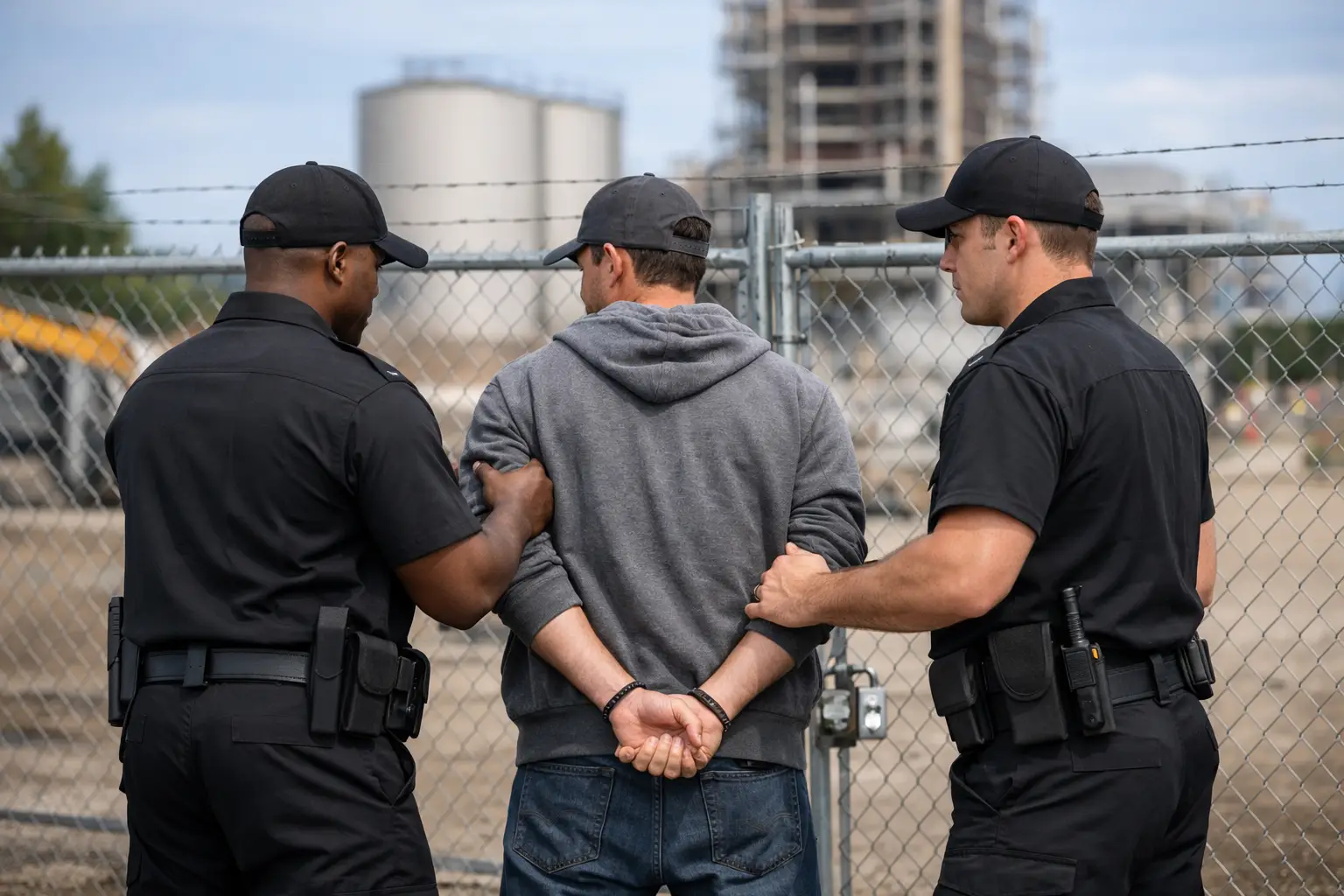
A person inside a substation fence, active work zone, laydown yard, or restricted industrial area is not simply a security concern. They may present an immediate threat to crews, energized equipment, material inventory, outage schedules, and public safety. Can officers detain trespassers? In many circumstances, a sworn officer can temporarily detain an individual when the facts support reasonable suspicion of criminal activity. The authority, duration, and outcome depend on the location, observed conduct, notice given, and applicable law.
For Georgia site operators, the practical question is not whether to confront every unauthorized person. It is whether the site has an enforcement-capable response that can assess the facts, control the scene, protect personnel, and create defensible documentation when trespass occurs.
Can Officers Detain Trespassers Under Georgia Law?
A sworn law enforcement officer may conduct a brief investigatory detention when the officer has specific, articulable facts suggesting a person is involved in criminal activity. At a protected site, those facts may include entering through a locked gate, crossing posted boundaries, attempting to access equipment, evading site personnel, removing materials, or remaining after being directed to leave.
A detention is not automatically an arrest. It is a limited stop used to identify the person, determine why they are present, investigate the reported conduct, and decide whether release, removal, citation, arrest, or another lawful action is appropriate. The detention must remain reasonable in scope and length for the circumstances.
Criminal trespass in Georgia is fact-specific. Under Georgia's criminal trespass statute, the issue may involve unauthorized entry, remaining after notice to depart, interference with another's lawful possession, property damage, or conduct that goes beyond a simple misunderstanding about access. Clearly posted restrictions, locked or controlled entry points, written site rules, and documented prior warnings strengthen the operational record. They do not replace an officer's duty to evaluate the facts at the scene.
An officer may have grounds to make an arrest when probable cause exists that a trespass offense or another crime has occurred. Theft, attempted copper removal, vandalism, sabotage, burglary indicators, threats, or interference with utility operations can quickly elevate an incident beyond a basic trespass call.
Officer Authority Is Different From Guard Presence
A conventional security guard can observe, report, control access within the scope of assigned duties, and request that an unauthorized person leave. That role can be useful, but it does not carry the same legal enforcement authority as a sworn officer.
A licensed, insured, off-duty sworn officer brings law enforcement training, authority, and command presence to the site. The officer can investigate suspicious conduct, lawfully detain when the legal standard is met, coordinate with the appropriate agency, and take enforcement action within the limits of commission, jurisdiction, department policy, and state law.
The uniform alone does not create unlimited authority. Off-duty status, agency policy, mutual-aid arrangements, and the officer's jurisdiction can affect how an incident is handled. That is why operators should not assume that any person wearing a law enforcement uniform has identical authority at every private site. A professional staffing plan confirms credentials, assignment expectations, escalation procedures, communications, and reporting requirements before coverage begins.
For critical infrastructure and construction environments, that distinction matters. A passive presence may discourage casual entry. It may not be enough when an intruder is testing a perimeter, targeting copper, approaching energized assets, or creating a traffic hazard near active crews.
What Creates a Defensible Trespass Response?
The best detention decision begins before an officer arrives. A site that cannot establish its boundaries, access rules, or authorized personnel creates unnecessary uncertainty during an incident.
Clear Notice and Controlled Access
Signs should identify restricted areas and prohibit unauthorized entry. Gates, fencing, badge controls, visitor procedures, and contractor check-in records help show who had permission to be on site. For temporary utility construction and storm work, the same principle applies even when the perimeter changes daily.
A person may have a legitimate reason to be nearby, such as a delivery, utility appointment, neighboring property access issue, or confusion about a changing work zone. Officers should verify before assuming criminal intent. Conversely, a person who bypasses controls, conceals tools, refuses to leave, or gives inconsistent explanations may create a stronger basis for detention and further investigation.
Immediate, Accurate Site Information
When calling for an officer response, site personnel should provide the exact location, direction of travel, description of the individual, vehicle information, access point used, known hazards, and whether the person is near critical equipment or crews. Reports such as "someone is on the property" are less actionable than a clear description of observed behavior.
For a substation, transmission yard, or industrial facility, identify energized areas, confined locations, rail spurs, heavy-equipment routes, hazardous materials, and any site-specific safety restrictions. The responding officer needs enough information to control the incident without sending personnel into a preventable hazard.
Documentation That Preserves the Facts
A defensible record should distinguish observed facts from assumptions. It should capture when the person was first seen, where they entered, what warnings or signs were present, what they did, what was said, property condition, witnesses, video availability, and the officer's disposition of the incident.
Documented incident footage can be particularly valuable when a person disputes notice, claims they were invited, or alleges improper treatment. It also helps operators identify repeat activity, weak perimeter points, and patterns connected to theft or vandalism.
What Officers Should Not Do
Legal enforcement authority does not eliminate the need for discipline. An officer should not detain someone solely because they appear out of place, are walking near a site, or cannot immediately explain their presence. The detention must be based on facts that support reasonable suspicion, not a generalized concern.
Site personnel should also avoid turning a routine access issue into a physical confrontation. Employees, contractors, and unarmed guards should prioritize observation, distance, notifications, and protection of people in the area. They should not attempt to physically restrain a suspected trespasser unless a separate, immediate safety emergency makes action necessary.
Officers must use only the level of control authorized by law, policy, and the circumstances. A person who calmly leaves after a verified misunderstanding calls for a different response than a person cutting a lock or entering a high-voltage yard. Good enforcement is measured, lawful, and documented.
A Practical Response Model for High-Risk Sites
For many operators, the right model combines visible sworn-officer coverage with remote monitoring and a defined escalation path. Cameras can detect activity at a remote fence line or after hours. Dispatch can notify the designated site contact and direct an officer to the right access point. The officer can then assess whether the event is a false alarm, a policy violation, a trespass warning, or a criminal matter requiring detention or arrest.
This model is especially useful where a full-time fixed post is not necessary but the consequence of unauthorized access is high. Utility yards, construction material laydowns, municipal facilities, large commercial properties, and storm-response staging areas often need coverage that can scale with risk, weather, crew schedules, and outage conditions.
Grid Guard Protective Services staffs licensed, insured, off-duty sworn Georgia officers for scheduled and rapid-response assignments, including 24/7 shifts. For planned work, a staffing request made with appropriate lead time allows the security plan to account for site maps, entry protocols, traffic patterns, safety hazards, reporting standards, and escalation contacts. During emergency conditions, the goal is the same: place real enforcement authority where operations are most exposed.
When Detention Becomes an Operations Issue
A trespass event can delay a crew, interrupt switching activity, stop equipment movement, trigger a safety stand-down, or expose an operator to regulatory and insurance questions. The immediate incident matters, but so does the operational record afterward.
After any significant event, review how the person gained access, whether notices were visible, whether camera coverage captured the approach, how quickly the response was initiated, and whether the report supports future enforcement. Repeated trespass at the same point is usually a perimeter, lighting, scheduling, or monitoring problem as much as an individual behavior problem.
The most effective site response is not built around detaining every unauthorized person. It is built around clear boundaries, trained sworn officers, lawful decision-making, and documentation that protects the site long after the person has left.