
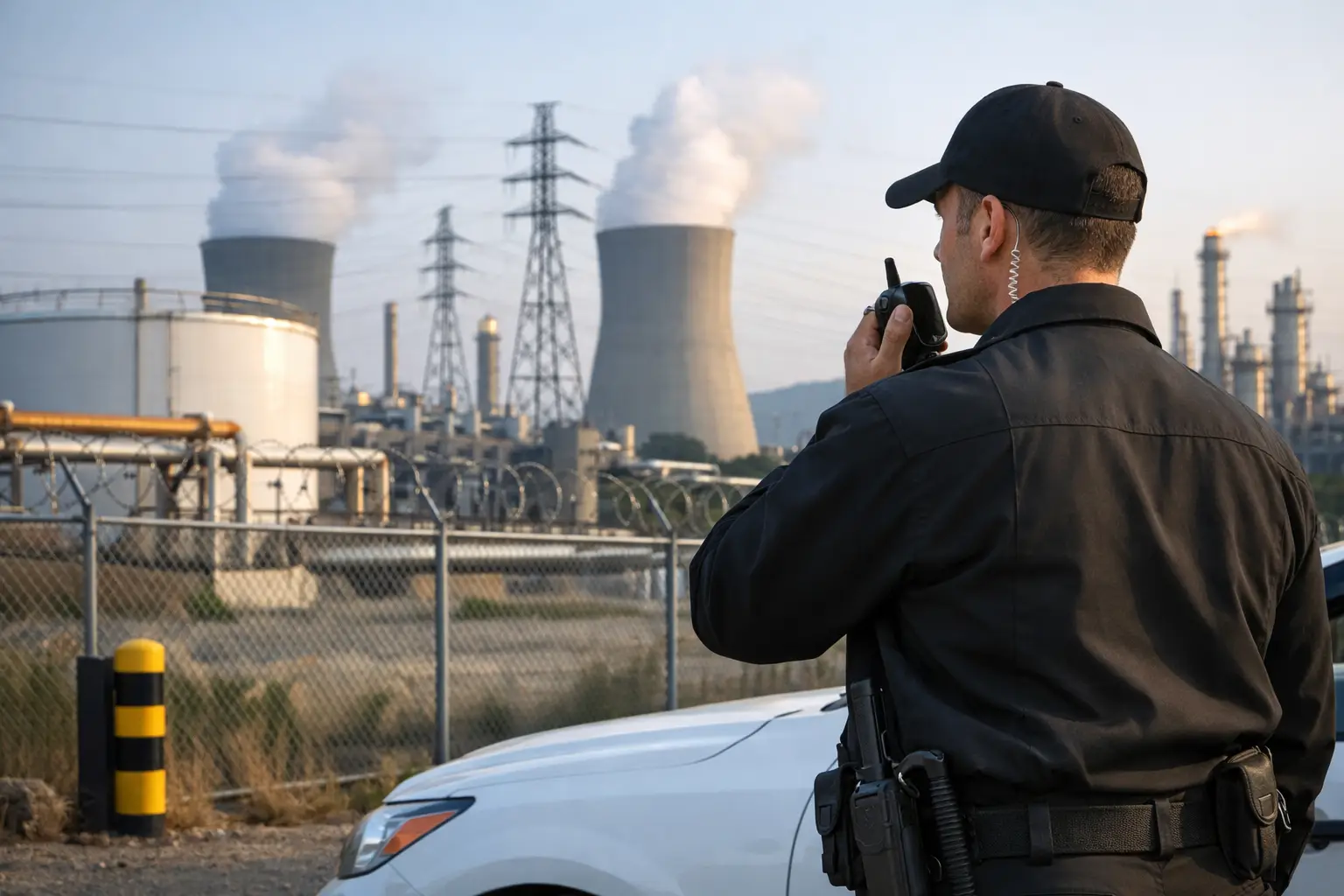
A cut fence at a substation is not a routine security incident. It can expose energized equipment, delay restoration, place responding crews at risk, and create a record that must stand up to operational and compliance review. Critical infrastructure security is the field discipline of preventing that chain reaction through visible authority, controlled access, fast response, and documentation that reflects what occurred.
For utilities, contractors, industrial operators, and public agencies, the objective is not simply to put a person at a gate. The objective is to keep critical assets, crews, work zones, and public access points under control when a trespasser, theft attempt, traffic conflict, protest activity, or storm-driven disruption threatens the operation.
Critical Infrastructure Security Is an Operational Function
Critical sites do not fail on a convenient schedule. Copper theft may occur after hours. An outage can turn a quiet transmission corridor into an active work area before daylight. A construction project can create an exposed access point for weeks, while a municipal event can shift traffic patterns in a matter of hours.
Security coverage must therefore fit the operating condition. A permanently staffed substation has different requirements than a transmission-yard expansion, a pipeline crossing, a storm staging site, or a utility construction zone beside an active roadway. The right plan identifies the asset, likely threats, access routes, escalation procedures, site contacts, patrol expectations, and the documentation the customer will need afterward.
This is where conventional guard coverage can fall short. A guard may observe, report, and discourage casual intrusion. A licensed, insured, off-duty sworn law enforcement officer brings legal enforcement authority to address trespass and criminal activity directly. That distinction matters when the person at the gate must make defensible decisions, coordinate with local agencies, preserve a safe scene, and maintain command presence without disrupting authorized work.
The Threat Is Usually More Than Theft
Copper theft remains a direct concern for substations, communications infrastructure, construction materials, and industrial facilities. But it is only one part of the exposure. Unauthorized access can lead to vandalism, sabotage concerns, equipment damage, fire hazards, worker confrontation, and delayed switching or restoration work.
At construction sites, the risk can be equally practical. Equipment arrives before permanent fencing is complete. Contractors work multiple shifts. Deliveries, inspectors, utility representatives, and subcontractors all need access. Without a controlled entry point and clear authority, a site can become difficult to manage quickly.
Traffic is another security issue that is often treated as a separate function. Crews working near roads, storm-response teams staging equipment, and municipalities managing high-attendance events need more than cones and signage when drivers ignore direction or enter restricted space. A sworn officer provides real authority a cone or flagger cannot provide. That authority helps protect workers, motorists, equipment, and the schedule.
Build Coverage Around the Site Condition
Effective coverage begins with a direct operational assessment, not a generic post order. The same officer assignment may be asked to control entry, conduct perimeter patrols, monitor contractor activity, enforce a work-zone closure, observe camera alerts, or preserve an incident record. Those duties need to be defined before the shift starts.
For a fixed facility, the priority may be controlled access and irregular patrol patterns. For a construction or maintenance project, it may be verifying authorized personnel, securing materials after shift change, and deterring after-hours entry. During a storm or outage, the emphasis may shift to rapid deployment, crew protection, traffic enforcement, and maintaining order around an active restoration site.
A workable plan answers several field questions: Who is authorized to enter? What credentials or vehicle identifiers are required? Which areas are off limits? Who receives an escalation call? When should the officer request additional law enforcement support? What photographs, reports, or footage are required after an incident?
Those answers prevent uncertainty when conditions change. They also prevent site managers from relying on informal handoffs between shifts, contractors, and dispatch personnel.
Use Visible Presence Where It Changes Behavior
Visible officer presence is most valuable where intrusion, theft, conflict, or unsafe driving is likely to occur. That may be the main gate, a material laydown yard, a vulnerable perimeter, a switching station entrance, or a roadway work zone. Placement should reflect the threat, not a habit of posting someone at the nearest booth.
There is a trade-off. A fixed post creates a clear control point and gives authorized personnel a predictable place to check in. Mobile patrol coverage extends visibility across larger properties and can make patterns less predictable. Many sites need both: an officer controlling access during active work periods and documented patrols during lower-traffic hours.
Extend the Officer's Reach With Monitored Cameras
Camera networks can expand awareness across a large or remote footprint, particularly when a site has multiple gates, long fence lines, or limited lighting. Solar-camera systems can provide remote monitoring, 24/7 surveillance, dispatch support, and documented incident footage without requiring a permanent power connection at every point.
Cameras are not a replacement for enforcement-capable presence. They can identify movement, capture activity, and prompt dispatch, but they do not physically control access or make a lawful enforcement decision on scene. The stronger model pairs a sworn officer with remotely monitored cameras, giving site leadership both immediate presence and broader visibility.
Documentation Must Be Useful After the Shift
A security report has little value if it only says that an officer was present. Site operators need records that support follow-up, claims, internal review, contractor accountability, and infrastructure protection requirements. Reports should identify the time, location, persons or vehicles involved when available, observed conditions, actions taken, notifications made, and any resulting law enforcement case information.
Documented incident footage can add critical context, especially when a camera alert, trespass event, traffic conflict, or property-damage allegation must be reviewed later. The goal is not paperwork for its own sake. It is a defensible record that allows decision-makers to understand what happened and what should change.
For electric-sector facilities, physical security documentation should be organized with applicable NERC CIP-014 expectations in mind. For active construction and work zones, security activity should also support OSHA-related safety practices, including clear access control, hazard awareness, and prompt reporting of conditions that could endanger crews. Security providers should not make vague compliance promises. They should provide records and field practices that help the customer meet its own obligations.
Plan for Routine Coverage Before the Emergency
The hardest time to source qualified coverage is after an incident, a weather event, or an unexpected work stoppage. Critical infrastructure operators should identify their officer staffing needs before a disruption occurs, including priority sites, escalation contacts, access instructions, required insurance, and desired reporting formats.
Planned work can typically be staffed with appropriate lead time. Grid Guard Protective Services supports scheduled coverage across Georgia with standard 72-hour lead times, 24/7 shift availability, and quotes within 48 hours. Emergency conditions may demand a different deployment model, but pre-established site information and points of contact reduce avoidable delays when response speed matters.
The vendor evaluation should be equally direct. Confirm that officers are sworn, licensed, and insured. Ask how the provider handles statewide deployment, overnight coverage, relief staffing, dispatch, site-specific instructions, incident reporting, and camera-triggered response. A provider that cannot answer those questions clearly may not be prepared for the operational consequences of an actual event.
Authority, Visibility, and Accountability Work Together
Critical infrastructure security is not measured by how quiet a shift appears on a timesheet. It is measured by whether unauthorized access was deterred, crews worked safely, traffic remained controlled, incidents were handled lawfully, and the customer received a clear record of the activity.
The right coverage will vary by asset and threat level. A remote substation may need patrols and monitored cameras. A high-value construction site may require a fixed officer post. A storm restoration operation may need sworn officers who can move quickly between traffic enforcement, crew protection, and access control. What should remain constant is the standard: qualified personnel, legal authority, clear instructions, and documentation that holds up after the immediate problem has passed.
Before the next outage, construction mobilization, or high-risk work period, treat security staffing as part of the operating plan. When authority and accountability are already positioned on site, crews can stay focused on the work that keeps Georgia running.