
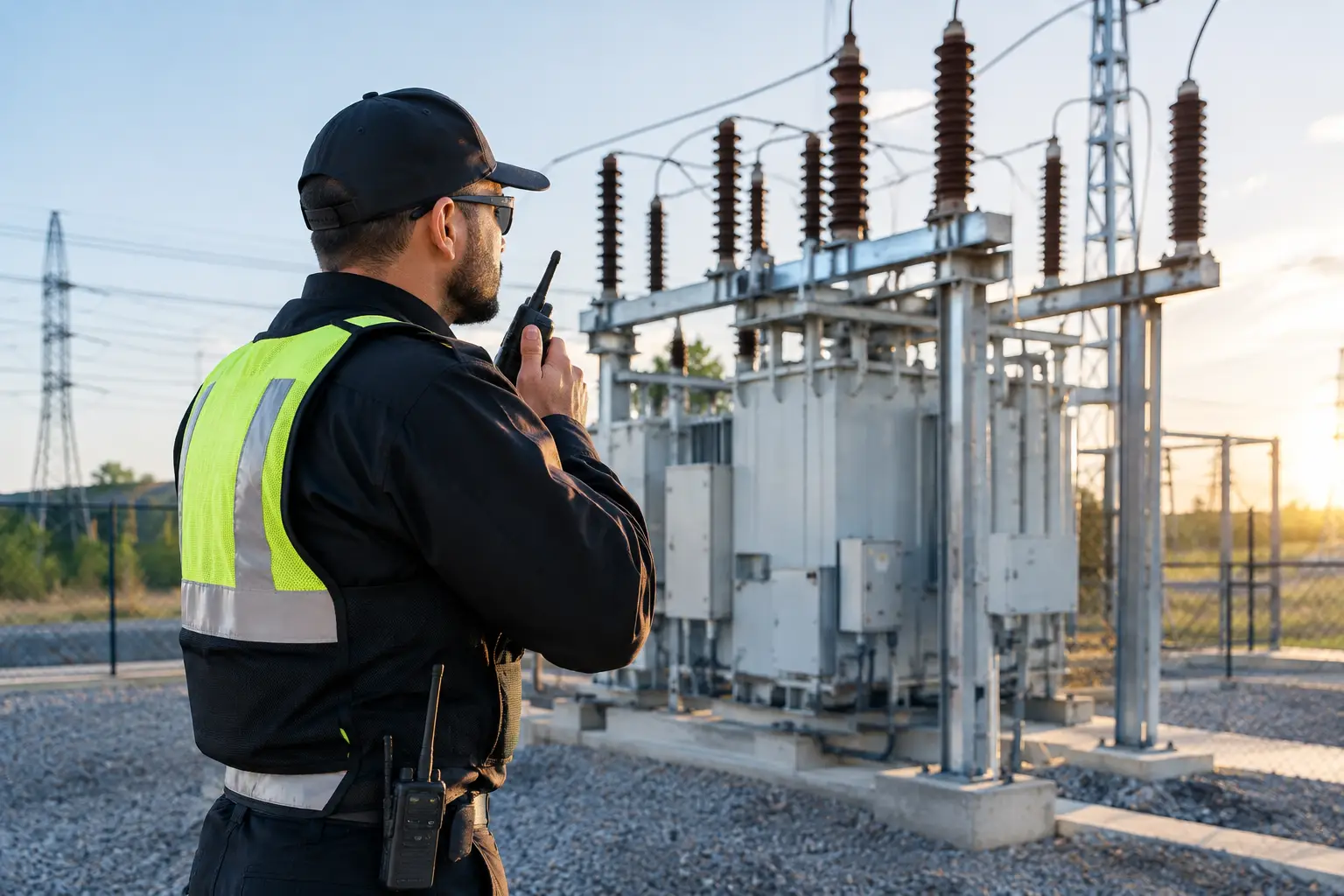
A compromised gate, cut copper ground wire, or unauthorized vehicle near a substation is not a minor security issue. It can create an outage risk, delay field crews, expose the public to dangerous equipment, and force a utility or contractor into an expensive response cycle. Electrical asset protection is the operational discipline of preventing those events, detecting them early, and responding with authority when they occur.
For utilities, transmission operators, contractors, and industrial site managers, the goal is not simply to put someone at a gate. The goal is to protect energized infrastructure, maintain site control, preserve the work schedule, and create a defensible record of what happened.
Electrical Asset Protection Requires More Than a Presence
Electrical sites attract risks that conventional commercial security plans often underestimate. Substations, transmission yards, laydown areas, renewable-energy sites, construction corridors, and utility warehouses may contain valuable copper, tools, fuel, cable, transformers, and specialized equipment. They also present high-consequence hazards for intruders, employees, contractors, and responding personnel.
A passive guard presence may discourage casual trespass, but it does not automatically solve a determined intrusion, theft in progress, impaired driver at a work zone, or a confrontational access-control issue. These situations require judgment, command presence, and the ability to take lawful enforcement action.
That is why the staffing decision matters. Off-duty sworn law enforcement officers bring legal enforcement authority that an unarmed guard, camera pole, cone, or flagger cannot provide. They can address trespass and suspected criminal activity directly, coordinate with local agencies, manage a scene until additional resources arrive, and document the incident in a manner that supports internal review, insurance reporting, and potential prosecution.
The appropriate level of coverage still depends on the site. A remote, low-traffic storage yard may benefit from monitored cameras paired with scheduled officer checks. A critical substation near a high-theft corridor may require a visible officer during vulnerable overnight hours. A utility construction project beside an active roadway may need sworn traffic enforcement at the entrance, not only a security post inside the fence.
Start With the Actual Exposure
Effective protection begins with an operational assessment, not a generic post order. Site leadership should identify what must be protected, when it is most vulnerable, who needs authorized access, and how a response should work after hours.
The asset inventory should go beyond equipment value. A stolen spool of cable has a replacement cost, but the larger exposure may be a delayed energization date, a missed outage window, idle contractor crews, liquidated damages, or public safety consequences. The same is true for vandalism. Damage that appears limited at first can trigger inspections, repairs, safety stand-downs, and extended restoration work.
Access patterns also matter. Consider whether the site has one controlled entrance or multiple fence-line entry points, whether deliveries occur after dark, whether subcontractors rotate frequently, and whether neighboring land uses create recurring trespass issues. Construction sites often change weekly. A security plan that worked when the perimeter was open may fail once high-value materials are staged on site.
A field-ready plan answers clear questions: Who is authorized to enter? What credentials are required? Where do visitors report? Which areas are restricted? Who is called if a supervisor cannot be reached? What should happen when a person refuses to leave? Ambiguity at the gate becomes a safety and schedule problem quickly.
Use Layers That Support a Real Response
Cameras, fencing, lighting, access logs, and warning signs all have a role. None should be treated as a complete security program by itself. A camera can capture evidence, but it cannot physically challenge an intruder. A fence can delay entry, but it cannot identify whether a vehicle at the gate is an authorized contractor or someone testing the perimeter.
The strongest approach combines physical deterrence, monitored detection, and an on-site response capability. For many electrical facilities, augmented protection pairs a sworn officer with remotely monitored solar-camera networks, 24/7 surveillance, dispatch support, and documented incident footage. The officer manages access and provides immediate command presence. Remote monitoring expands visibility over blind spots, perimeter sections, material storage, and periods when patrol positioning must shift.
This layered model is especially useful for large yards and distributed construction sites. It allows the site to maintain a visible enforcement-capable presence without assuming one person can observe every gate, fence line, and equipment area at once.
There are trade-offs. Full-time fixed-post coverage provides the strongest visible deterrent but carries a higher staffing cost. Remote monitoring can extend coverage efficiently, but its value depends on camera placement, reliable communications, defined escalation procedures, and a responsible party who can respond. Scheduled patrols may suit a lower-risk location, but they are not equivalent to continuous access control.
The right decision should follow risk, asset criticality, incident history, and operational consequences, not a one-size-fits-all staffing formula.
Protect Crews and Work Zones Along With Equipment
Electrical asset protection extends beyond the fence. Utility crews, restoration teams, and contractors are exposed when they work near public roadways, storm-damaged infrastructure, or active construction entrances. Unauthorized vehicles, impatient drivers, and poor traffic control can turn a routine mobilization into an injury event.
A sworn officer assigned to a work zone provides real authority a cone or flagger cannot provide. The officer can enforce traffic laws, establish a controlled scene, address aggressive or noncompliant drivers, and coordinate with responding agencies when conditions escalate. That protection helps crews focus on the work in front of them rather than traffic conflict at the edge of the job.
During storm response, the need becomes more acute. Restoration work may begin before normal daylight hours, in damaged neighborhoods, with changing road conditions and limited access. Security coverage must be able to move with the operation, protect staging areas and fuel supplies, manage public interaction, and support safe crew movement. A provider that only offers standard business-hour coverage is not aligned with the operating reality of outage restoration.
Documentation Is Part of the Security Function
When an incident occurs, site leaders need more than a verbal account. They need facts: time, location, persons involved, vehicle details, actions taken, notifications made, and supporting footage where available. That record informs internal decisions, supports claims and law enforcement follow-up, and demonstrates that the site acted responsibly.
For regulated or critical infrastructure environments, documentation also supports broader compliance readiness. Security records can help demonstrate a disciplined approach to physical security planning and incident management aligned with NERC CIP-014 considerations and OSHA-related safety expectations. Documentation does not replace an organization’s compliance program, but poor documentation can weaken an otherwise sound response.
Officer reports should be clear, timely, and specific enough for an operations manager, security director, or legal team to understand what occurred without reconstructing the event from memory. Incident footage should be preserved according to the site’s retention process. Repeated issues, such as recurring fence-line breaches or after-hours delivery confusion, should be tracked and used to adjust staffing, patrol routes, lighting, or access rules.
Build Coverage Around the Operating Schedule
Security plans fail when procurement timelines ignore field realities. A planned substation outage, transmission project, or municipal work zone needs coverage coordinated with mobilization dates, shift changes, contractor schedules, and demobilization. Emergency events require a different posture: rapid staffing, 24/7 availability, clear site contacts, and officers who can operate within a changing command structure.
Before deploying, establish the coverage window, post location, shift length, reporting expectations, escalation contacts, parking and access instructions, radio or phone procedures, and any required site orientation. Confirm that staffing is licensed, insured, and appropriate for the assignment. For Georgia operations, statewide reach matters when projects move across counties or storm damage spreads beyond a single service area.
Grid Guard Protective Services provides licensed, insured, off-duty sworn officers for scheduled and rapid-response electrical security assignments throughout Georgia, including 24/7 shifts and standard planned-project lead times of 72 hours. For urgent needs, early communication about location, conditions, access, and the immediate threat helps accelerate a useful deployment.
Electrical infrastructure cannot wait for a security plan to catch up after theft, trespass, or a work-zone incident. Put enforcement-capable coverage, clear reporting, and a defined response structure in place while the site is still under your control.