
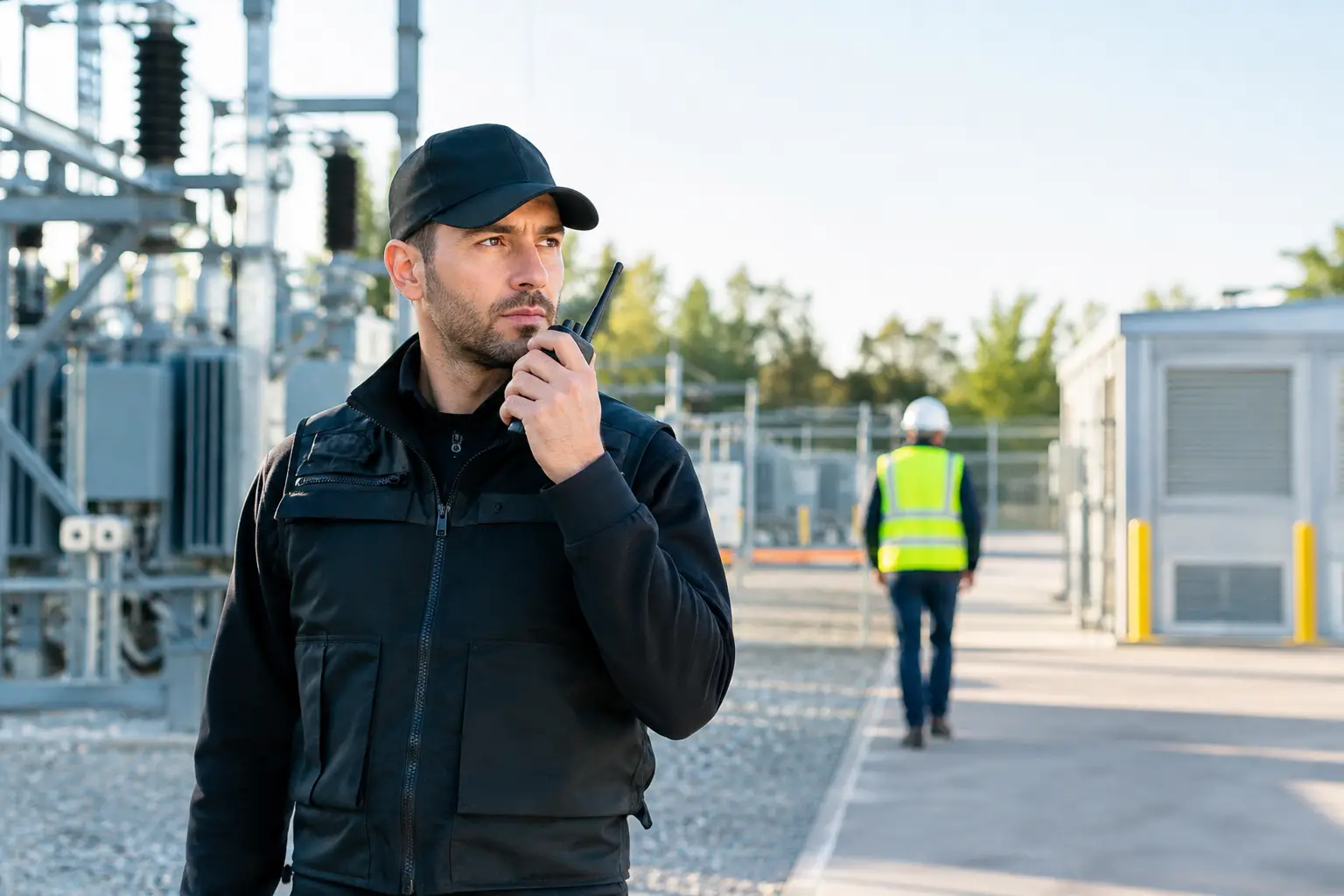
A substation gate found open at 2:00 a.m., a storm crew working beside live traffic, or copper theft discovered near an energized yard are not routine guard-post issues. These are emergency deployment triggers that can expose personnel, interrupt restoration work, compromise critical assets, and create an immediate documentation burden. The decision is not simply whether to add a body at the site. It is whether the conditions require a sworn, licensed, insured officer with legal enforcement authority.
For utility, industrial, municipal, and construction leaders, the strongest trigger is a change in site risk that existing controls cannot contain. Cameras, locks, fencing, and unarmed personnel each have a role. None replaces an officer who can establish command presence, address trespass directly, coordinate with responding agencies, and produce a defensible record of what occurred.
Emergency Deployment Triggers That Require Action
Emergency coverage should begin when the operational consequence of waiting exceeds the cost and complexity of immediate mobilization. The right response depends on the site, threat, jurisdiction, and availability of internal personnel, but several conditions consistently justify an enforcement-capable deployment.
Unauthorized access at critical infrastructure
A forced gate, damaged perimeter fence, breached access point, or unknown person inside a restricted facility is an immediate security event. At substations, transmission yards, utility compounds, pump stations, and industrial sites, unauthorized access can become more than a theft concern. It may create safety exposure, equipment damage, service disruption, or regulatory scrutiny.
A sworn officer can secure the entry point, verify who is authorized to be present, preserve the scene for law enforcement follow-up, and document the incident. If cameras captured activity, the officer's on-site report helps connect footage, physical conditions, witness statements, and response actions into one usable record.
Theft patterns or active property crime
Copper theft, tool theft, fuel siphoning, vandalism, and repeated trespass often accelerate after the first incident. A site that has been hit once may be tested again when offenders believe repairs, replacement materials, or construction equipment will remain exposed. Waiting for a second loss can put crews behind schedule and increase replacement, outage, and insurance costs.
The trigger is not limited to witnessing a crime in progress. Fresh cut fencing, disturbed equipment, missing material, suspicious vehicles circling the site, or credible local intelligence can justify immediate coverage. An on-site sworn officer provides visible deterrence and legal enforcement authority that passive monitoring cannot provide alone.
Storm restoration and outage work
Severe weather changes the security posture of utility operations quickly. Crews may be dispatched to unfamiliar locations, staging yards may fill with equipment and material, and repair work may continue overnight under compressed restoration schedules. Public frustration, road hazards, opportunistic theft, and unauthorized entry all become more likely when normal operations are disrupted.
Storm and outage response is one of the clearest emergency deployment triggers because crews need to restore service, not manage site security or traffic conflict. Officers can protect staging locations, control access to repair areas, support traffic enforcement around hazardous work zones, and document incidents that affect operations. Coverage can be placed where conditions are moving, rather than fixed only at a permanent facility.
Work-zone conflict or unsafe traffic conditions
When a utility crew, contractor, or public-works team is working near active traffic, an unsafe driver can turn a routine assignment into a life-safety event. The trigger may be repeated vehicle intrusions, aggressive motorists, an intersection failure, a lane closure near a high-speed corridor, or emergency repairs that cannot wait for a conventional traffic-control plan.
A cone or flagger has limits. A sworn officer provides real authority a cone or flagger cannot provide. That distinction matters when drivers ignore instructions, enter a closed work zone, threaten personnel, or create conditions that place crews and the public at risk. Officers can enforce traffic laws while maintaining a clear, documented security presence around the work area.
Separate an Urgent Need From a Poorly Defined Request
Not every urgent call requires the same deployment. The fastest way to lose time is to request "security" without identifying what changed, where the threat exists, and what authority is needed on site. A useful emergency request defines the incident and the operating environment.
Operations leaders should be prepared to provide the site address or nearest access point, the nature of the threat, current personnel on site, shift duration, known hazards, access procedures, and the site contact with decision authority. If there is video, photos, incident numbers, or a prior trespass report, that information should be preserved and shared through the appropriate channel. It helps the responding officer arrive with a clearer mission.
This does not mean an emergency request must be perfect. During a storm, outage, or active incident, conditions may change by the hour. It means the coverage plan should identify the first objective: secure the perimeter, protect a crew, manage traffic, hold a scene, control access, or deter repeat criminal activity. Once that objective is clear, staffing can be adjusted as the event develops.
What an Enforcement-Capable Deployment Should Include
A credible emergency deployment is more than assigning an officer to stand at a gate. The officer needs a defined post, communications path, escalation process, and reporting expectation. For critical infrastructure and regulated environments, documentation is part of the protective function.
At minimum, the deployment plan should establish who can authorize access, what areas are restricted, how incidents are escalated, which site rules apply, and where reports are delivered. For a substation or transmission facility, this may include coordination with control center procedures and facility access requirements. For a construction or utility repair site, it may include crew-lead coordination, work-zone boundaries, equipment staging controls, and traffic-routing expectations.
Documented incident footage and written officer reports create operational value after the immediate threat has passed. They can support internal reviews, insurance claims, contractor accountability, police follow-up, and security planning. They may also help demonstrate that the site took reasonable, timely protective action when conditions changed.
For some locations, augmented protection is the right model. An on-site sworn officer can be combined with remotely monitored solar-camera coverage, 24/7 surveillance, dispatch support, and recorded footage. This approach is especially useful when a temporary site has multiple access points, when risk continues after an initial incident, or when coverage must extend beyond the period an officer is physically present. The trade-off is straightforward: cameras expand visibility, but they do not replace a sworn officer when immediate on-site enforcement authority is required.
Plan for Emergencies Before the Trigger Occurs
Emergency staffing works best when procurement, operations, and security teams establish the framework before an incident. Planned assignments generally allow for standard lead times, site orientation, post orders, and tailored staffing. Grid Guard Protective Services typically supports scheduled coverage with a 72-hour lead time, 24/7 shift availability, and statewide Georgia coverage. Emergency conditions may require a faster assessment based on officer availability, location, mission requirements, and scene conditions.
That distinction should be built into your vendor plan. Do not assume that a provider able to staff routine posts can deliver sworn officers, insurance documentation, lawful enforcement capability, or critical-infrastructure-ready reporting under pressure. Confirm those points in advance, along with escalation contacts, billing authorization, site-access protocols, and any NERC CIP-014 or OSHA-related documentation expectations.
A short pre-event profile for each high-risk location can save meaningful time. Keep gate codes and access instructions controlled, but ensure authorized emergency contacts can provide them quickly. Identify safe staging areas, restricted zones, utility hazards, traffic-control concerns, and the person who can approve an extension of coverage after normal business hours. When a trigger occurs, the request becomes an activation, not a scramble to define the mission.
Use the First Shift to Set the Security Posture
The first officer on site should not be left to infer the risk level. A concise shift briefing should establish whether the priority is deterrence, access control, scene preservation, crew protection, traffic enforcement, or observation while a repair is completed. It should also identify when the officer should request additional law-enforcement response or notify the designated site authority.
Conditions should be reassessed at shift change, after any new incident, and when the operational footprint expands. A single officer may be appropriate for a controlled access point. A dispersed storm staging yard, active construction corridor, or site with repeat intrusion may require additional coverage or a camera-supported model. The correct posture is driven by exposure, not by a standard template.
The practical question is simple: if the next hour brings another intrusion, a traffic conflict, or a crew safety issue, does the site have someone present with legal authority to act? If the answer is no, the trigger has already occurred.