
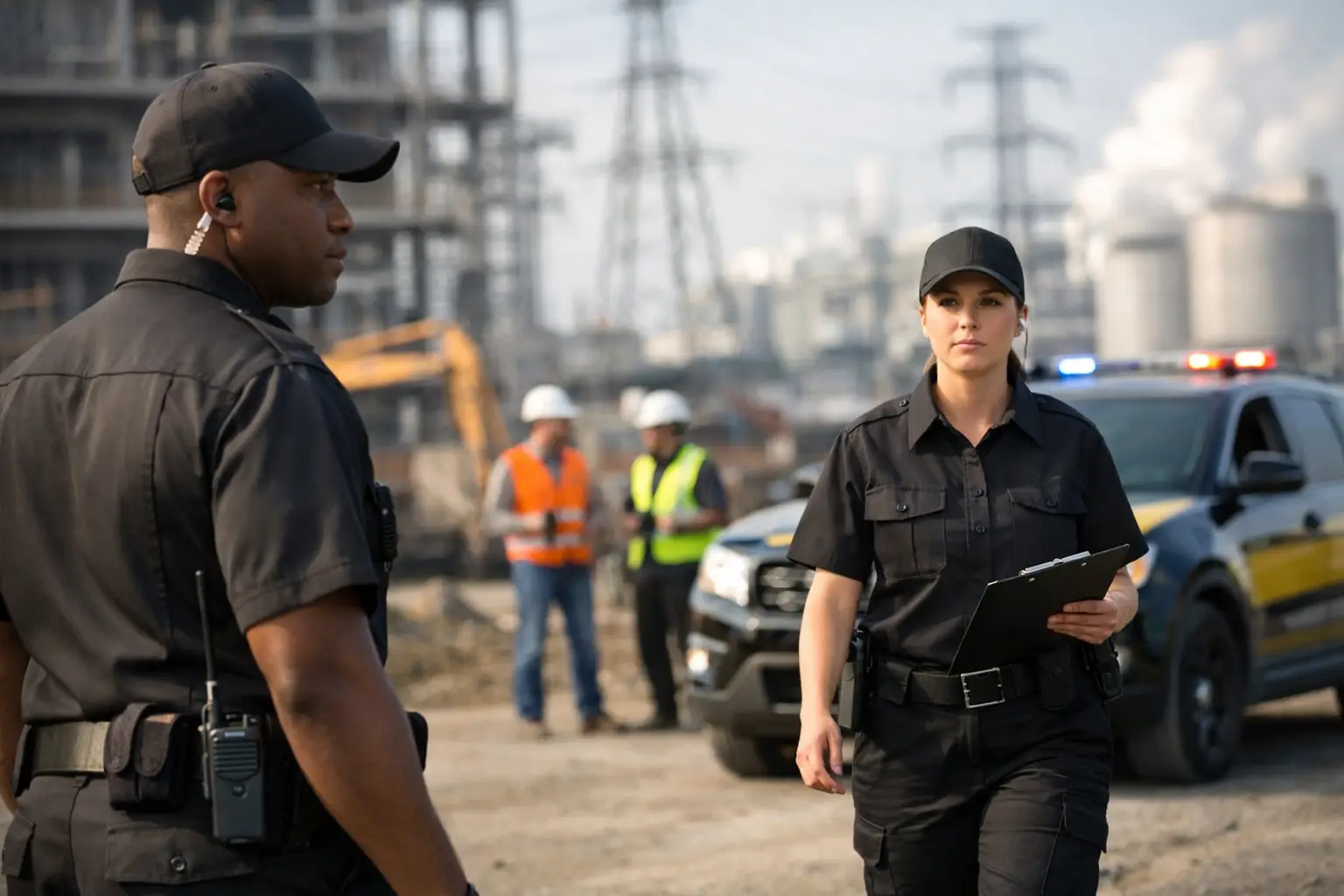
A substation gate forced open at 2:00 a.m., a storm crew arriving before daylight, or a work zone that suddenly draws unsafe traffic cannot wait for a standard security procurement cycle. Emergency staffing is the operational bridge between a developing risk and a controlled site. For utilities, contractors, municipalities, and industrial operators, the question is not whether an incident deserves attention. It is whether qualified personnel can establish order, protect crews, and document what occurred before the problem expands.
Emergency Staffing Is an Operations Decision
Emergency coverage is often treated as a last-minute security purchase. That approach misses the larger exposure. An unprotected site can become a safety issue, a construction delay, an outage complication, a theft target, or a compliance concern at the same time.
The right assignment begins with the conditions on the ground. A storm-damaged transmission yard may need controlled access and a visible law enforcement presence while restoration crews cycle through. A utility construction site may need traffic enforcement after a lane closure changes public travel patterns. A commercial site dealing with repeat trespass may need an officer who can address criminal activity directly rather than observe and report it for someone else to handle.
That distinction matters. Sworn, licensed, insured off-duty law enforcement officers bring legal enforcement authority to the post. They can respond to trespass, suspicious activity, traffic violations, and criminal conduct within the scope of their authority. A generic guard or flagger may still have a place in a broader site plan, but neither provides the command presence or enforcement capability required when conditions are unstable.
When Emergency Staffing Should Be Activated
Activation should be driven by operational triggers, not by a vague sense that a site feels exposed. Clear triggers help decision-makers move quickly without debating whether coverage is justified while crews and assets remain at risk.
Common triggers include a weather event, outage restoration, equipment theft, damaged fencing or gates, credible trespass concerns, a work-zone incident, civil disturbance near a facility, or a sudden expansion in construction activity. A municipal event can also become an emergency assignment when attendance, parking demand, or traffic volume exceeds the original plan.
For critical infrastructure, consider activating coverage when physical barriers are compromised, crew movements increase, or normal access-control procedures are no longer practical. A remotely located substation may be secure under normal conditions but become vulnerable when contractors, delivery vehicles, and repair personnel are entering through temporary points of access.
The decision also depends on the consequence of delay. A site holding copper, fuel, tools, transformers, or sensitive utility equipment has a different risk profile than an ordinary vacant lot. So does a work zone where an unauthorized vehicle can place line crews, operators, or the public in immediate danger. Emergency staffing should be scaled to the consequence, location, duration, and expected activity at the site.
What a Fast Deployment Plan Must Define
Speed without a clear post order creates confusion. Before an officer is dispatched, the requesting organization should be able to communicate the site address, access point, primary contact, operational hazard, coverage start time, and expected duration. That information allows the assignment to be built around the actual risk instead of a generic standing post.
For a utility or industrial location, the post order should identify restricted areas, authorized contractors, vehicle entry procedures, emergency contacts, and any safety orientation requirements. If there is an active outage or restoration effort, officers need to know where crews are staging, which routes must remain clear, and who has authority to modify access rules as conditions change.
Work-zone assignments require additional precision. The officer should understand the traffic-control plan, lane restrictions, equipment movement, pedestrian conditions, and the point at which enforcement action or a request for additional resources is necessary. Real authority is what a cone or flagger cannot provide when a driver ignores a closure or creates an immediate hazard.
A strong deployment plan also establishes communications. Determine who receives incident updates, how after-hours escalation works, and whether the officer reports to a site supervisor, utility representative, project manager, or emergency operations contact. One responsible contact per shift prevents conflicting instructions during an already time-sensitive response.
Why Documentation Cannot Be an Afterthought
Emergency conditions create competing priorities. Crews need to restore service, managers need status updates, and site personnel need to keep the public out of hazardous areas. That is exactly when accurate reporting becomes most valuable.
Documented incident footage, written activity logs, arrival and departure records, access-control observations, and incident reports create an accountable record of the assignment. They can support internal review, insurance matters, contractor coordination, law enforcement follow-up, and security planning after the immediate threat is resolved.
For regulated infrastructure, documentation should also align with the organization’s physical-security and safety obligations. NERC CIP-014-related planning and OSHA-focused site controls require more than a verbal assurance that someone was present. Decision-makers need a record that shows what was observed, what action was taken, when escalation occurred, and how the site was protected.
The level of documentation should match the event. A one-shift gate assignment may require concise activity reporting and access logs. A multi-day outage response may require shift handoffs, recurring situation reports, incident footage, and a structured record of changing conditions. More paperwork is not automatically better. Useful documentation is timely, factual, and tied to the site’s operational needs.
Pairing Officers With Remote Surveillance
An on-site sworn officer and remotely monitored solar-camera network address different parts of the risk. The officer provides immediate presence, judgment, access control, and legal enforcement authority at the location. Remote surveillance adds broader visibility, 24/7 monitoring, dispatch support, and documented incident footage across large or difficult-to-staff areas.
This augmented model is especially practical when an incident affects more than one location, when a site has long perimeter runs, or when security needs continue after repair crews leave. Cameras can help identify activity outside the officer’s immediate line of sight and preserve evidence when a person, vehicle, or event needs later review.
It is not a substitute for an officer when direct intervention is required. A camera can detect a breach. It cannot safely manage an aggressive trespasser, control traffic at an active work zone, or establish command at a damaged facility. The best configuration depends on the site layout, expected threat, available budget, and whether the risk is concentrated at one point or spread across the property.
Building an Emergency Staffing Relationship Before the Incident
The most effective emergency response is arranged before the emergency. Procurement teams should verify officer credentials, insurance, statewide coverage, reporting practices, rate structure, and the provider’s ability to support 24/7 shifts. They should also identify site-specific requirements that could slow deployment, including badging, safety training, vehicle access, gate codes, and union or contractor coordination.
Planned assignments generally allow for a standard 72-hour lead time, while urgent conditions require direct confirmation based on officer availability, location, assignment complexity, and the number of posts needed. A provider that offers quotes within 48 hours for planned coverage can help establish the baseline agreement before emergency conditions compress the decision window.
Grid Guard Protective Services supports coverage across Georgia counties with sworn, licensed, insured officers for planned and rapid-response assignments. The value is not simply filling a post. It is placing enforcement-capable personnel into a defined operating plan that protects assets, crews, public safety, and the project schedule.
Emergency staffing works best when it is treated as part of continuity planning, not a reaction to a headline or a damaged gate. Set the activation triggers, establish the contacts, define the documentation standard, and determine where sworn officer coverage or augmented surveillance will matter most. When conditions change, your site team can move from exposure to control without losing critical time.