
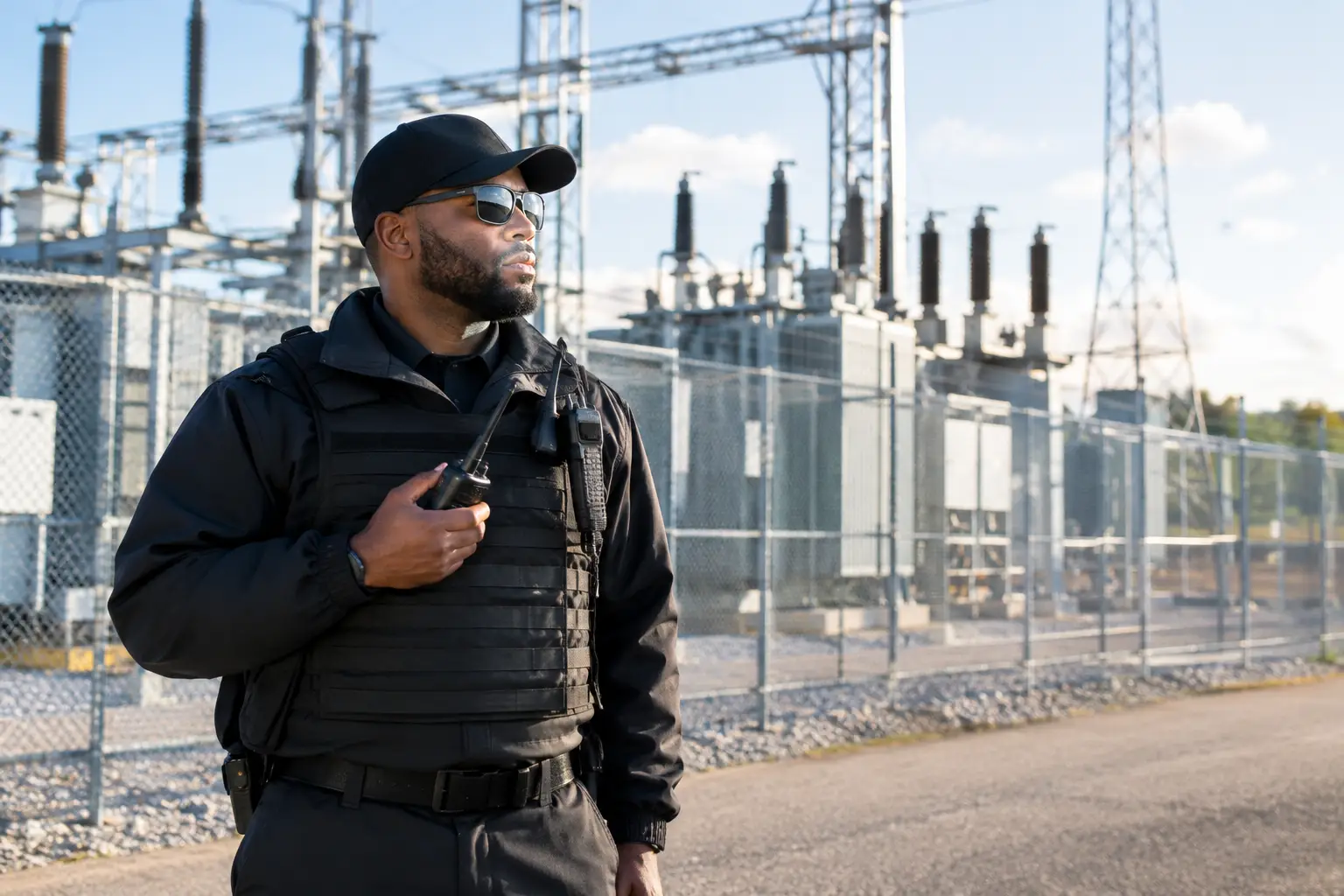
A substation can have redundant equipment, backup communications, and detailed restoration plans, yet still lose critical operating time to a cut fence, copper theft, unauthorized vehicle, or unsafe crowd around a work zone. Grid resilience is not only an engineering objective. It is the ability to maintain, restore, and protect essential operations when physical threats, severe weather, construction activity, or public interference put the system under pressure.
For utility operators, transmission owners, contractors, and municipal partners, physical security must function as part of the operating plan. The question is not whether a site has a guard post or a camera. The question is whether the security posture can deter intrusion, establish control, support crews, document incidents, and escalate an event with legal authority when conditions change.
Grid Resilience Starts at the Perimeter
The grid is increasingly dependent on dispersed, high-value assets. Substations, switching yards, transmission corridors, staging areas, mobile equipment, fuel supplies, and construction materials may sit miles apart with limited staff on site. That footprint creates opportunity for theft, vandalism, trespass, and unauthorized access.
A physical incident does not have to disable a major facility to become an operational problem. Missing grounding components, stolen copper, damaged gates, compromised controls, or a delayed construction crew can affect restoration schedules, safety planning, procurement costs, and public confidence. During an outage, the consequences expand quickly. Crews need clear access, traffic must be controlled, and site leadership needs reliable information instead of conflicting reports from the field.
This is where passive measures have limits. Fencing, locks, warning signs, and cameras remain necessary layers, but they do not confront an intruder, enforce a trespass order, manage an escalating encounter, or direct a vehicle away from an active work area. A sworn, licensed, insured officer adds legal enforcement authority and visible command presence at the point where a security concern becomes an operational event.
Resilience Is Measured by Recovery, Not Just Prevention
No security plan prevents every incident. A practical resilience plan assumes that a threat may reach the perimeter and establishes what happens next. Who verifies the condition? Who protects crews arriving after dark? Who preserves the scene if criminal activity is suspected? Who records the event in a form that operations, insurers, law enforcement, and compliance personnel can use?
Those details determine whether a disruption is contained or prolonged. They also determine whether the organization can explain its response afterward. A vague account of a suspicious vehicle is not the same as a documented incident report identifying the time, location, actions taken, personnel notified, and available footage.
Physical Security That Supports Utility Operations
Effective site coverage begins with the operating condition, not a generic guard schedule. A planned transmission project, an energized substation, a storm restoration staging area, and a municipal road closure each require different officer positioning and response priorities.
At a substation or transmission yard, the focus may be access control, perimeter patrols, contractor verification, trespass prevention, and documented site checks. At a utility construction site, the priority may shift to protecting equipment and materials overnight, managing delivery access, and keeping unauthorized personnel out of an active hazard area. During storm response, officers may need to secure damaged infrastructure, maintain clear routes for utility crews, and support traffic control around hazardous work.
The value is not simply having a uniformed presence. It is assigning an officer who understands where access must be controlled, which activity requires immediate notification, and how security actions affect safety and restoration work. Security that interrupts a crew unnecessarily is a problem. Security that gives crews room to work safely and keeps the public out of danger is an operational asset.
Work Zones Need Authority, Not Just Visibility
Utility work zones often create the most immediate public-safety exposure. Drivers may ignore cones, move around barricades, or enter a lane closure because they do not understand the risk ahead. Pedestrians may approach downed lines, excavation areas, or heavy equipment without recognizing the danger.
A cone or flagger cannot provide the real authority a sworn officer can provide. An officer can enforce traffic direction, address aggressive driving, manage a collision near the work area, and take direct action when someone refuses to comply. That authority protects workers, reduces avoidable delays, and helps keep a planned outage or repair from becoming a larger incident.
Coverage should also match the work schedule. A daytime road closure may require traffic enforcement during peak travel periods, while overnight equipment protection may require fixed-post visibility, patrol patterns, and rapid escalation procedures. The right approach depends on traffic volume, site geography, crime history, asset value, and the consequence of interruption.
Documentation Turns Security Activity Into Accountability
For critical infrastructure operators, security activity must be visible beyond the gate. Site managers, compliance teams, project leaders, and risk personnel need records that show what occurred and how it was handled.
Documented incident footage, officer reports, patrol logs, access observations, and escalation records provide that accountability. They can support internal review, criminal investigations, insurance claims, contractor coordination, and security planning for future work. They also help demonstrate that security coverage was actively managed rather than treated as a checkbox.
Documentation is particularly useful when physical security programs must align with NERC CIP-014 considerations, OSHA-related infrastructure requirements, or internal corporate controls. Officers do not replace an organization’s compliance program or legal obligations. They can, however, produce field-level documentation that supports a defensible security posture and gives decision-makers a clearer record of conditions on the ground.
The quality of those records matters. Reports should distinguish observation from action, capture relevant times and locations, identify notifications made, and preserve facts without speculation. In an outage or safety review, clean documentation saves time because leadership does not have to reconstruct events from incomplete verbal accounts.
Layered Coverage Is Stronger Than a Single Post
High-risk sites rarely benefit from one security measure alone. An officer at the gate provides immediate presence and legal authority, while remotely monitored solar-camera networks extend visibility across large or temporary areas. Together, they can identify activity early, direct the officer to the right location, and preserve documented incident footage.
This augmented model is especially useful for remote substations, transmission construction, material yards, and locations that need continuous observation but do not require a full-time officer at every point. Cameras can cover broad terrain and after-hours conditions. The on-site sworn officer can investigate, enforce, coordinate with local agencies, and make informed decisions based on actual site conditions.
There are trade-offs. Remote monitoring may be appropriate for a stable, lower-traffic site with defined access points. It is not a substitute for an officer when a location faces active theft, repeated trespass, crew conflict, public traffic hazards, or immediate response needs. Conversely, fixed officer coverage alone may not provide enough visibility across a large corridor or multi-entry construction site. The security plan should reflect the threat, not a standard package.
Mobilization Planning Matters Before the Incident
Resilience depends on speed, but rapid deployment works best when the operational basics are settled in advance. Site leadership should know who can request coverage, what information dispatch needs, how officers will enter the site, which contacts receive notifications, and when conditions require additional staffing.
For planned coverage, advance scheduling allows the security provider to match shift timing, officer assignment, access instructions, and reporting expectations to the work plan. For urgent conditions, the request should identify the site location, hazard status, scope of the event, crew activity, access restrictions, and whether law enforcement coordination is already underway.
Grid Guard Protective Services provides sworn Georgia officers across all counties for planned and emergency assignments, with 24/7 shift availability and standard 72-hour lead times for scheduled coverage. That model matters when a contractor needs protection before mobilization, a utility needs work-zone enforcement during restoration, or an industrial site needs an accountable response after a security event.
The strongest time to decide who will secure a site is before the fence is cut, the storm arrives, or the first crew truck reaches the shoulder. Put enforcement-capable coverage into the operating plan, and physical security becomes one more controlled part of keeping the grid working.