
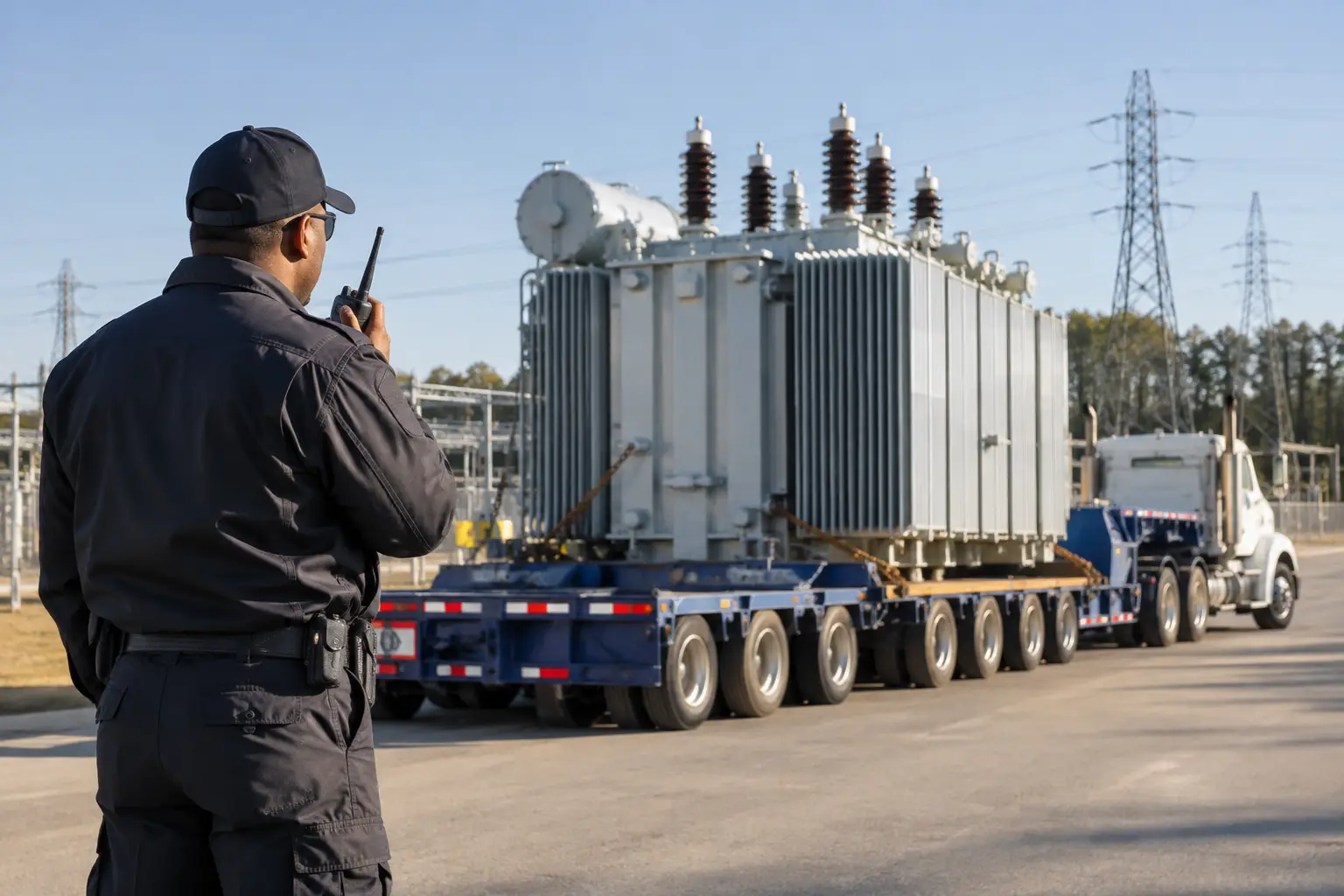
A transformer delivery can place a high-value asset, specialized transport crew, public roadway, and energized utility environment on the same operating timeline. Knowing how to secure transformer deliveries means treating the move as a controlled operation, not simply arranging an escort for a heavy-haul truck. A delay at a gate, an unauthorized vehicle near the load, or a theft attempt during an overnight staging period can affect safety, outage schedules, contractor costs, and public confidence.
For utilities, transmission operators, and contractors in Georgia, the security plan must account for the entire chain of custody: origin release, route movement, staging, site entry, offload, and post-delivery protection. Sworn law enforcement officers provide legal enforcement authority at the points where passive security measures and standard traffic control have limits.
Start Security Planning Before the Transformer Moves
The most effective delivery protection begins when logistics, construction, operations, and security teams review the move together. A transformer may be shipped under a narrow delivery window because of crane availability, planned outages, road restrictions, or site energization milestones. Security coverage must be built around those constraints rather than added after the route is finalized.
Identify the transformer’s expected route, scheduled stops, movement times, staging locations, receiving gate, crane pad, and final placement area. Confirm who has authority to change the route or stop the delivery when road, weather, protest activity, equipment failure, or a site emergency creates risk. That decision should not be left unclear between the driver, project manager, and site supervisor.
A practical plan also identifies the people who are authorized to approach the load. This includes carrier personnel, escort operators, rigging crews, utility representatives, construction management, and designated site security. Everyone else should be treated as unauthorized until verified.
Assess the Risk at Each Handoff
The biggest vulnerabilities are often found at handoffs. The transformer may be protected while moving but exposed during an unscheduled stop. It may arrive at a secure substation only to wait outside the gate because the receiving crew is not ready. It may be offloaded safely, then remain accessible overnight before installation.
Review each handoff for access, visibility, communications, and response capability. Ask direct operational questions: Is the staging area fenced and lighted? Who opens the gate after hours? Can approaching vehicles be identified before they reach the crew? Is there a written escalation procedure if someone refuses to leave the area?
A generic guard post cannot answer every one of those questions. A licensed, insured, off-duty sworn officer can address trespass, disorderly conduct, unauthorized access, and criminal activity with real legal authority while maintaining a clear chain of communications with local agencies.
How to Secure Transformer Deliveries on the Road
Heavy-haul movement creates two security problems at once: protecting the transformer and controlling the environment around it. Oversize loads move slowly, require wide turns, and can create long periods where traffic queues around the transport. Drivers who ignore traffic control, attempt unsafe passing, or enter a work area can put the transport crew and public at risk.
Sworn officers assigned to the route can support traffic enforcement at critical intersections, lane closures, railroad crossings, bottlenecks, and final approaches to the receiving site. Their role is not limited to visibility. Legal enforcement authority gives them the ability to address unsafe or noncompliant motorists when cones, signs, and civilian flaggers are insufficient.
Route coverage should be scaled to the move. A short daytime delivery to a controlled industrial site may need enforcement at only a few critical intersections. A multi-county move with overnight staging, tight roadway geometry, and a substation destination may require officers at the front and rear of the operation, key route points, and the staging location.
Do not assume that a transportation escort alone provides site-security coverage. Escort vehicles manage the movement of the load. Security personnel protect the operation from unauthorized access, criminal interference, and foreseeable disruptions. Those functions should coordinate, but they are not interchangeable.
Protect Overnight Staging and Site Arrival
The period before offload is frequently the least controlled portion of the delivery. Crane delays, weather holds, permitted travel hours, or a missed delivery window can leave a transformer parked at a laydown yard or outside a restricted site. High-value equipment draws attention, particularly where copper theft, vandalism, and trespass are established concerns.
For overnight staging, establish a hard perimeter and controlled entry point. The officer assigned to the location should have the carrier details, authorized contact list, vehicle descriptions, delivery schedule, and a clear instruction on whether the load may be moved. The goal is to prevent confusion as much as intrusion. A driver arriving late, a subcontractor looking for equipment, or a utility employee without current site authorization should be verified before access is granted.
At the destination, coordinate the officer’s post with the gate and offload plan. The officer needs a position that allows observation of arriving traffic, pedestrian approaches, the transformer transport, and the crew’s active work area. Placing security where it cannot see the actual delivery path creates a gap at the moment control matters most.
For locations without fixed cameras or reliable lighting, augmented protection can combine an on-site sworn officer with remotely monitored solar-camera networks, 24/7 surveillance, dispatch, and documented incident footage. This is particularly useful when the transformer must remain in a laydown area after the delivery crew leaves.
Build a Delivery Command Packet
A concise command packet keeps the field team from relying on verbal assumptions. It should be distributed to the delivery lead, site representative, officer supervisor, and any personnel authorized to make operational decisions. Include at least the following:
- Delivery date, movement window, route, planned stops, and alternate route authority.
- Carrier contacts, driver names, tractor and trailer descriptions, and the transformer identification number.
- Authorized site contacts, gate procedures, staging instructions, and offload sequence.
- Officer post assignments, radio or phone communications plan, and emergency escalation contacts.
- Procedures for trespass, traffic crashes, protests, suspicious activity, weather holds, and delayed arrival.
The packet should distinguish between a logistical delay and a security incident. A late crane operator may require schedule coordination. A person attempting to access the load, photograph restricted equipment from within the perimeter, or defeat a gate requires documentation and, when appropriate, law-enforcement action.
Document Incidents and Preserve Accountability
Transformer deliveries often support major capital projects, replacement work after failures, or planned reliability upgrades. When an incident occurs, decision-makers need more than a verbal report the next morning. They need a defensible record of what happened, when it happened, who responded, and how the site was restored to control.
Require documented incident reports for unauthorized access attempts, threats, traffic collisions, property damage, theft, safety violations, and significant route deviations. Where surveillance is used, preserve relevant documented incident footage. These records can support contractor accountability, insurance review, project delay analysis, and infrastructure security documentation aligned with NERC CIP-014 and OSHA-related expectations.
Documentation also improves the next delivery. If a particular gate creates traffic conflict, a staging yard has poor lighting, or the approved route produces recurring public interference, the project team can correct the plan instead of repeating the same exposure.
Match Staffing to the Consequence of Failure
Not every transformer delivery requires the same level of coverage. The right staffing model depends on transformer value, travel distance, time of day, public exposure, site controls, local crime conditions, outage sensitivity, and the duration of any staging period. Understaffing can leave a high-consequence operation exposed. Overstaffing without a defined assignment can add cost without improving control.
For planned Georgia deliveries, Grid Guard Protective Services can deploy licensed, insured, off-duty sworn officers statewide with standard 72-hour lead times and 24/7 shift availability. Emergency conditions, including storm restoration and urgent replacement work, may demand faster coordination around changing routes and site conditions.
The key is to request coverage early enough for the security provider to review the movement plan, assign the right officers, and establish post instructions. A quote should be based on the real operational footprint, not just the expected arrival time at the gate.
A transformer is not protected because someone is standing nearby. It is protected when authorized access is controlled, traffic is enforced, crews know who is in command, and every disruption has a documented response path. Build those controls into the delivery plan before the load leaves the yard.