
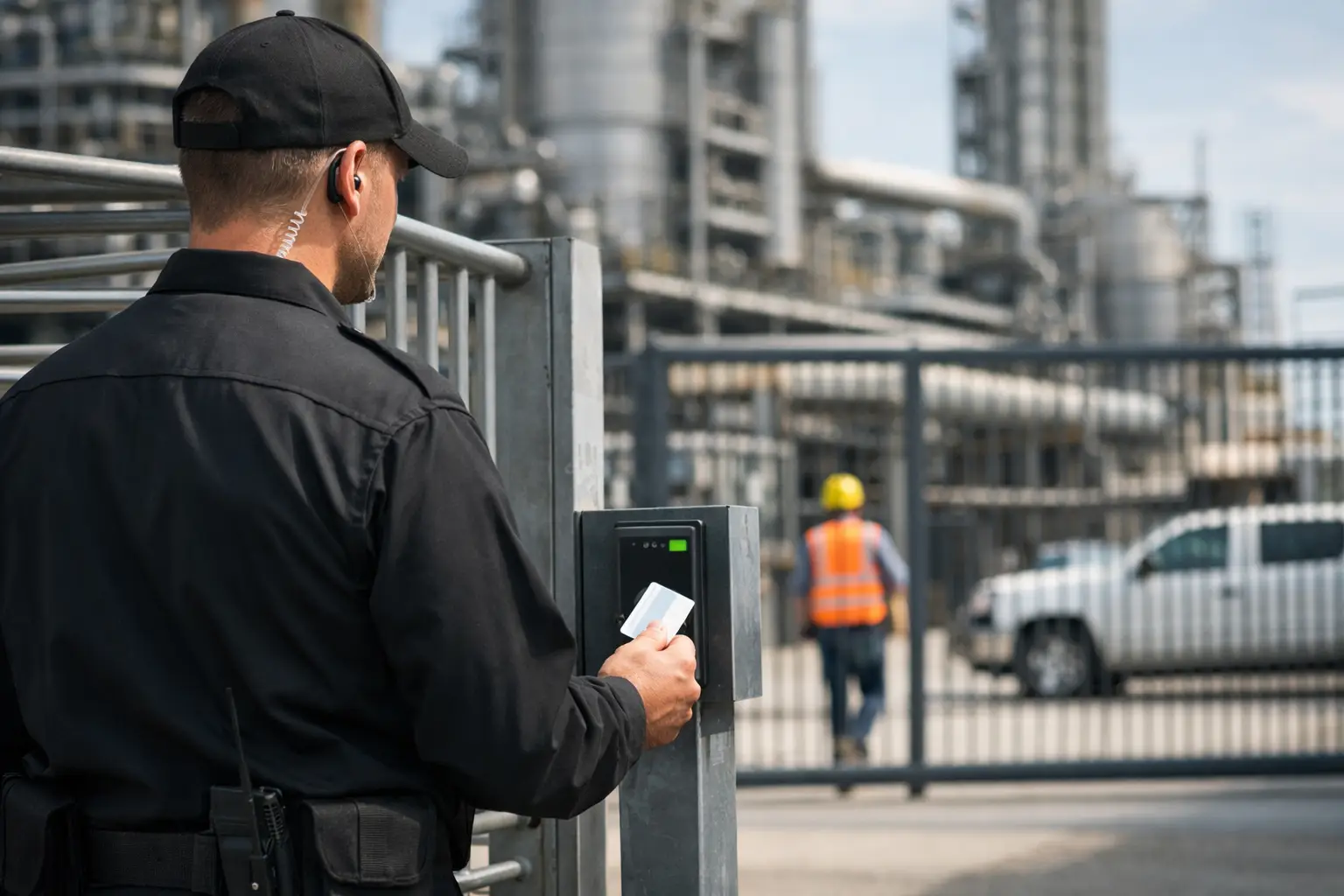
A gate is not industrial facility access control. Neither is a sign, a badge reader, or a contractor check-in sheet standing alone. Control begins when a site can identify who is authorized to enter, verify why they are there, direct them safely, and respond with real authority when someone refuses to comply.
For industrial operators, utilities, construction managers, and public works teams, access failures are rarely minor. An unsecured entrance can expose copper and equipment to theft, put crews in conflict with unauthorized visitors, interrupt deliveries, compromise a restricted work area, or create a recordkeeping problem after an incident. The right program protects the perimeter, but it also protects the schedule and the people working behind the gate.
What Industrial Facility Access Control Must Accomplish
At a high-risk facility, access control has four operating jobs: deter unauthorized entry, verify authorized entry, control vehicle and pedestrian movement, and document exceptions. Each job has to work during normal shifts, after hours, during contractor surges, and when an outage, storm, or emergency changes site conditions quickly.
A badge system can verify credentials, but it cannot safely manage an aggressive driver at a busy construction entrance. A camera can record a trespasser, but it cannot direct that person off a restricted site. An unarmed guard may observe and report, but a sworn, licensed, insured officer brings legal enforcement authority to address trespass and criminal activity directly, subject to applicable law and agency policy.
That distinction matters when the site contains energized infrastructure, heavy equipment, controlled materials, critical communications equipment, or active crews. Access control must be treated as an operational security function, not a receptionist task.
Start With the Actual Exposure
The strongest access plan is based on what can happen at a specific entrance, not on a generic post order. A substation gate, pipeline laydown yard, manufacturing plant entrance, municipal work zone, and large commercial loading area all have different traffic patterns and enforcement needs.
Site leadership should identify the people, vehicles, assets, and conditions that create exposure. That includes employees, contractors, delivery drivers, vendors, visitors, former employees, nearby foot traffic, and vehicles arriving outside approved hours. It also includes the physical realities of the location: blind approaches, limited turnaround space, poor lighting, multiple gates, shared access roads, rail crossings, and areas where a stopped vehicle could block emergency access.
The key question is practical: what happens when a person arrives without authorization? If the answer is only “call someone,” the site has a delay built into its security plan. For many industrial operations, that delay is exactly when theft, confrontation, or a safety incident develops.
Separate Routine Access From Exceptions
Most site entries should be predictable. Employees use assigned credentials. Scheduled contractors appear on an approved roster. Deliveries arrive through a defined gate and are routed to a designated point of contact. Those routine entries should move efficiently without weakening verification.
Exceptions need a separate process. A driver who is early, an unfamiliar subcontractor, a visitor without identification, or a person attempting to enter after hours should not be handled through informal judgment. The officer or gate representative needs clear authority for who can approve entry, what identification is required, where the person waits, and when entry must be denied.
This is where written post orders earn their value. They remove guesswork when conditions are busy and preserve a consistent record when management later needs to review an event.
Put Enforcement Authority Where Decisions Happen
The gate is often the point where security decisions become immediate. An officer may need to stop a vehicle from entering a restricted area, address suspected trespass, preserve a safe path for equipment, or coordinate with local agencies after a crime. A passive presence is not enough in every environment.
Sworn officers provide command presence that changes the encounter before it escalates. Their legal enforcement authority gives operators a practical option when access denial is ignored or a person’s behavior becomes criminal. This can be especially relevant at substations, transmission yards, utility construction sites, industrial campuses, and locations with repeated theft or vandalism exposure.
The role must still be defined correctly. Access control officers should know the facility’s authorization rules, emergency contacts, contractor procedures, traffic plan, restricted areas, and reporting requirements before assuming a post. Enforcement authority is effective only when it is paired with site-specific direction and disciplined documentation.
Control Vehicles, Not Just Credentials
Many industrial access failures occur inside the gate line. A valid driver may still be at the wrong entrance, lack a required escort, arrive with an unapproved trailer, or create a traffic conflict with crews and equipment. Vehicle control needs to account for movement, staging, inspection requirements, and exit procedures.
For active projects, the access point should establish where vehicles stop, how drivers are verified, which lane is used for entry and exit, and how oversized loads or emergency vehicles receive priority. During shift changes, delivery windows, or outage work, a sworn officer can provide traffic enforcement and direction that a cone or flagger cannot provide.
Temporary access plans are often necessary. A storm-response mobilization, for example, can bring unfamiliar mutual-aid crews, fuel deliveries, equipment haulers, and vendors to a site within hours. The plan should allow necessary work to proceed without creating an open gate condition that invites unauthorized entry.
Pair People With Cameras and Documentation
On-site coverage and technology serve different purposes. Remote solar-camera networks can monitor broad perimeters, record activity, provide 24/7 surveillance, and support dispatch when personnel are not positioned at every access point. Documented incident footage can also strengthen internal reviews, claims handling, law enforcement coordination, and corrective action.
But cameras do not replace a capable response at a live access point. The best arrangement depends on the site. A remote, low-traffic yard may benefit from monitored cameras with scheduled officer patrols. A busy construction entrance or facility with repeated trespass may require a dedicated officer during working hours, supported by camera coverage after hours.
The important issue is response time. If monitoring identifies a breach, who receives the alert, who is dispatched, and what record is produced? A security plan should answer those questions before an incident occurs.
Make Documentation Useful to Operations and Compliance
Reports should do more than prove an officer was present. They should give facility leadership usable facts: time of contact, identity or vehicle details when available, access decision, reason for denial, actions taken, notifications made, and whether footage or photographs were preserved.
For critical infrastructure operators, documentation can support physical-security reviews and practices aligned with NERC CIP-014 considerations. For construction and industrial sites, it can also support OSHA-related safety expectations by recording access restrictions, traffic incidents, unsafe entry attempts, and emergency actions.
Not every event requires a lengthy narrative. Routine logs should be fast and consistent. Significant events should be detailed enough that a manager, compliance lead, insurer, or responding agency can understand what happened without reconstructing the situation from memory.
Build a Coverage Plan That Can Change With the Work
Access control requirements change as projects move from mobilization to active construction, commissioning, and closeout. A facility may need overnight gate coverage during equipment delivery, expanded daytime control during contractor peaks, or immediate reinforcement after a theft attempt. Static staffing plans often leave gaps because the work itself is not static.
Grid Guard Protective Services deploys licensed, insured, off-duty sworn law enforcement officers across Georgia for planned coverage and urgent conditions. Standard scheduling can be arranged with a 72-hour lead time, with 24/7 shifts and rapid-response support for outage, storm, and emergency conditions. That operational flexibility matters when the risk window does not fit standard business hours.
Before coverage begins, the site should provide gate maps, authorized contact lists, work hours, delivery schedules, emergency procedures, restricted-area rules, and known problem patterns. In return, the security provider should define post responsibilities, relief procedures, escalation paths, incident reporting, insurance status, and the communication process for supervisors.
A controlled entrance should never become a bottleneck that crews work around. It should become a reliable operating point: people are verified, vehicles are directed, unauthorized access is addressed, and every meaningful exception is documented. When the next delivery surge, theft attempt, or emergency deployment arrives, that preparation keeps the site moving while keeping control where it belongs.