
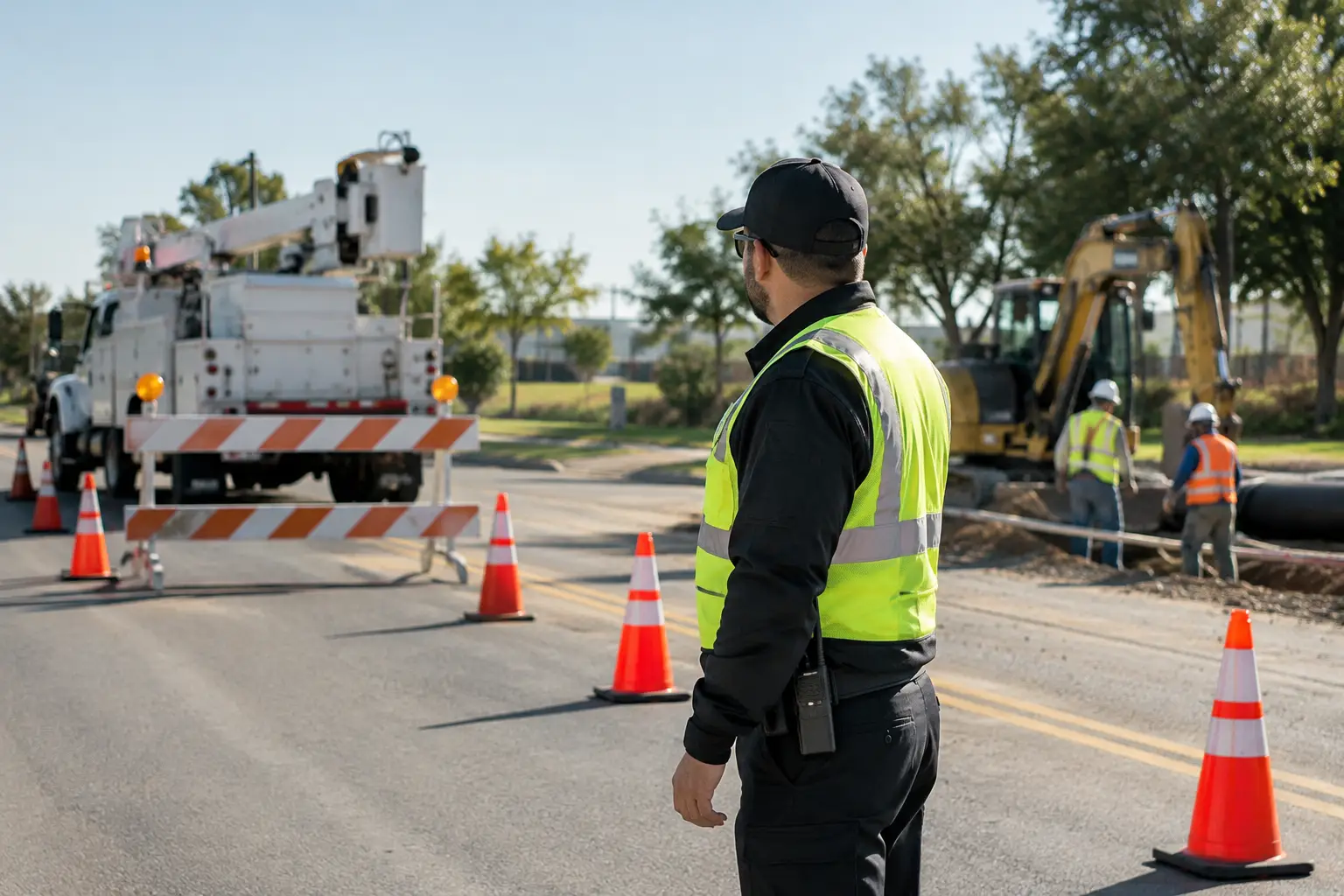
A utility road closure can become a public-safety problem before the first crew member reaches the work zone. A missed detour sign, an impatient driver entering a restricted lane, or an unplanned outage response can place crews, motorists, equipment, and the utility schedule at risk. To manage utility road closures effectively, operators need more than cones and a traffic-control drawing. They need field command, legal enforcement authority, and a documented plan that holds up under changing conditions.
For utility contractors, municipal departments, and infrastructure operators across Georgia, the goal is not simply to slow traffic. It is to establish a controlled work area where crews can perform critical work without unauthorized vehicle entry, avoidable conflict, or gaps in accountability.
Start With the Closure Type and the Actual Risk
Road closures are not all the same. A planned lane closure for overhead line work carries different risks than a full roadway closure during storm restoration. A substation access road may need restricted entry for delivery vehicles while remaining open to emergency responders. A work zone near a school, hospital, industrial site, or major commuter route requires additional attention to traffic volume, local access, and public behavior.
Before assigning personnel, define the closure in operational terms: what road or access point is affected, what movement is prohibited, how long the restriction is expected to last, and what conditions would require the plan to change. Identify whether the job requires a lane shift, alternating traffic, a full closure, a rolling closure, or controlled access at a utility entrance.
The traffic-control plan must also account for the work itself. Bucket trucks, cranes, line crews, trenching equipment, material deliveries, and damaged infrastructure can all change sight lines and available roadway width. A plan that looks adequate at 7:00 a.m. may fail by afternoon if equipment expands into the travel lane or traffic backs up beyond the advance-warning area.
Assign Real Authority at the Closure Point
Cones, barricades, and signs communicate restrictions. They do not enforce them. When a driver ignores a detour, challenges a flagger, attempts to drive around a closure, or enters an active work zone, the person at the closure point needs the authority to act decisively.
A sworn, licensed, insured law enforcement officer provides real authority a cone or flagger cannot provide. Officers can direct traffic, address unlawful entry, respond to disorderly conduct, coordinate with local agencies when needed, and intervene when public behavior threatens crew safety. Their command presence also changes how motorists approach the work zone. Drivers are more likely to comply with a closure when they see clearly marked enforcement capability rather than passive controls alone.
This does not mean every utility project requires an officer at every cone line. Lower-volume, fully separated work areas may be managed with standard traffic-control measures. The decision depends on traffic speed, public exposure, duration, roadway geometry, history of noncompliance, crew vulnerability, and the consequences of a vehicle breach. But for high-risk locations, overnight work, emergency repairs, and closures near critical infrastructure, enforcement-capable staffing is often the appropriate control.
Keep Roles Clear Between Officers and Work-Zone Personnel
Confusion at the roadside creates delays and weakens safety. The officer should know who has authority over traffic movement, who communicates equipment changes, who contacts the utility supervisor, and who calls for additional support. The site supervisor should know the officer's post location, shift hours, communications method, and escalation procedures.
Flaggers may still have an important role in controlling routine traffic flow. The officer's role is different: enforce compliance, protect the work zone, manage conflict, and respond when a routine traffic issue becomes a safety or security event. Clear role separation keeps both functions effective.
Build the Closure Plan Around Field Conditions
A road-closure plan should be usable in the field, not merely acceptable on paper. It needs accurate closure limits, advance-warning locations, detour routes, access points, staging areas, crew parking, and emergency vehicle procedures. It should identify the person authorized to modify the closure when conditions change.
For planned work, conduct a pre-shift review with the crew lead, traffic-control provider, and sworn officer. Confirm the work window, expected equipment movements, public access concerns, utility emergency contacts, and the process for reopening the roadway. If the project has multiple phases, define when and how traffic patterns will change rather than relying on informal handoffs.
Storm and outage response requires a more flexible approach. Crews may arrive before a full detour package is available, and road conditions may be degraded by downed lines, flooding, debris, or damaged poles. In these situations, the immediate priorities are to establish a safe perimeter, prevent public access to electrical hazards, preserve emergency access, and expand the closure as resources arrive. A capable provider must be able to staff 24/7 shifts and adapt to conditions without losing command of the site.
Protect Local Access Without Losing Control
Full closures often affect residents, businesses, delivery vehicles, school transportation, and emergency services. A closure plan should state whether local access is permitted and, if it is, who verifies the destination and directs the vehicle safely through or around the work zone.
Local access can be necessary, but it should not become an open invitation for drivers to bypass controls. The officer and site supervisor should agree on the standard before the shift starts. Exceptions for emergency vehicles, property owners, or essential deliveries should be handled consistently and documented when they affect the closure plan.
Document What Happened, Not Just What Was Scheduled
A closure schedule proves what was intended. It does not prove what occurred. For utilities and contractors managing public risk, documentation should capture the actual operating picture: officer arrival and departure times, post location, traffic incidents, unauthorized-entry attempts, public complaints, emergency access events, changes to the closure, and any law-enforcement action taken.
This documentation supports more than billing. It provides a defensible record when a motorist alleges poor notice, a contractor dispute arises, a near miss occurs, or an incident becomes part of an OSHA review, insurance claim, or internal safety investigation. For critical-infrastructure operators, documented site activity can also support broader physical-security and compliance expectations.
When the closure includes augmented protection, remotely monitored solar-camera networks can add another layer of accountability. Live surveillance, dispatch support, and documented incident footage are particularly useful for overnight closures, equipment staging areas, remote utility access roads, and sites where theft or trespass is a concern. Cameras do not replace an officer where traffic enforcement is required, but they can extend visibility beyond the immediate post.
Plan Staffing Before the Work Window Closes In
Last-minute coverage is possible only when qualified resources are available. Planned projects should request officer staffing early enough to confirm the roadway requirements, post instructions, shift duration, and agency coordination needs. A 72-hour lead time gives a provider room to schedule the right sworn personnel and prepare for the conditions at hand.
Emergency work operates on a different clock. Outages, storm damage, and infrastructure failures can require immediate traffic enforcement before normal procurement steps are complete. The right staffing partner should be able to provide a clear response process, insured personnel, defined shift coverage, and a direct line for operational changes at any hour.
Grid Guard Protective Services deploys sworn Georgia law enforcement officers for planned utility work, emergency response, and work-zone traffic enforcement across all Georgia counties. That model gives utilities and contractors a practical option when public safety depends on legal authority, visible command presence, and documented field activity.
Reassess the Closure Until the Road Reopens
The work zone is not static. Traffic patterns change, weather changes, equipment moves, and drivers become less patient as delays increase. The officer and crew lead should reassess the closure throughout the shift, especially after darkness, weather events, equipment repositioning, or a significant traffic backup.
Reopening also deserves discipline. Remove restrictions only when crews, equipment, hazards, and debris are clear of the roadway and the responsible supervisor confirms the area is safe for normal traffic. A controlled reopening protects the public just as much as a controlled closure. When the job is over, the strongest result is simple: crews leave safely, motorists return to a clear roadway, and the utility has a complete record of how the work zone was protected.