
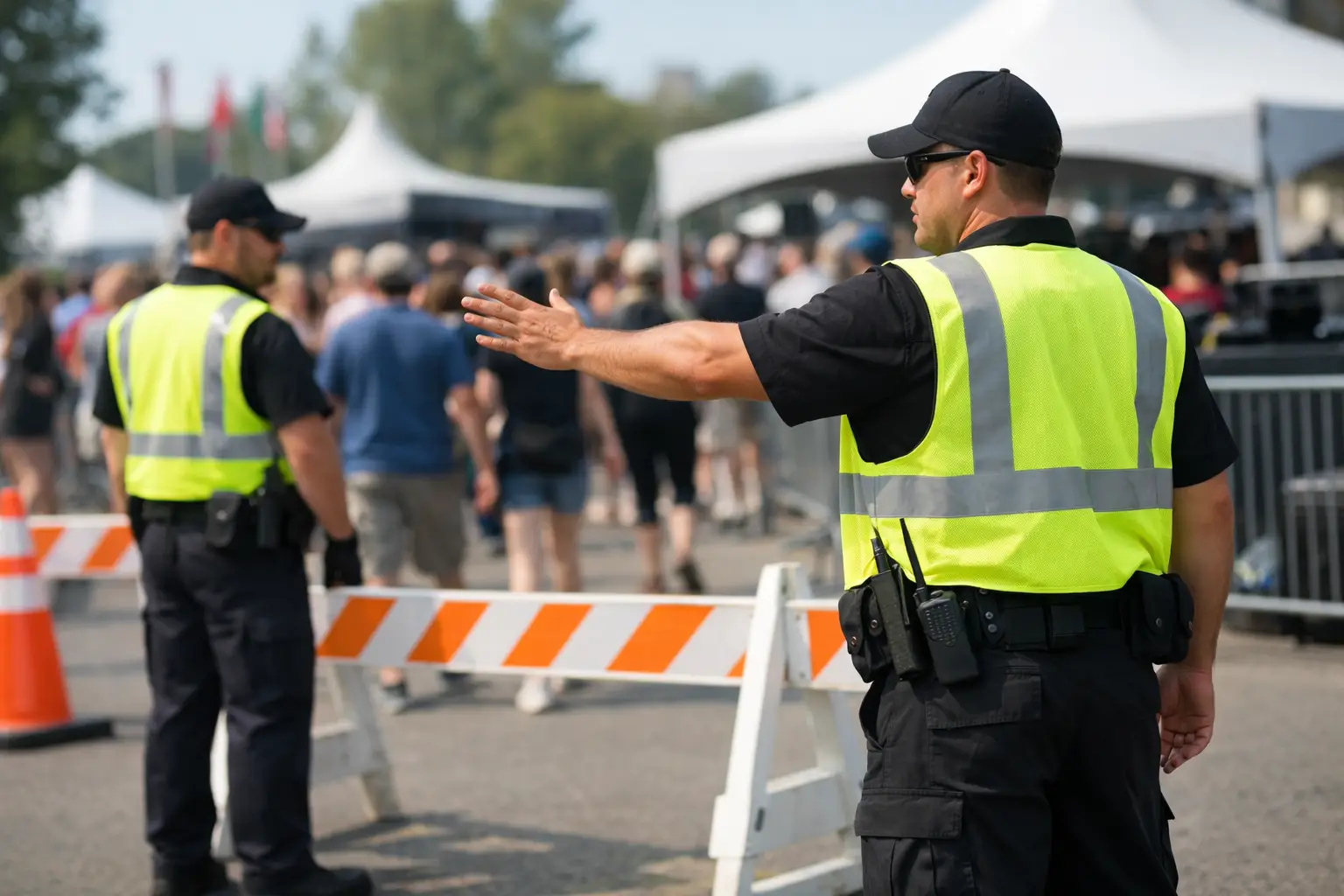
A street festival can turn a normal downtown intersection into a conflict point in minutes. Delivery vehicles arrive after closures begin. Pedestrians cross outside designated routes. Rideshare traffic stacks up at a single curb. Emergency access narrows just as attendance reaches its peak. Municipal event traffic officers provide the sworn, visible authority needed to keep those conditions from becoming an incident, a delay, or a public-safety failure.
For municipalities, event planners, public-works teams, and venue operators, traffic control is not simply a matter of placing cones and posting detour signs. It is an active field operation. The right staffing plan protects pedestrian movement, maintains emergency lanes, supports nearby businesses and residents, and gives event leadership a direct line to officers who can make lawful, real-time decisions on the ground.
Why municipal event traffic officers matter
Temporary traffic patterns create confusion even when the event plan is sound. Drivers may ignore barricades, enter restricted areas, dispute detours, or block intersections while trying to reach parking. A flagger can communicate a direction, but cannot enforce a closure or address criminal conduct. A sworn, licensed, and insured officer brings legal enforcement authority a cone or flagger cannot provide.
That distinction matters when traffic control shifts from routine direction to enforcement. An officer can address a driver refusing to comply, respond to an impaired or aggressive motorist, preserve access for fire and EMS, and coordinate with local law enforcement when conditions escalate. Command presence also reduces the likelihood that a temporary closure becomes an informal route for unauthorized vehicles.
For high-attendance events, the objective is not merely moving cars faster. It is keeping vehicle movement predictable around people. A backed-up exit can be inconvenient. A vehicle entering a pedestrian-heavy closed street can create a severe exposure within seconds.
Where sworn officers add the most value
Municipal events rarely have one traffic problem. They have a sequence of problems that changes throughout the operating window. Arrival periods, road closures, peak pedestrian activity, vendor load-out, and post-event departure each require a different posture.
Closure points and restricted access
Road closure posts need more than a physical barrier, particularly where local traffic, residents, vendors, and emergency personnel need controlled access. A sworn officer can verify authorization, redirect unauthorized vehicles, and make decisions within the approved traffic plan without leaving a gap at the closure.
This is particularly useful for downtown events, parades, holiday markets, concerts, races, and civic gatherings where several streets close at once. Officers can protect the closure while maintaining practical access for approved service vehicles and residents.
Intersections and pedestrian crossings
High-volume intersections demand clear commands, consistent timing, and immediate attention to unsafe driver behavior. Officers can manage traffic phases around crossing surges, prevent vehicles from blocking marked crosswalks, and protect groups moving between parking areas, transit stops, event gates, and public facilities.
The placement of an officer matters as much as the number assigned. An officer stationed at the wrong intersection may leave the actual conflict point unmanaged. Pre-event review should identify turn movements, parking entrances, ambulance routes, school or church access, rail crossings, and nearby construction activity that may alter normal traffic flow.
Event ingress, egress, and parking routes
The end of an event often creates the greatest strain. Guests leave at the same time, parking lots empty in waves, and drivers seek the quickest exit without understanding the traffic plan. Officers positioned at lot exits and key outbound intersections can distribute vehicles across approved routes instead of allowing traffic to concentrate in one direction.
It depends on the venue and attendance profile. A daytime community event may need strong pedestrian coverage during arrival, while an evening concert may require more officers for post-event egress. A traffic staffing plan should reflect actual operating conditions, not a generic officer count copied from a prior event.
Build the assignment around the event footprint
Effective municipal event traffic coverage starts before the first barricade is placed. The planning team should establish the event footprint, closure times, expected attendance, vendor access requirements, parking locations, emergency routes, and the authority responsible for final traffic decisions.
A field-ready assignment brief should identify each post, shift time, reporting location, supervisor contact, radio or phone protocol, and escalation procedure. It should also clarify whether officers are expected to work fixed intersections, roving patrols, closure enforcement, escort duties, or a combination of these assignments.
The strongest plans account for conditions outside the event boundary. Nearby utility work, active construction zones, a stadium event, severe weather, or a major arterial closure can change traffic volume quickly. When that happens, event leadership needs officers who can communicate conditions clearly and adjust within the direction of the incident command structure.
For a parade route, that may mean protecting cross-street closures and preventing vehicles from entering the route. For a downtown festival, it may mean managing repeated pedestrian crossings and delivery conflicts. For a large public gathering near critical infrastructure, it may also include maintaining controlled access around utility facilities, service corridors, and restricted operational areas.
Documentation supports accountability after the event
Traffic coverage should produce more than an officer presence. Municipal clients and event organizers need records that explain what occurred, when it occurred, and how it was handled.
Documented activity can include officer check-in and check-out times, post assignments, closure status, traffic disruptions, enforcement actions, medical or fire access issues, vehicle incidents, and unusual public-safety conditions. If an incident occurs, a clear written record supports municipal review, insurance reporting, public records obligations, and future event planning.
When conditions warrant added protection, an on-site sworn officer can be paired with remotely monitored solar-camera networks, 24/7 surveillance, dispatch support, and documented incident footage. This approach is especially useful for extended event footprints, staging areas, equipment storage, remote parking, and overnight setup or breakdown periods. Cameras expand visibility, but they do not replace the officer at the point where immediate direction or enforcement is required.
Staffing considerations for Georgia municipalities
Municipal planners should verify that traffic officers are sworn, properly licensed, insured, and assigned through a provider with a clear operational process. Credentials matter, but deployment discipline matters too. Officers need accurate post information, defined authority, direct communication channels, and a supervisor or event contact capable of resolving changes quickly.
Lead time should be discussed early for planned events, especially during holiday weekends, graduation periods, major sporting events, and severe-weather seasons. Grid Guard Protective Services provides statewide Georgia coverage, standard planned-event scheduling with 72-hour lead times, 24/7 shift availability, and quotes within 48 hours. For emergency conditions or rapidly changing municipal needs, staffing requirements should be communicated as early as possible so coverage can be scaled appropriately.
Procurement teams should also define cancellation terms, minimum shift requirements, uniform expectations, marked or unmarked vehicle needs, and whether the event requires a dedicated supervisor. These details prevent a staffing gap from becoming an operational surprise on event day.
Coordinate officers with the broader event command plan
Traffic officers perform best when they are part of the event operation, not an isolated vendor line item. They should know who controls street closures, who can authorize route changes, how to reach fire and EMS, where incident command is located, and what to do if weather forces an evacuation or early release.
A short pre-shift briefing can prevent avoidable problems. It should cover the closure map, emergency lane, accessible parking and drop-off points, vendor schedule, crowd peaks, detour messaging, and escalation contacts. If the event uses public-works crews, private parking staff, volunteers, or unarmed security, define those roles clearly so officers are not pulled away from critical traffic posts to solve routine questions.
The practical test is simple: when a driver challenges a closure, an ambulance needs passage, or a crowd spills into a travel lane, everyone on site should know who has authority to act and how that action will be documented.
A well-staffed event does not call attention to itself. Streets stay controlled, pedestrians move with confidence, emergency routes remain open, and event organizers can focus on the program rather than the next traffic problem. That is the operating standard municipal event traffic officers should be deployed to deliver.