
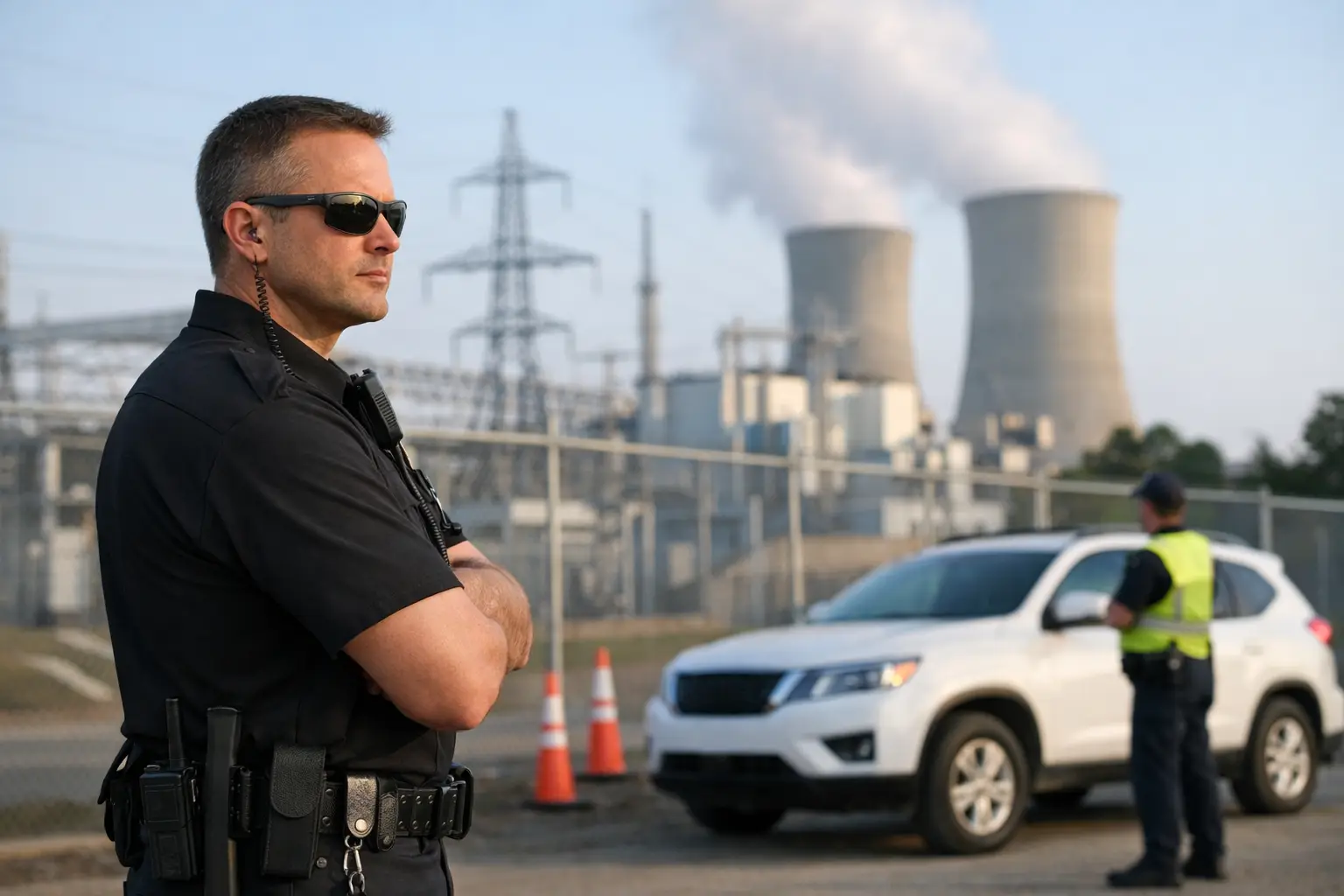
A transmission yard is not a retail parking lot, and a utility work zone is not adequately protected by a cone line and a watchful presence. Off duty police security places a sworn, licensed, and insured law enforcement officer where unauthorized access, theft, traffic conflict, or escalating conduct can disrupt operations. For critical sites, that difference is operational: the officer has legal enforcement authority, command presence, and the ability to document what happened.
For Georgia utilities, contractors, municipal departments, and industrial operators, the question is rarely whether a site has risk. The question is whether the assigned security coverage can act decisively when risk becomes an incident.
What Off Duty Police Security Changes on Site
Conventional private security may observe, report, and request law enforcement assistance. An off-duty sworn officer arrives with a different role. Within the scope of their authority and assignment, the officer can address trespass, criminal conduct, access violations, and traffic-related hazards directly rather than waiting for a responding unit to arrive.
That distinction matters at substations, transmission facilities, utility laydown yards, pipeline projects, industrial properties, and large commercial sites. Copper theft, vandalism, unauthorized vehicles, suspicious activity, and confrontations at a gate can quickly affect crew safety, asset availability, and construction schedules. A sworn officer provides the visible authority that passive monitoring and unarmed staffing cannot provide.
The value is not limited to intervention. Officers produce incident documentation that gives site leadership a clear record of conditions, actions taken, involved parties, and available evidence. That record supports internal reporting, claims handling, contractor management, regulatory preparation, and follow-up with local agencies.
Where Sworn Officer Coverage Is Most Effective
Off-duty officer assignments should be built around the actual exposure, not simply a standard guard-post template. A remote substation with repeated intrusion attempts requires a different coverage plan than a downtown utility excavation or a municipal event with heavy pedestrian movement.
Critical Infrastructure and Utility Assets
Substations, transmission yards, switching stations, and other electrical infrastructure are attractive targets for trespass, sabotage, and metal theft. These sites also carry serious public-safety consequences when an unauthorized person enters an energized area. Sworn officer coverage establishes access control, deters opportunistic activity, and gives operations teams an immediate escalation path when a threat is identified.
For facilities with physical-security obligations tied to NERC CIP-014 or internal infrastructure standards, documentation matters as much as presence. Officers can record patrol activity, access concerns, suspicious contacts, and incident response in a format that strengthens a site’s compliance posture.
Utility Construction and Work Zones
Utility construction creates shifting access points, exposed materials, parked equipment, lane closures, and crews working close to moving traffic. A sworn officer can protect the work area while managing traffic behavior that creates risk for workers and the public. This is real authority a cone or flagger cannot provide.
Coverage may be needed at a single high-risk intersection, along a multi-day road closure, or during overnight construction when equipment and materials are vulnerable. The right deployment accounts for work hours, traffic patterns, public access, staging areas, and the contractor’s escalation procedures.
Storm Response and Outage Restoration
Storm conditions compress the time available to make good security decisions. Downed lines, darkened intersections, damaged facilities, fuel staging, mobile command locations, and restoration crews can draw public attention and create uncontrolled access problems.
During an outage, officer coverage protects the restoration effort itself. Officers can support traffic control, secure damaged infrastructure, manage access to work areas, and document incidents that occur while crews are focused on restoring service. Because conditions change by the hour, the provider must be able to staff 24/7 shifts and adapt coverage as the response footprint moves.
Industrial, Municipal, and Commercial Operations
Access control at an industrial gate is more than checking names against a list. It requires judgment when an individual refuses direction, a vehicle attempts to enter without authorization, or a dispute develops between site personnel and a visitor. The same is true for municipal events, large commercial properties, and public-works operations where crowd movement, traffic, and public access overlap.
An officer can enforce site rules with professional authority while keeping the operation moving. This helps protect employees, contractors, visitors, equipment, and the business continuity of the location.
How to Scope the Assignment Before Coverage Begins
The strongest deployments begin with a clear operating picture. Procurement and site leaders should define the asset being protected, the risks that prompted coverage, the authority expected at the post, and the specific outcomes the officer must support. Vague instructions such as “watch the site” produce vague results.
Start with site access. Identify gates, pedestrian entry points, fence-line vulnerabilities, public roads, contractor staging areas, and locations where equipment or material is stored. Then establish the officer’s post orders: who may grant access, what credentials are required, when law enforcement notifications must be made, and who receives incident reports.
Shift design also deserves attention. Overnight coverage may provide the highest deterrence for an isolated facility, while daytime coverage may be more valuable at an active construction site with traffic exposure. Some projects need a fixed post. Others require mobile patrols, roving checks, or an officer positioned at the point where public interaction is most likely.
A provider should also confirm insurance, officer credentials, communications procedures, and reporting expectations before the first shift. For risk-sensitive facilities, request sample documentation and clarify how records will be delivered after an incident. A fast verbal update is useful, but a documented account is what remains when decisions are reviewed later.
When Camera Coverage Should Augment an Officer
Remote solar-camera networks extend awareness across large or remote properties. They can provide 24/7 surveillance, dispatch support, and documented incident footage from locations that a single officer cannot watch continuously. This is particularly useful along expansive fence lines, equipment yards, temporary construction sites, and facilities with multiple entrances.
Camera coverage is not a substitute for an officer in every situation. If a site needs an enforcement-capable response at a gate, a work zone, or an active incident, an on-site sworn officer remains the direct solution. The most effective model often combines both: an officer handles access, visible deterrence, and immediate decisions while remote monitoring expands detection and preserves footage.
The trade-off is practical. Cameras improve visibility and may reduce the number of on-site hours needed in lower-risk periods. They do not replace human judgment, lawful direction, or the command presence required when someone is already on the property.
Selecting a Georgia Coverage Partner
For statewide operations, coverage capacity is part of security quality. A provider should be able to staff planned assignments across Georgia counties, operate 24/7 shifts, and respond when a storm, outage, theft pattern, or project change creates an urgent need. Ask about standard lead times, quote turnaround, backup staffing, insurance, and the process for modifying a post after deployment.
Grid Guard Protective Services staffs licensed, insured, off-duty sworn law enforcement officers for scheduled and rapid-response coverage throughout Georgia. Standard assignments can be planned with 72-hour lead times, while the operating model is built to support urgent conditions when crews, assets, and public safety cannot wait for a conventional security process.
Evaluate the provider’s reporting discipline as closely as its staffing promise. The assignment should produce useful documentation, not just a time sheet. Site leadership needs records that show patrol activity, access issues, enforcement actions, incidents, and supporting footage when available.
The right officer assignment protects more than a perimeter. It protects the schedule, the crew’s working conditions, the asset owner’s accountability, and the public standing near the work. When the site’s risk changes, coverage should be ready to change with it.