
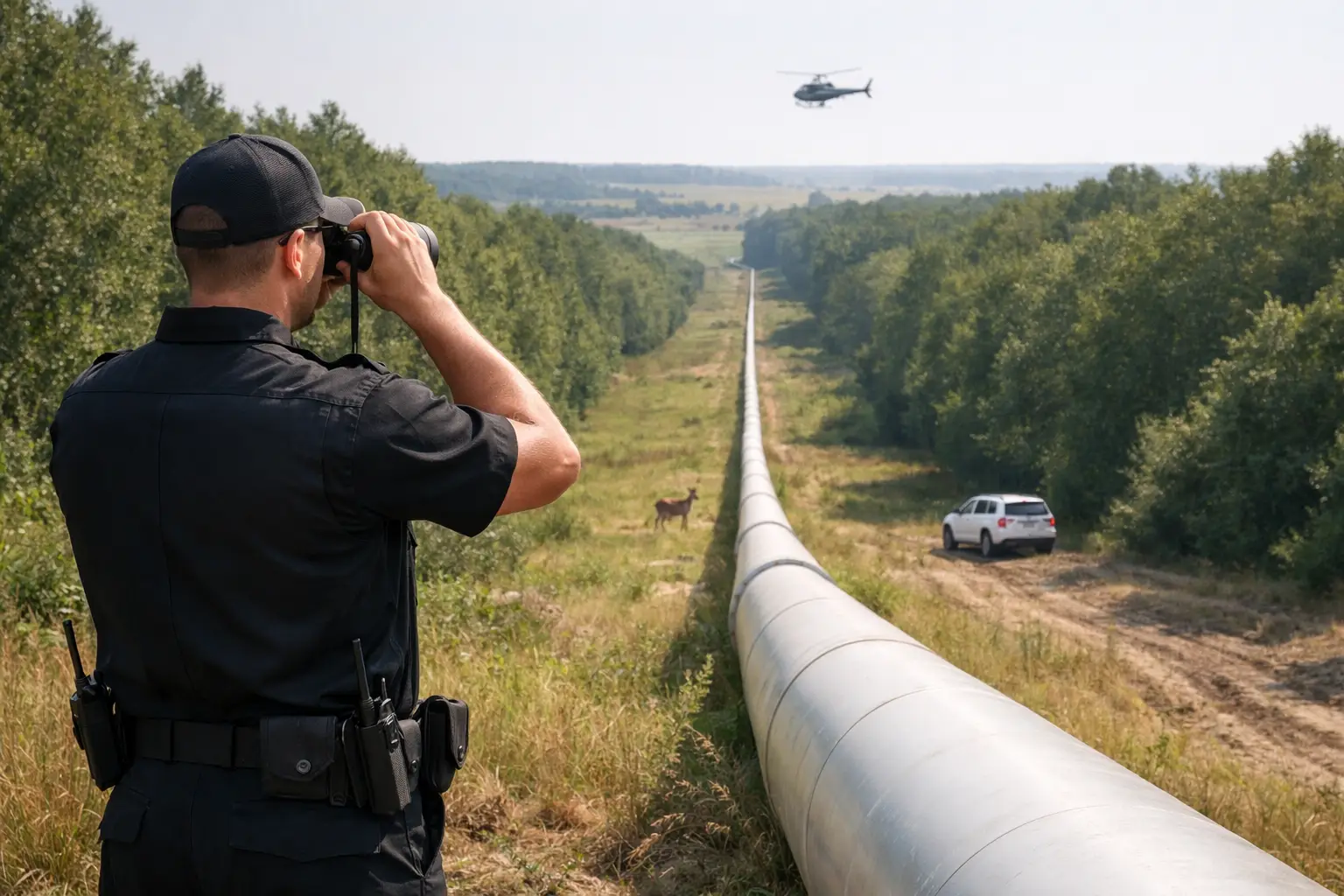
A locked gate at a county-road crossing does not tell an operator who entered the corridor after dark, whether a vehicle stopped near an exposed valve site, or whether a crew will arrive to an unsafe access point at first light. A pipeline right of way patrol closes that visibility gap with a field presence that can observe, deter, document, and respond with legal enforcement authority.
For pipeline operators and contractors, the objective is not simply to put a vehicle on a route. It is to protect access, personnel, equipment, public safety, and the operating schedule across miles of distributed assets. That requires a patrol plan built around actual exposure, not a generic security tour.
What a Pipeline Right of Way Patrol Is Designed to Do
A right of way is not one site with one perimeter. It may include road crossings, easements behind residences, remote valve locations, compressor or meter facilities, construction spreads, temporary laydown areas, and access routes shared with landowners and the public. Conditions can change quickly following storms, construction activity, seasonal hunting, nearby development, or a service interruption.
A sworn-officer patrol provides visible deterrence where it matters and a documented record of what was found. Officers can check for unauthorized vehicles, open or damaged gates, signs of excavation, encroachment, dumped material, tampering indicators, suspicious activity, and threats to crew access. When criminal trespass or theft is occurring, an off-duty sworn law enforcement officer brings legal enforcement authority that an unarmed guard cannot provide.
The patrol is also a communications function. A field officer can report conditions to an operations contact, preserve incident details, coordinate with local agencies when needed, and provide a written account that supports follow-up, claims handling, internal review, or regulatory documentation. That level of accountability matters when a small issue becomes a service disruption, property dispute, injury exposure, or criminal case.
This service does not replace integrity management, leak detection, aerial inspection, land surveying, or required operational inspections. It protects the people, access points, and physical environment around those functions. The strongest programs define that boundary clearly so officers know what to observe, who to notify, and when an operational condition requires escalation.
Where Patrol Coverage Has the Most Value
The right patrol frequency depends on the corridor, current work, asset criticality, local crime conditions, and the consequence of delayed discovery. A stable, rural segment may need periodic high-visibility coverage. A construction segment with stored materials, open excavations, or repeated trespass may require scheduled patrols on every shift. Following a storm or outage, the priority may shift to clearing access routes, protecting repair crews, and monitoring locations where public curiosity creates a hazard.
Patrol coverage is particularly useful at transition points: where a pipeline crosses a road or waterway, enters a populated area, connects to a station, or runs beside active construction. These are places where vehicle access, public contact, and unauthorized activity are more likely. They are also locations where a documented officer presence can prevent a minor boundary violation from escalating.
Temporary project assets deserve the same attention. Fuel, copper, tools, generators, trailers, and specialized equipment attract opportunistic theft when left in lightly supervised areas. A patrol plan should account for when crews leave, which assets remain exposed, how keys and access credentials are controlled, and whether lighting or cameras cover the actual approach routes rather than only the equipment itself.
Sworn Patrols Change the Response Model
Many providers can observe and report. That may be sufficient for low-risk properties where an unauthorized person is unlikely to challenge the post or create a safety issue. Pipeline corridors often present a different operating environment. The officer may encounter trespassers near critical infrastructure, individuals operating vehicles on restricted routes, theft in progress, or unsafe activity near a work area.
A licensed, insured, off-duty sworn officer can make lawful contact, address criminal activity directly, and produce professional incident documentation. The command presence alone can change behavior at known problem locations. More importantly, it gives operations leaders a defined escalation path instead of relying on a guard to call for help and wait.
That does not mean every patrol needs continuous officer coverage. It means the response model should match the risk. A remote corridor with no current work may be well served by scheduled checks supported by monitored cameras. A high-consequence crossing, active construction spread, or location with repeated theft may justify an on-site officer during vulnerable hours. The practical question is not whether every mile receives the same attention. It is whether the highest-risk miles receive enough attention to prevent avoidable loss.
Build Patrol Orders Around Decisions, Not Just Routes
A patrol route without clear instructions produces inconsistent results. Before coverage begins, the operator should provide the officer with approved access points, site maps where available, emergency contacts, restricted locations, known hazards, work schedules, and reporting expectations. If a corridor crosses multiple counties, the plan should identify the local operational contacts and the preferred notification sequence.
Patrol orders should also establish what the officer is expected to do when conditions are found. For example, an unsecured gate may require photographs, immediate notification, and continued presence until a responsible representative arrives. A suspected excavation near the right of way may require a safety perimeter, contact with the project manager or dispatch, and law enforcement action if unauthorized work is underway.
The most useful instructions answer four operational questions:
- What conditions require immediate notification?
- Which locations or assets have elevated risk?
- Who has authority to approve access or make operational decisions?
- What documentation is required at the end of each shift?
Those answers reduce hesitation in the field. They also create repeatable records across shifts, officers, and response periods.
Documentation Turns Patrol Activity Into a Defensible Record
A patrol that cannot be verified is difficult to manage. Operators should expect shift logs that identify patrol times, locations checked, observed conditions, contacts made, actions taken, and any needed follow-up. Incident reports should be specific enough to establish chronology, preserve relevant facts, and support coordination with internal security, safety, legal, or local law enforcement teams.
Documented incident footage adds another layer of accountability when camera coverage is available. Solar-camera networks can monitor remote access points, equipment areas, and known trespass routes around the clock. Remote monitoring and dispatch can identify activity between officer patrols, while an on-site sworn officer can respond to confirmed issues requiring field action. This combined approach is often more practical than assigning fixed coverage to every isolated location.
Documentation also supports compliance readiness. While security patrol reports do not substitute for a pipeline operator's regulatory obligations, organized records can show that access control concerns, suspicious activity, and site-security events were addressed with a defined process. For operators managing broader critical-infrastructure requirements, that evidence can be valuable during internal reviews and after an incident.
Planning for Construction, Storms, and Changing Risk
Routine patrols should not become rigid. A corridor's risk profile changes when excavation begins, a contractor mobilizes, a storm causes washouts, or an outage brings crews into remote areas at unusual hours. Coverage must be able to expand quickly around the work rather than remain tied to an outdated route.
For planned work in Georgia, Grid Guard Protective Services can schedule licensed, insured sworn officer coverage statewide, typically with a 72-hour lead time, including 24/7 shift availability. Emergency conditions may require a different staffing approach, especially when multiple repair locations need protection at once. Early communication about anticipated storm exposure, active work zones, and priority assets gives the security provider a better chance to place the right officers where they can protect the schedule.
The best time to define a patrol plan is before a gate is cut, equipment disappears, or a crew is delayed at an unsafe site. Start with the locations where access failure would hurt most, establish the response authority in writing, and make every patrol report useful to the next operational decision.