
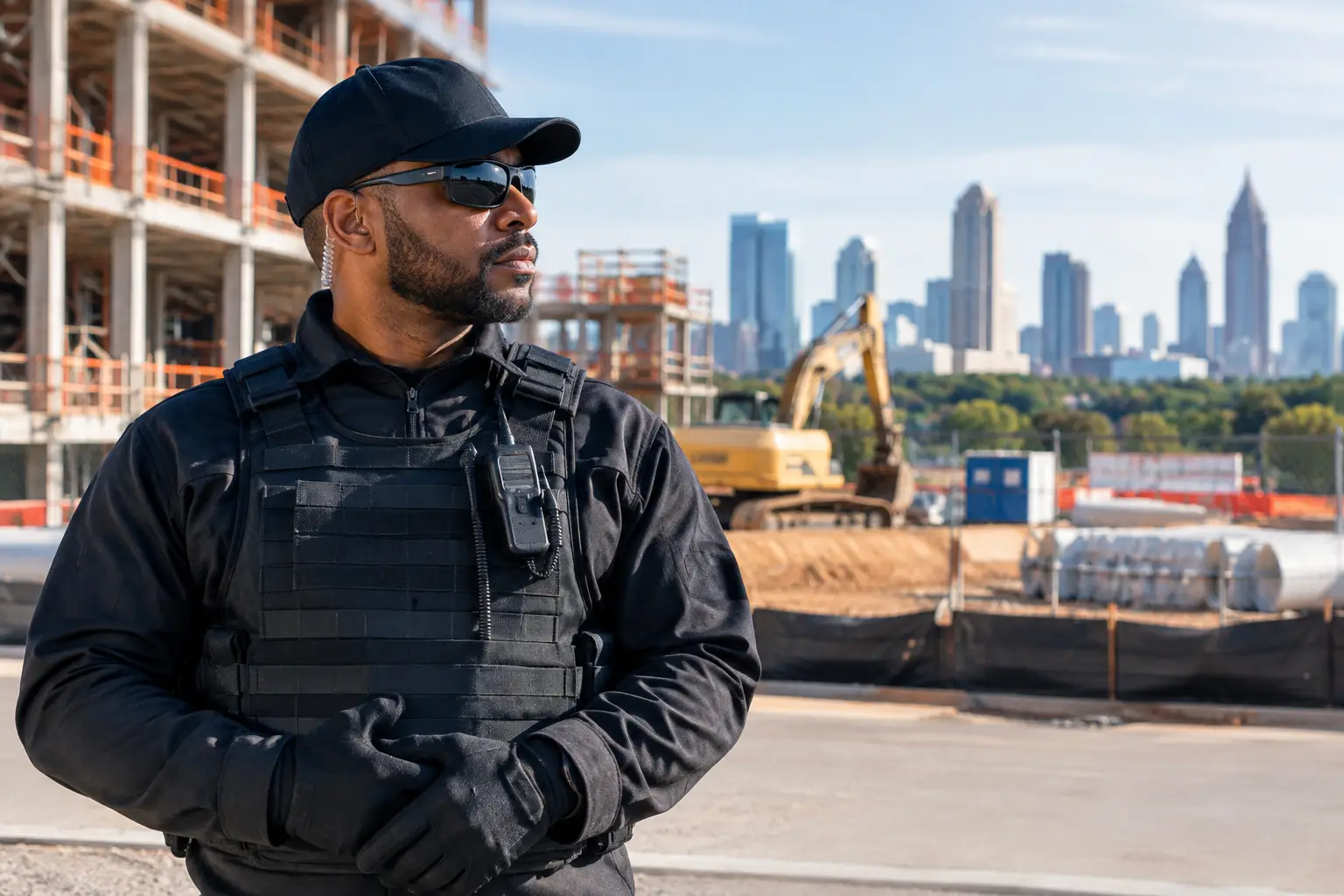
A substation gate left open after dark, a crew working beside live traffic, or an outage restoration team arriving in a damaged neighborhood creates a different security problem than a routine patrol can solve. Police details place off-duty sworn law enforcement officers at the point of risk, with legal enforcement authority to address trespass, criminal activity, traffic violations, and unsafe public interference directly.
For utilities, contractors, municipalities, and industrial operators, the question is not whether a visible presence helps. It is whether the person on site can take lawful action, document what occurred, and protect the schedule without creating another operational problem. In high-consequence environments, those distinctions affect asset loss, worker safety, outage duration, and compliance exposure.
What Police Details Provide That Guards Cannot
A police detail is staffed by a sworn officer working an authorized off-duty assignment. The officer remains licensed, trained, and accountable under applicable law-enforcement standards while providing dedicated coverage for a client site, project, event, or emergency operation.
That matters when a person ignores a verbal instruction, enters restricted property, damages equipment, threatens a crew, or creates a traffic hazard. An unarmed guard can observe, report, and request assistance. A sworn officer has legal enforcement authority and can respond to the conduct in front of them within the scope of the assignment and the law.
This is not an argument against every form of private security. Remote monitoring, access-control systems, cameras, and guard patrols can all serve a purpose. The trade-off is capability. If the risk involves active trespass, theft crews, aggressive confrontations, unsafe driving, or a need for immediate traffic enforcement, passive observation may leave the site waiting for a response. A properly assigned officer provides command presence and direct enforcement where the operational risk requires it.
Where Police Details Fit Best
Police details are most effective when the site has a defined exposure, a clear operating window, and consequences that outweigh the cost of sworn coverage. For a utility operator, that may be a transmission yard storing high-value materials or a substation undergoing construction. For a contractor, it may be an overnight road closure where workers and motorists are separated by little more than cones and temporary barriers.
Critical infrastructure and utility property
Substations, transmission sites, staging yards, and utility construction areas attract risks that are rarely limited to simple unauthorized entry. Copper theft, equipment vandalism, illegal dumping, casing of a site, and attempts to breach a perimeter can interrupt service and create substantial restoration costs.
A sworn officer can control access at the gate, conduct visible patrols, identify suspicious activity, and take appropriate enforcement action when a violation occurs. The presence also gives project managers a defined point of contact during shift changes, deliveries, contractor arrivals, and escalation events. When paired with a remotely monitored solar-camera network, the officer can respond to verified activity while 24/7 surveillance preserves documented incident footage outside staffed hours.
Work zones and traffic control
Work-zone security is a public-safety function as much as a site-security function. Motorists may ignore lane closures, drive through active work areas, argue with flagging personnel, or place utility crews at direct risk. A cone or flagger cannot provide the real authority a sworn officer can provide.
The officer's role should be planned around traffic conditions, work hours, detour points, ingress and egress routes, and the specific behavior creating risk. On a municipal paving project, that may mean controlling an intersection during peak traffic. During utility restoration, it may mean holding a lane closure through the night while crews repair damaged infrastructure. The right assignment keeps workers focused on the job rather than managing confrontations with the public.
Storm, outage, and emergency response
Emergency deployments do not operate on normal construction schedules. Crews may arrive after a storm with limited notice, work long shifts, stage equipment in exposed areas, and enter communities under stress. Police details can protect work zones, control access to staging areas, discourage theft from parked equipment, and support safe movement around damaged roads or downed infrastructure.
In these conditions, response speed matters, but so does clarity. The provider should understand the crew's reporting location, command contact, shift handoff process, equipment footprint, and rules for public access. Coverage that starts quickly but lacks a clear assignment plan can become a costly visible presence without delivering the protection the incident requires.
Municipal and commercial operations
Public events, large retail sites, industrial facilities, and high-traffic commercial properties may need a sworn officer when crowd management, access disputes, theft risk, or traffic congestion exceed the limits of standard security staffing. The key is to define the officer's mission before the shift begins.
For an event, the priority may be pedestrian crossings, parking-lot flow, and a direct response capability for disturbances. For an industrial site, it may be contractor credential checks, restricted-area enforcement, and loss-prevention support during high-value deliveries. The officer should not be treated as a general-purpose extra set of hands. Clear boundaries preserve the authority and value of the detail.
How to Scope Police Details Before Scheduling
The strongest deployments begin with operational facts, not a generic request for an officer. A site manager should be prepared to identify the location, dates, shift hours, primary point of contact, scope of work, known threats, access points, and whether the officer will be stationary, mobile, or assigned to traffic enforcement.
Risk history is especially useful. If copper theft has occurred at a storage yard, the officer needs to know where materials are staged, how offenders previously entered, and when activity was discovered. If motorists routinely breach a closure, the detail needs the traffic-control plan, roadway authority, expected vehicle volume, and the locations where enforcement visibility will have the greatest effect.
It also helps to establish escalation expectations in advance. Who can authorize extended coverage? Who receives incident notifications after hours? What should occur if a crew cancels a shift, relocates, or needs an officer to remain beyond the planned end time? These details prevent gaps during the moments when a project is most exposed.
For planned Georgia assignments, Grid Guard Protective Services can generally schedule statewide sworn-officer coverage with a standard 72-hour lead time, while maintaining 24/7 shift availability for operational needs. Emergency conditions may require a different mobilization plan based on officer availability, geography, and the scale of the incident. A realistic provider will state that plainly rather than promise coverage it cannot staff.
Documentation Is Part of the Security Function
A police detail should create more than a visual deterrent. It should produce a usable record of what happened at the site. That may include officer activity logs, incident reports, access observations, enforcement-related documentation, and documented incident footage when camera coverage is part of the protection plan.
For infrastructure operators, documentation can support internal security reviews, contractor management, claims, law-enforcement follow-up, and compliance planning. It can also demonstrate that known risks were addressed with a defined, accountable measure rather than an informal arrangement.
The documentation standard should match the assignment. A quiet access-control post may require clear shift reporting and visitor exceptions. A theft attempt, work-zone crash, or trespass incident requires a more detailed record of time, location, actions taken, involved parties, and any evidence preserved. Where NERC CIP-014 or OSHA-related expectations influence site planning, security records should fit the organization's broader protective and safety procedures.
Selecting a Provider for Sworn Coverage
The procurement decision should focus on officer status, insurance, scheduling discipline, and field accountability. Ask whether the provider supplies licensed, insured, off-duty sworn officers rather than generic security personnel. Confirm the geographic coverage area, shift capacity, lead-time expectations, reporting process, and the ability to support both routine assignments and urgent events.
It is also reasonable to ask how the provider handles site instructions, officer briefing, client communication, and incident escalation. A qualified officer is essential, but the coverage model matters too. The officer must arrive with a clear post order, know who is in charge, understand the site hazards, and be positioned where enforcement authority produces a measurable operational benefit.
Cost should be evaluated against exposure, not compared only to the hourly rate of an unarmed guard or flagger. A detail may be unnecessary for a low-risk daytime delivery at a controlled site. It may be the prudent choice for an isolated overnight yard, an active roadway operation, a storm restoration zone, or a facility with repeated trespass and theft losses. The correct level of protection depends on the consequence of delay, disruption, or confrontation.
A well-planned detail gives crews room to work, protects restricted assets, and establishes a documented response capability before an incident becomes an outage, injury, or lost project day. When the conditions call for real authority at the site, assign it before the risk tests the perimeter.