
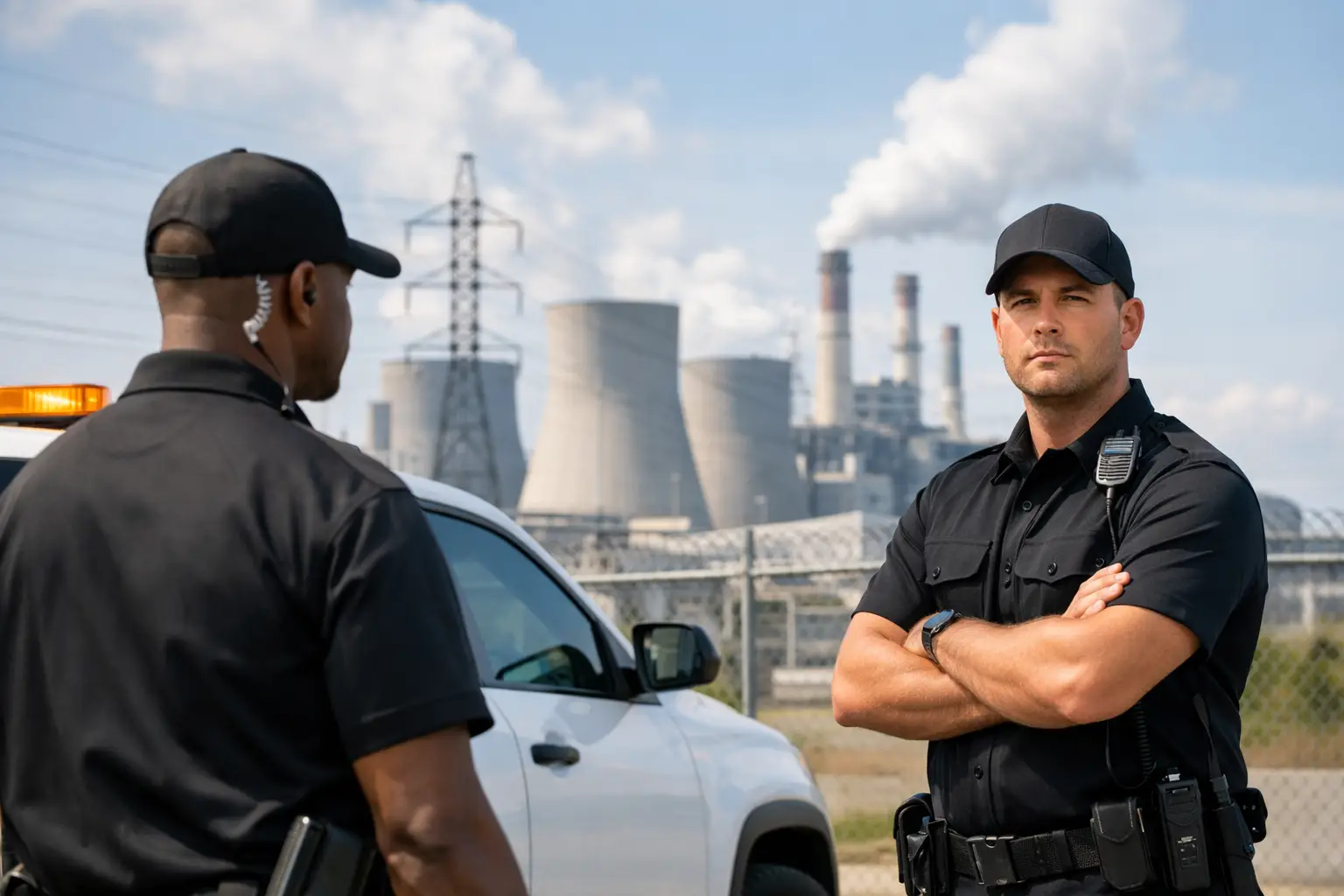
A forced gate, cut fence, or unauthorized vehicle at a power facility is not a routine guard-report issue. It can interrupt construction, expose energized equipment, delay restoration work, create a public-safety hazard, and trigger reporting obligations. Power plant security services must be built for that operating reality: visible deterrence, controlled access, lawful intervention, and documentation that stands up to internal review.
For utilities, generation operators, transmission owners, and contractors, the question is not whether security is present. The question is whether the person on site has the authority, training, communications, and site direction needed to act when conditions change.
Why Power Plant Security Services Require Sworn Officers
Power facilities face a distinct mix of threats. Copper theft, vandalism, trespass, attempted equipment access, protest activity, contractor disputes, and vehicle intrusion can all carry consequences far beyond property damage. A substation, switchyard, generation site, or temporary laydown yard may also have an open perimeter during active construction, multiple access points, changing work crews, and high-value material arriving after hours.
Conventional guard coverage can provide observation and reporting. That has a place in lower-risk settings. It does not always provide the immediate legal enforcement authority required when a trespasser refuses to leave, a theft is in progress, or an incident threatens crews and critical assets.
A licensed, insured, off-duty sworn law enforcement officer brings a different level of command presence. The officer can enforce laws, address criminal conduct directly, coordinate with responding agencies, and document the event from the first contact forward. That changes both deterrence and response. People deciding whether to breach a perimeter recognize the difference between passive observation and an enforcement-capable presence.
This is especially relevant when a site is isolated, carries a high threat profile, or cannot afford delay. An officer does not replace the facility's security plan, access procedures, or technical controls. The officer makes those controls enforceable in the field.
Security Coverage Should Match the Facility's Risk
There is no single staffing model for every power plant or electrical facility. A permanently staffed generation site may need gate control, visitor verification, vehicle screening, patrols, and coordination with plant management. A transmission project may need evening coverage around a material yard and equipment staging area. A substation undergoing expansion may need officers at the entrance during contractor arrival windows, then mobile patrol coverage after the workday ends.
The right deployment begins with operational questions: What assets are exposed? When is the site most vulnerable? Who is authorized to enter? What must occur before a visitor reaches controlled equipment? How quickly can a supervisor or utility representative be reached? These answers determine whether the assignment calls for a fixed post, vehicle patrol, overnight officer, or augmented camera coverage.
Fixed Posts and Access Control
A fixed sworn officer post is appropriate when every entry needs to be checked, when public interaction is likely, or when the site has a narrow access point that must remain controlled. The officer can verify credentials, maintain visitor logs, enforce delivery instructions, direct traffic, and intervene if an unauthorized person attempts entry.
For construction-heavy locations, access control also protects the work schedule. A late delivery, blocked gate, or unapproved vehicle can create safety conflicts during crane operations, excavation, or material placement. Security is part of keeping the site moving, not a separate function operating outside the project.
Patrols for Large or Remote Properties
Large generation campuses, storage yards, and transmission corridors often need patrol-based coverage. Marked or clearly identifiable officer presence can deter opportunistic theft and identify perimeter damage before it becomes an access point. Patrol duties should be defined around actual exposure, including gates, fence lines, fuel areas, spare-part storage, contractor parking, and isolated equipment locations.
Patrol coverage involves trade-offs. It covers more ground at a lower cost than multiple fixed posts, but an officer cannot be at every point at once. For sites with known intrusion routes or a critical gate, pairing patrols with remote monitoring or a fixed access post can close that gap.
Documented Response Supports Compliance and Recovery
A security program is only as useful as the record it creates after an event. Plant operators may need to show what happened, when it happened, who responded, what actions were taken, and whether the incident affected site operations. Clear reports also help support law enforcement follow-up, insurance claims, contractor accountability, and internal corrective actions.
Sworn officers should provide documented incident reporting aligned with the facility's escalation process. That may include trespass contacts, gate denials, suspicious activity, theft attempts, property damage, traffic incidents, welfare checks, and emergency notifications. The report should identify relevant times, locations, observations, actions, involved parties, and notifications made.
For sites operating under critical-infrastructure protection expectations, this documentation can support NERC CIP-014-related physical security planning and OSHA-related site safety requirements. Security providers should not present themselves as the compliance owner. The utility or facility remains responsible for its program. However, officer reports and documented incident footage can provide credible field evidence that procedures were followed and risks were addressed.
Cameras Extend Coverage, but They Do Not Replace Enforcement
Remote solar-camera networks are valuable at remote substations, material yards, and construction sites where 24/7 physical staffing at every location is not practical. Cameras can detect movement, preserve footage, support live monitoring, and provide dispatch information before an officer arrives.
Their limitation is straightforward: a camera sees and records. It does not physically control a gate, challenge an intruder, manage a confrontation, or secure a scene after a crime. For many locations, the stronger model is augmented protection: an on-site sworn officer during high-risk periods supported by remotely monitored cameras and 24/7 surveillance outside those windows.
That combination gives operators both visibility and response capability. It also allows the security plan to scale as project phases change. A site may need full officer coverage during equipment delivery and commissioning, then shift to camera-led monitoring with rapid officer response once the active work period ends.
Storm Response Requires a Different Security Posture
Storm restoration and outage work change site conditions quickly. Crews may be mobilized overnight. Temporary work zones may appear along public roads. Substations and staging yards can become active around the clock, often with limited lighting, heavy equipment traffic, and public frustration caused by outages.
In these conditions, security assignments should be ready to protect crews, manage access, support traffic enforcement, and keep unauthorized persons away from hazardous work areas. An officer provides real authority a cone or flagger cannot provide when motorists ignore a work zone or when members of the public attempt to enter a restricted area.
Rapid staffing matters. Grid Guard Protective Services can schedule statewide Georgia coverage with standard 72-hour lead times, 24/7 shift availability, and specialized officer staffing for planned projects and emergency conditions. For urgent needs, the operational goal is not simply filling a post. It is placing the right officer at the right location with clear instructions, verified contacts, and an established reporting chain.
What to Require From a Security Provider
Procurement teams should evaluate power plant security services as an operational capability, not a commodity labor purchase. The provider should be able to confirm officer credentials, insurance, supervisory structure, coverage geography, shift availability, reporting standards, and mobilization process before the assignment starts.
Ask how the provider handles an arrestable offense, a medical emergency, a utility representative who needs immediate access, a contractor arriving without authorization, and a camera alert after normal hours. The answers reveal whether the company understands critical-infrastructure conditions or merely supplies a uniformed presence.
The site instructions should also be specific. Officers need current access lists, restricted-area rules, emergency contacts, evacuation procedures, delivery protocols, patrol expectations, and escalation thresholds. A sworn officer brings legal authority, but clear post orders ensure that authority supports the facility's operating plan.
A power facility does not get a second chance to protect an exposed transformer, an outage crew, or a compromised perimeter. Establish coverage before the risk window opens, define what the officer is authorized to protect, and require documentation that gives operations leadership a clear record of every significant event.