
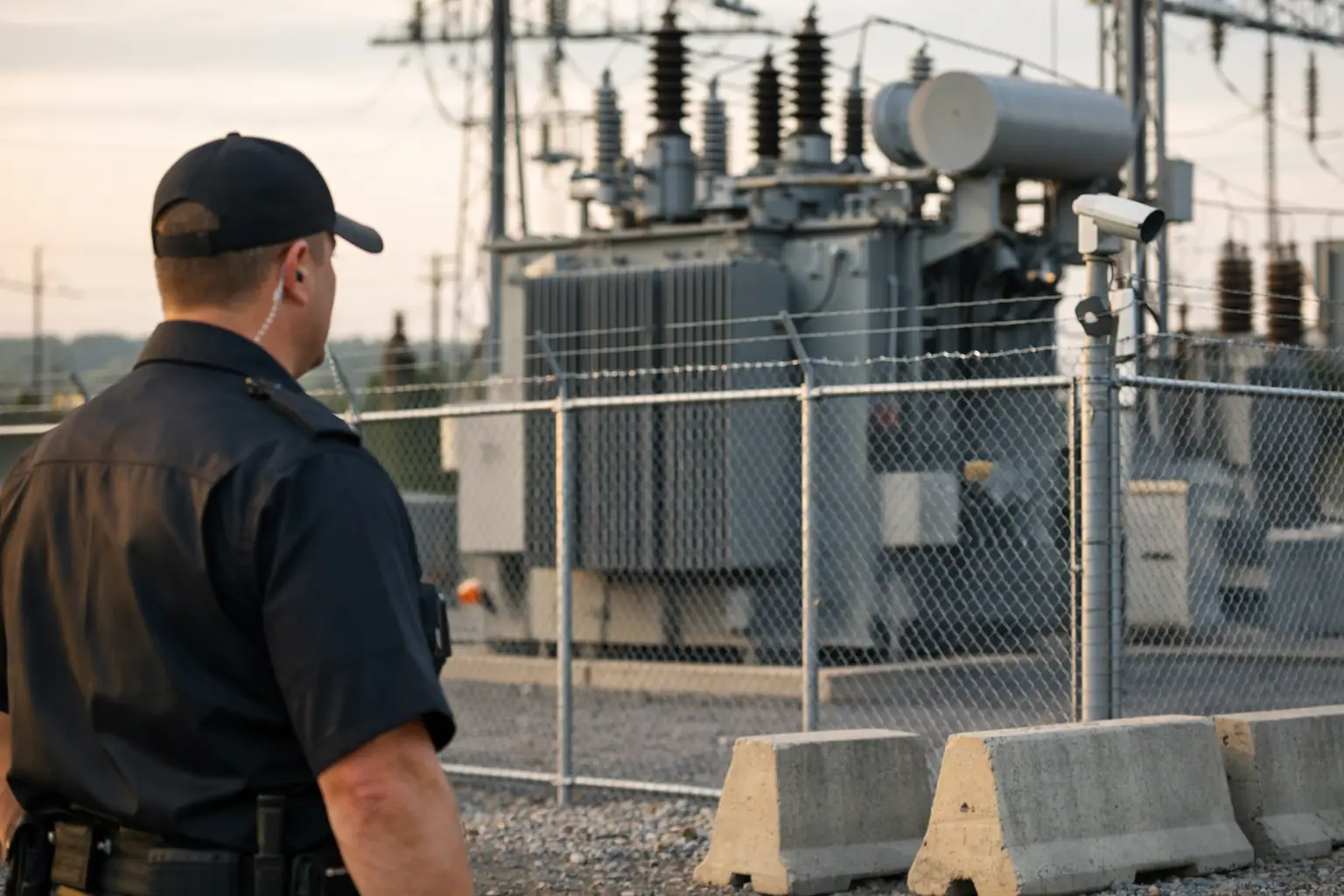
A damaged transformer enclosure is not a routine property-loss event. It can expose energized equipment, delay restoration, endanger crews and the public, and turn a targeted theft into an outage, environmental response, or reportable security incident. To prevent transformer site vandalism, utilities and contractors need more than a locked gate or an occasional drive-by. They need a security posture that makes unauthorized access difficult, visible, and immediately actionable.
Transformer sites are often attractive because they are remote, predictable, and temporarily unattended during construction, maintenance, or storm recovery. The same conditions that allow crews to work efficiently can give vandals time to cut fencing, breach cabinets, remove copper, damage controls, or enter restricted areas. Effective protection begins by treating these sites as operating assets with defined security requirements, not as vacant lots protected by hardware alone.
How to Prevent Transformer Site Vandalism With Layered Security
The strongest plans combine physical hardening, clear access control, visible enforcement, remote detection, and documented response. Each layer addresses a different failure point. A fence may slow entry, but it does not identify a trespasser. A camera may record an incident, but it may not stop a suspect who knows no one is responding. An on-site sworn officer provides legal enforcement authority and command presence, but that officer is more effective when site boundaries, lighting, and camera coverage support the assignment.
The right combination depends on the asset, its location, its outage consequence, nearby crime patterns, construction phase, and how long the site will be unattended. A rural temporary laydown yard requires a different posture than an energized substation near a high-traffic commercial corridor. Security should be scaled to the operational risk, not selected as a generic guard package.
Start with the points an intruder will actually use
Most site breaches are not random. Intruders look for a loose fence line, an obscured service gate, a blind side of the transformer pad, an unlocked equipment cabinet, or a period when normal work activity ends. A field assessment should identify those practical access routes before deciding where to place officers or cameras.
Examine vehicle gates, pedestrian entry points, adjacent rights-of-way, drainage crossings, vegetation cover, lighting failures, and the distance from public roads. Confirm whether contractors, delivery drivers, vegetation crews, and utility personnel have a controlled process for entering the site. If multiple people possess keys, codes, or gate credentials without a current authorization list, access control is already compromised.
Hardware still matters. Anti-climb fencing, tamper-resistant locks, protected hinges, secured control cabinets, marked restricted areas, and maintained lighting raise the time and effort required to breach the site. But hardening works best when it is inspected regularly. A damaged lock that remains unrepaired for a week sends a clear message that the site is not actively monitored.
Put real enforcement authority where risk is highest
A visible, on-site sworn law enforcement officer changes the decision-making environment for a potential trespasser. Unlike an unarmed guard, a sworn officer has legal enforcement authority to address trespass and criminal activity directly within the scope of the assignment and applicable law. That authority matters when suspects test boundaries, ignore instructions, or return to a location they believe has limited oversight.
Officer coverage is especially valuable during predictable high-risk windows: overnight shifts, weekends, shutdown periods, material deliveries, transformer replacement work, and storm restoration. It can also be placed at the site entrance to control access, verify credentials, protect crews, and document all unusual activity.
The assignment must be specific. An officer should receive the site map, restricted zones, approved personnel list, vehicle access process, emergency contacts, known hazards, and escalation instructions. At critical infrastructure sites, officers also need to understand that a suspicious person near a fence line may be a trespass concern, while a person attempting to access energized equipment may require an immediate life-safety and law-enforcement response.
Use cameras as detection and evidence, not decoration
Remote solar-camera networks can extend coverage across remote yards, construction sites, and temporary transformer locations where permanent power or communications are limited. Their value is not simply that they record video. Their value comes from active monitoring, rapid dispatch, audible deterrence when appropriate, and documented incident footage that helps establish what occurred, when it occurred, and how the response was handled.
Camera placement should cover the perimeter approach, gates, equipment pads, material storage, and likely escape routes. Avoid relying on one elevated camera pointed generally at the site. A wide image may show movement but fail to capture usable identifying detail, vehicle information, or the specific equipment being tampered with.
There is a trade-off. Cameras can provide continuous visibility at a lower cost than staffing every hour, but they do not replace immediate physical intervention. Sites with repeated theft attempts, high-consequence equipment, or active construction crews often need augmented protection: remote monitoring backed by an on-site sworn officer during the periods that present the greatest exposure.
Control Access During Construction, Maintenance, and Outages
Transformer vandalism risk frequently rises when the site is changing. Construction gates are left open for deliveries. Contractors rotate through different shifts. Temporary materials accumulate. Crews are focused on restoration timelines, not perimeter discipline. Those conditions can create opportunities even at sites with strong permanent security standards.
Set one clearly controlled entrance whenever operations allow it. Require sign-in procedures for contractors and visitors, and verify that vehicles entering the site have a legitimate work purpose. Credential checks should not become an obstacle to emergency restoration, but they should create a record of who was authorized to be present and when.
For planned projects, establish who owns gate control after regular work hours, who responds to alarms, and who can authorize access outside the approved schedule. For storm and outage conditions, designate an on-scene contact who can confirm arriving crews and vendors. Confusion at the gate creates delays for legitimate workers and cover for unauthorized people.
Material controls deserve the same attention. Copper, cable, tools, fuel, control components, and portable generators should not be left in exposed staging areas without a defined inventory and protection plan. Marked assets, secured storage, documented transfers, and end-of-shift checks reduce both theft opportunity and disputes about when a loss occurred.
Build a Response Plan Before an Incident Happens
The difference between a minor trespass and a costly event is often the response timeline. A plan should define who receives alarm notifications, who verifies the condition, who contacts law enforcement, who protects arriving utility personnel, and who preserves the scene if damage or theft is confirmed.
Do not rely on informal calls or a single supervisor's personal phone. Use a documented escalation sequence with primary and backup contacts. Include after-hours utility operations, site supervision, security leadership, and any contractor responsible for the affected equipment. During an active event, crews should not be sent into a potentially compromised transformer site without confirming hazards and law-enforcement conditions.
Documentation should capture time, location, responding personnel, observed conditions, access points, vehicle descriptions, photographs or footage references, and actions taken. This record supports internal review, insurance claims, criminal investigations, and security planning. It also helps operators show that physical-security decisions were made deliberately and maintained in line with site-specific compliance and safety expectations, including relevant NERC CIP-014 and OSHA-related requirements.
Measure Whether the Security Plan Is Working
A security plan should be adjusted using field information, not left unchanged because the fence looks intact. Track attempted entries, alarm activations, damaged hardware, recurring patrol observations, contractor access issues, response times, and locations where cameras repeatedly capture suspicious activity. Patterns often reveal whether the problem is a weak perimeter, inconsistent gate discipline, insufficient lighting, or a predictable coverage gap.
If attempts occur only after a crew leaves, shift officer coverage to the transition period and the first overnight hours. If activity concentrates along one fence line, improve visibility and camera detection there rather than adding equipment everywhere. If repeated false alarms consume response resources, correct the camera settings or environmental cause without reducing protection for genuine threats.
For Georgia utilities, contractors, and infrastructure operators, Grid Guard Protective Services can deploy licensed, insured, off-duty sworn officers statewide for scheduled coverage, rapid-response needs, and 24/7 shifts. Officer assignments can be paired with remotely monitored solar-camera networks to provide visible enforcement capability, dispatch support, and documented incident footage.
The practical goal is not to make a transformer site look guarded. It is to create a site where unauthorized access is harder to achieve, easier to detect, and met with a controlled response that protects equipment, crews, schedules, and the public.