
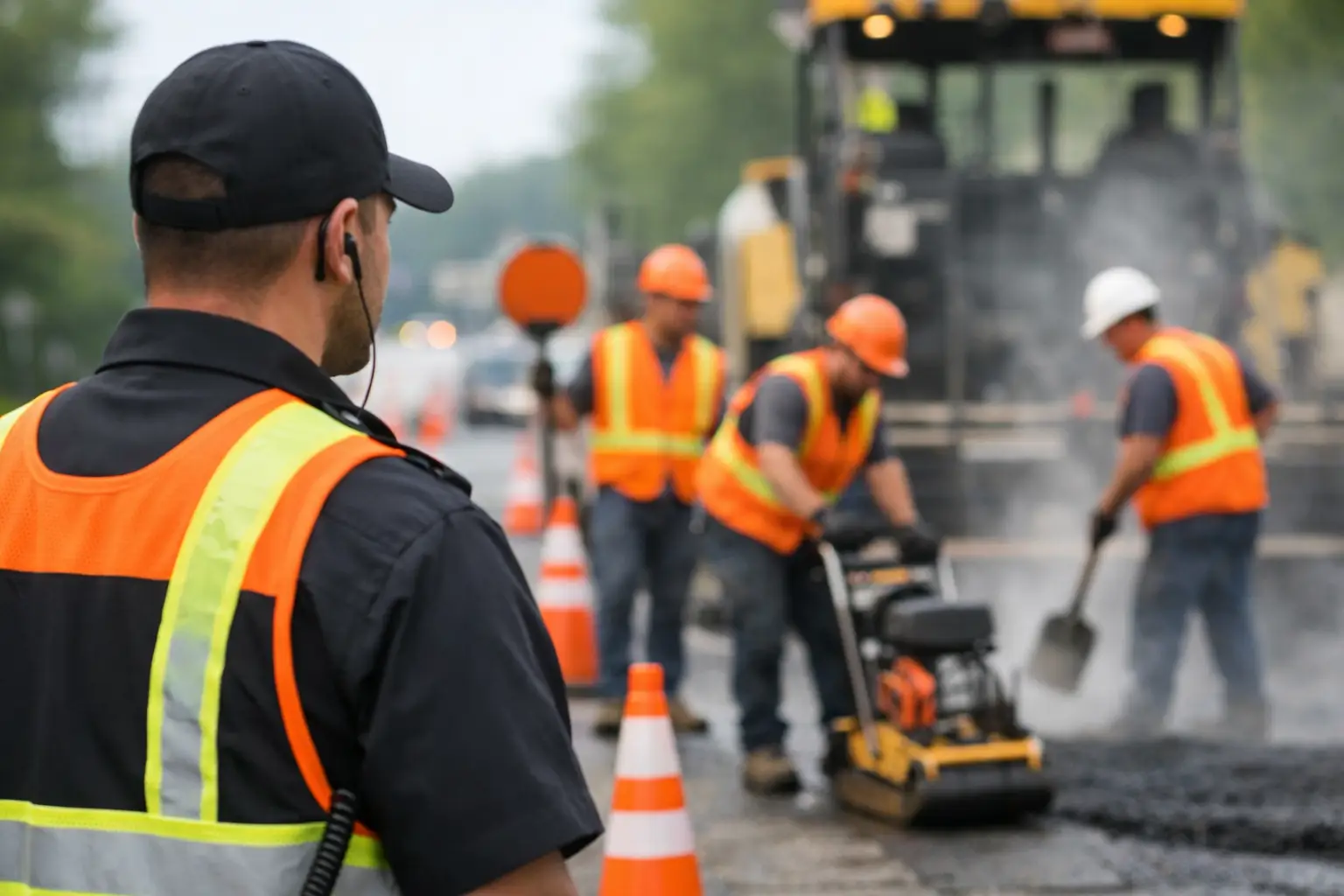
A lane closure can be installed correctly and still leave a crew exposed. Drivers make late merges, ignore reduced-speed signs, follow navigation apps into active work areas, or become aggressive when a closure affects their commute. To protect crews during roadwork, project leaders need more than cones, signs, and a traffic-control plan. They need visible authority at the point where public traffic meets people working on the roadway.
For utility contractors, public-works departments, municipalities, and infrastructure operators, work-zone protection is an operational control. It protects employees and equipment, keeps lanes available as planned, reduces disruption, and creates a documented response when unsafe or unlawful conduct occurs. A sworn, licensed, and insured law enforcement officer brings legal enforcement authority a cone or flagger cannot provide.
Why Roadwork Exposure Changes by the Minute
Roadwork is not a fixed security environment. Traffic density changes by the hour. A routine daytime closure can become more dangerous during a school dismissal, a sporting event, rainstorm, shift change, or unplanned detour. Night work adds impaired driving, reduced visibility, fatigue, and the challenge of identifying whether an approaching vehicle has recognized the taper or crew activity.
The risk also changes with the work itself. A short-duration utility repair may require a rapid setup on a busy arterial. A multi-day paving, excavation, or transmission project can create repeated exposure at access points, material staging areas, and lane transitions. Emergency outage work often begins before a full traffic-control deployment is in place.
That is why a work-zone plan should identify not only where signs and channelizing devices go, but also when enforcement-capable coverage is needed. The answer depends on traffic speed, road geometry, visibility, public behavior, crew size, duration, and the consequences of a stopped or delayed operation.
Put Sworn Authority Where It Has Operational Value
A sworn officer assigned to a work zone is not a substitute for compliant traffic-control devices, trained flaggers, or the contractor's safety program. Those functions work together. The officer's distinct role is to establish command presence, enforce traffic laws, respond to dangerous conduct, and address incidents without leaving the crew to manage a confrontation.
Positioning matters. An officer may be most effective upstream of the closure where drivers first encounter the reduction in available lanes. On other projects, the better placement is at a temporary access point, an intersection affected by detoured traffic, or a location where motorists have repeatedly entered a closed lane. For mobile operations, the coverage plan may need to move with the crew rather than remain at one static post.
Visible marked presence can change driver behavior before an officer takes enforcement action. When a motorist ignores the closure, drives recklessly, threatens personnel, or attempts unauthorized access, legal enforcement authority gives the site a direct response path. That authority is especially valuable where crews are working near live traffic with little room to retreat.
Build Protection Into the Pre-Shift Plan
Coverage works best when the officer receives a field-ready briefing before arriving at the post. A dispatch request that says only "roadwork security" leaves too much to interpretation. The project team should communicate the work zone's operating conditions, authority lines, and decision points.
Before each shift, confirm:
- the work location, closest cross streets, setup time, closure limits, and expected release time;
- the officer's post location, patrol area, safe parking position, and radio or phone contact with the superintendent or traffic-control lead;
- the planned traffic pattern, including detours, lane shifts, flagging stations, delivery entrances, and emergency-vehicle access;
- known hazards such as speeding complaints, prior intrusions, hostile motorists, poor sight distance, or a history of crashes; and
- escalation procedures for collisions, medical emergencies, impaired drivers, threats, media inquiries, and weather-related shutdowns.
This planning should also clarify what the officer is expected to document. A clear reporting standard helps the project manager distinguish between a normal delay, a safety near miss, an enforcement event, and a reportable incident that requires follow-up.
Protect Crews During Roadwork Without Slowing the Job
Some teams hesitate to request law-enforcement coverage because they assume it will add coordination or cost without improving production. The better question is what a single traffic incident, crew shutdown, or hostile-driver event could cost the project. Lost work hours, equipment exposure, missed utility restoration targets, injury investigations, and schedule penalties can quickly exceed the cost of planned coverage.
Still, coverage should be proportionate to the actual risk. A low-speed, fully separated work area may need periodic patrol support rather than a dedicated officer for every shift. A high-speed roadway, congested urban intersection, night lane closure, or emergency utility repair may justify continuous sworn-officer presence. This is not a one-size-fits-all decision.
The most efficient deployments match officer hours to the highest-risk windows. For example, a contractor may schedule coverage for setup, peak commuter periods, concrete pours, equipment moves, and demobilization rather than maintain the same posture throughout a long shift. For critical work zones, 24/7 coverage may be the appropriate control, particularly when barriers, equipment, or open excavations remain near public access after crews leave.
Documentation Is Part of Work-Zone Protection
A work-zone incident often produces questions long after the lane is reopened. Who was present? When did the unsafe behavior occur? What action was taken? Was the traffic-control setup intact? Did the event delay work or create a crew safety issue?
Sworn officers provide a disciplined chain of observation and reporting. Documented incident reports can support internal safety reviews, contractor coordination, insurance matters, municipal communication, and decisions about increasing coverage on future shifts. When an event warrants enforcement action, the officer can handle the matter within the scope of legal authority rather than asking site personnel to confront a driver or trespasser.
For sites with repeated exposure, documented incident footage can add another layer of accountability. Remotely monitored solar-camera networks can support an on-site officer by recording access activity, identifying recurring vehicle patterns, and maintaining awareness when the work zone is unattended. Cameras do not replace the immediate judgment and enforcement capability of a sworn officer, but the combined approach can be effective for extended projects, material laydown areas, and vulnerable overnight conditions.
Plan for Emergency and After-Hours Work
Storm restoration, water-main breaks, damaged poles, and unplanned utility outages do not wait for standard procurement timelines. In these conditions, crews may be dispatched onto roadways before daylight, with changing work limits and public frustration already elevated. The coverage provider must be able to mobilize quickly, understand the command structure, and operate safely around an evolving response.
Grid Guard Protective Services provides statewide Georgia coverage with licensed, insured, off-duty sworn officers for planned and emergency work-zone assignments. Standard planned coverage can be scheduled with a 72-hour lead time, while 24/7 shift availability supports projects that cannot pause when traffic conditions or weather change. Clear scope details allow the team to staff the appropriate post and provide a quote within 48 hours for planned requirements.
For emergency work, give dispatch the best available location, agency or project contact, anticipated duration, traffic conditions, and immediate threat level. The information may be incomplete at first. It is still enough to begin aligning officer coverage with the crew's real exposure while the site plan develops.
Measure Whether the Coverage Is Working
A work-zone officer should be treated as a measurable part of the project's safety and delivery plan. Review incident reports, driver violations, public complaints, response times, unplanned work stoppages, and changes in crew concerns. If dangerous entries continue at one point in the closure, repositioning the officer or adjusting the traffic-control setup may have more value than simply adding hours.
Field conditions should drive those decisions. Protection that worked for a weekday daytime closure may not work for Friday night paving or a storm response on a rural highway. Reassess after major schedule changes, phase shifts, traffic pattern changes, or any serious near miss.
The practical objective is straightforward: let qualified crews focus on the work in front of them while sworn professionals manage the public-facing risk around them. When enforcement presence, traffic control, communications, and documentation are aligned, the work zone is better prepared for the moment a driver does not do what the signs told them to do.