
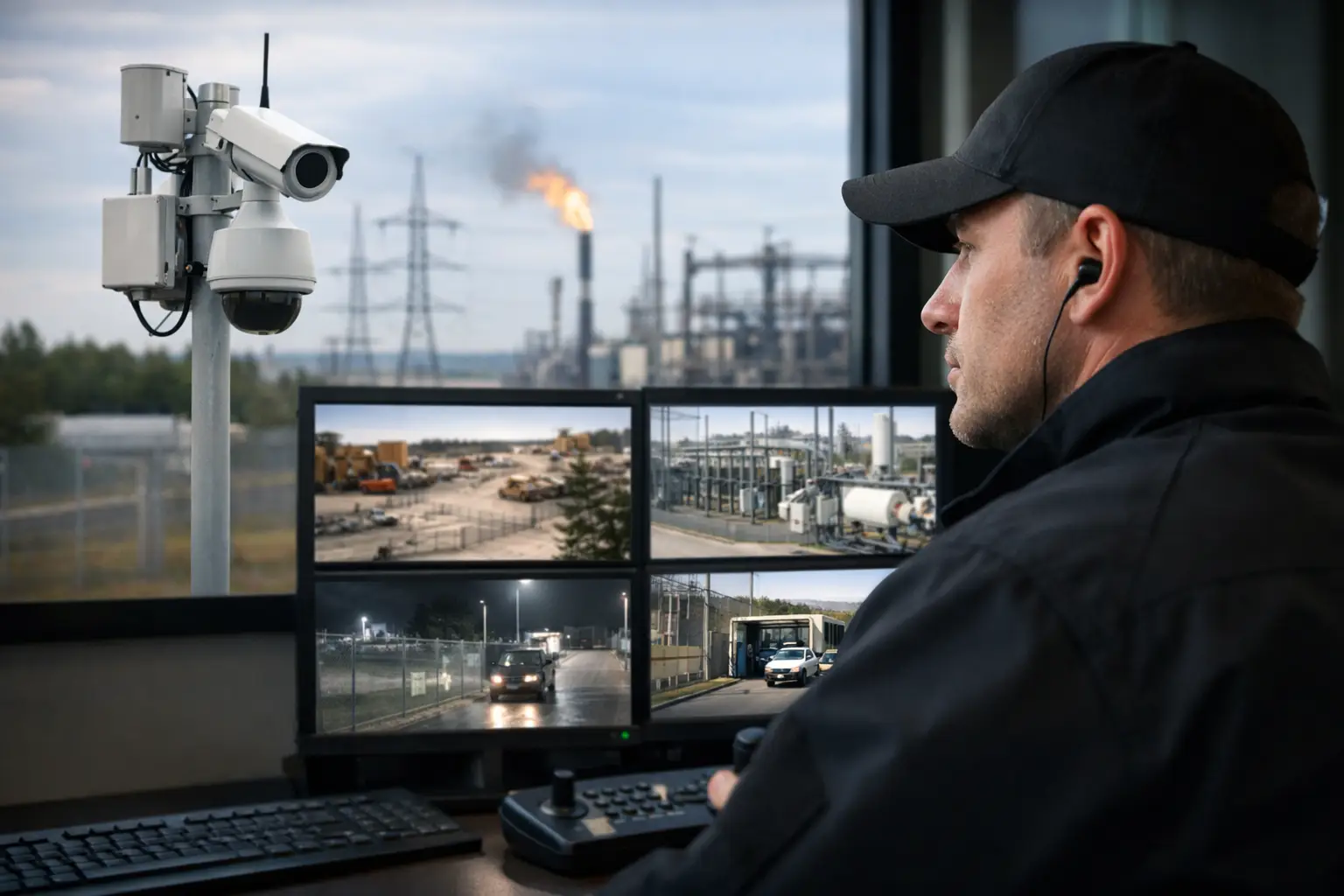
A camera that records a theft after the offender has left is evidence. Remote video monitoring is an operational security function designed to identify activity while there is still time to respond. For substations, transmission yards, utility construction sites, industrial facilities, and large commercial properties, that distinction affects asset loss, crew safety, outage exposure, and schedule control.
The right deployment does more than place cameras at a gate. It establishes continuous observation, verified alarms, documented incident footage, dispatch procedures, and a defined escalation path when trespass, vandalism, copper theft, or unsafe activity is confirmed. Where the risk requires authority on the ground, remote monitoring can be paired with a sworn, licensed, insured officer who can address criminal activity directly.
What Remote Video Monitoring Actually Does
Remote video monitoring connects field cameras to a live monitoring center staffed around the clock. When video analytics or motion detection flags activity, a trained operator reviews the live feed. The operator can determine whether the alert is a person entering a restricted yard, a vehicle approaching an unsecured access point, an animal, weather movement, or an authorized crew arriving for work.
That verification step is the difference between a camera system and a security response system. Unverified alerts can create alarm fatigue, unnecessary callouts, and a false sense of coverage. Verified activity allows the site owner or designated security lead to use a response plan based on the actual threat.
A typical response may include live audio warning, notification to a site contact, dispatch of on-site security, coordination with law enforcement, and preservation of video clips and incident details. The precise sequence should reflect the location, hours of operation, access rules, nearby public areas, and the consequences of unauthorized entry.
For critical infrastructure, the objective is not merely to collect footage. It is to reduce the time between detection, verification, and decisive action.
Where Remote Video Monitoring Fits Best
Remote monitoring is especially useful where the physical footprint is large, the site is intermittently occupied, or a fixed guard post does not provide full visibility. Utility yards with multiple fence lines, contractor laydown areas, remote substations, pump stations, material storage areas, and temporary construction zones often fall into this category.
It is also effective during predictable risk windows. Copper theft and vandalism frequently occur overnight, on weekends, during holiday closures, or while a project transitions between work phases. A monitored solar-camera network can maintain observation when crews are off site without requiring an officer at every camera location.
Storm and outage operations create another clear use case. Crews may be working extended shifts, equipment may be staged at temporary locations, and normal site controls may be disrupted. Monitoring supports command awareness by documenting access, observing equipment areas, and identifying unauthorized presence while operations personnel focus on restoration.
Remote coverage has limits. Cameras cannot physically secure a gate, stop a vehicle, conduct a lawful detention, direct traffic at an active work zone, or provide the command presence of a sworn officer. High-consequence sites and active incidents often require both capabilities: remote visibility to expand coverage and an enforcement-capable officer to respond on site.
Camera Placement Should Follow Risk, Not Convenience
A strong system begins with a site-specific assessment. Camera locations should be selected based on likely entry points, asset value, blind spots, traffic flow, lighting conditions, and the routes offenders would use to leave the property. Mounting cameras where installation is easiest can leave the actual exposure unobserved.
At a substation or transmission yard, priority areas commonly include vehicle gates, pedestrian access points, fence lines near public roads, transformer and control-house approaches, material storage, and any area with a history of intrusion. At a construction site, the plan may focus on equipment staging, fuel tanks, tool containers, temporary power, perimeter openings, and delivery access.
Solar-camera networks can be particularly valuable for remote locations where permanent power and communications are unavailable or impractical. However, solar equipment still requires planning. Trees, weather patterns, seasonal daylight, cellular signal strength, mounting security, and camera viewing angles all affect performance. A mobile unit positioned poorly is not a substitute for a properly designed coverage plan.
Monitoring rules must also distinguish authorized activity from suspicious activity. Provide current crew schedules, approved vendor lists, vehicle descriptions, access procedures, and escalation contacts. Without that information, a monitoring center cannot reliably separate a permitted contractor from an unauthorized person using the same entrance.
Build a Response Plan Before an Alert Occurs
The most common weakness in remote surveillance is not the camera. It is the absence of a clear response protocol. If an operator sees a person inside a restricted area at 2:00 a.m., the site should already define who is notified, who has authority to make decisions, and what happens if the person remains on site.
Response protocols should establish primary and secondary contacts, after-hours numbers, notification thresholds, dispatch instructions, and documentation requirements. They should also account for practical conditions such as severe weather, gate access, rural travel distances, and whether the property is open to the public during certain hours.
For Georgia utility, industrial, and municipal operations, a sworn-officer response changes the available options. A licensed, insured off-duty sworn officer has legal enforcement authority that a conventional unarmed guard does not. The officer can assess the situation in person, address trespass and criminal conduct directly, protect crews, and prepare professional incident documentation.
Grid Guard Protective Services uses this combined approach where conditions warrant it: remotely monitored camera coverage extends observation across the site, while on-site sworn officers provide the field presence, lawful authority, and response capability needed for higher-risk periods. This is especially valuable during outages, overnight construction, asset staging, and repeated trespass events.
Documentation Supports Security and Compliance Readiness
Documented incident footage has value beyond the immediate event. It can support internal investigations, insurance reporting, contractor accountability, law-enforcement follow-up, and reviews of recurring vulnerabilities. Time-stamped video, alert records, call logs, officer reports, and response notes create a defensible record of what occurred and how the site responded.
For facilities operating under NERC CIP-014-related physical security expectations, documentation should support a disciplined security posture. Remote monitoring does not independently satisfy every physical-security obligation, nor does a camera network replace site-specific risk assessment or established utility procedures. It can, however, provide useful evidence of perimeter observation, alarm review, incident escalation, and corrective-action follow-through.
The same principle applies to OSHA-related jobsite concerns. Video may help document access conditions, traffic movement, unsafe public intrusion, or incidents near active crews. It should complement, not replace, the site safety plan, competent supervision, barricades, traffic controls, and required work practices.
Retention standards matter. Decide how long footage will be stored, who can access it, how clips are exported, and how incident footage is preserved when a claim or investigation is possible. A site that loses relevant video because retention settings were never defined has not gained the full value of monitoring.
Questions to Resolve Before Procurement
Decision-makers should ask whether the provider offers live human verification or only automated alerts, whether monitoring is genuinely 24/7, and how quickly the provider can activate a new location. They should also confirm camera ownership, connectivity requirements, power options, maintenance responsibility, footage retention, and whether the system can be relocated as construction phases change.
Just as important, ask what happens after a verified threat. Is there an established dispatch process? Can the provider coordinate with the site’s designated contacts? Is sworn-officer coverage available for planned overnight work, repeated incidents, storm response, or a specific high-risk window? A security plan is only as credible as its response capability.
For scheduled deployments, confirm lead times early. For urgent events, identify the emergency contact and the information needed to mobilize quickly: exact location, access instructions, operating status, known threats, site map, and the responsible field contact. Clear intake information shortens the distance between a security decision and coverage on the ground.
The best remote monitoring program is not judged by the number of cameras on a site. It is judged by whether the right people see the right activity soon enough to protect assets, crews, and operations when it matters.