
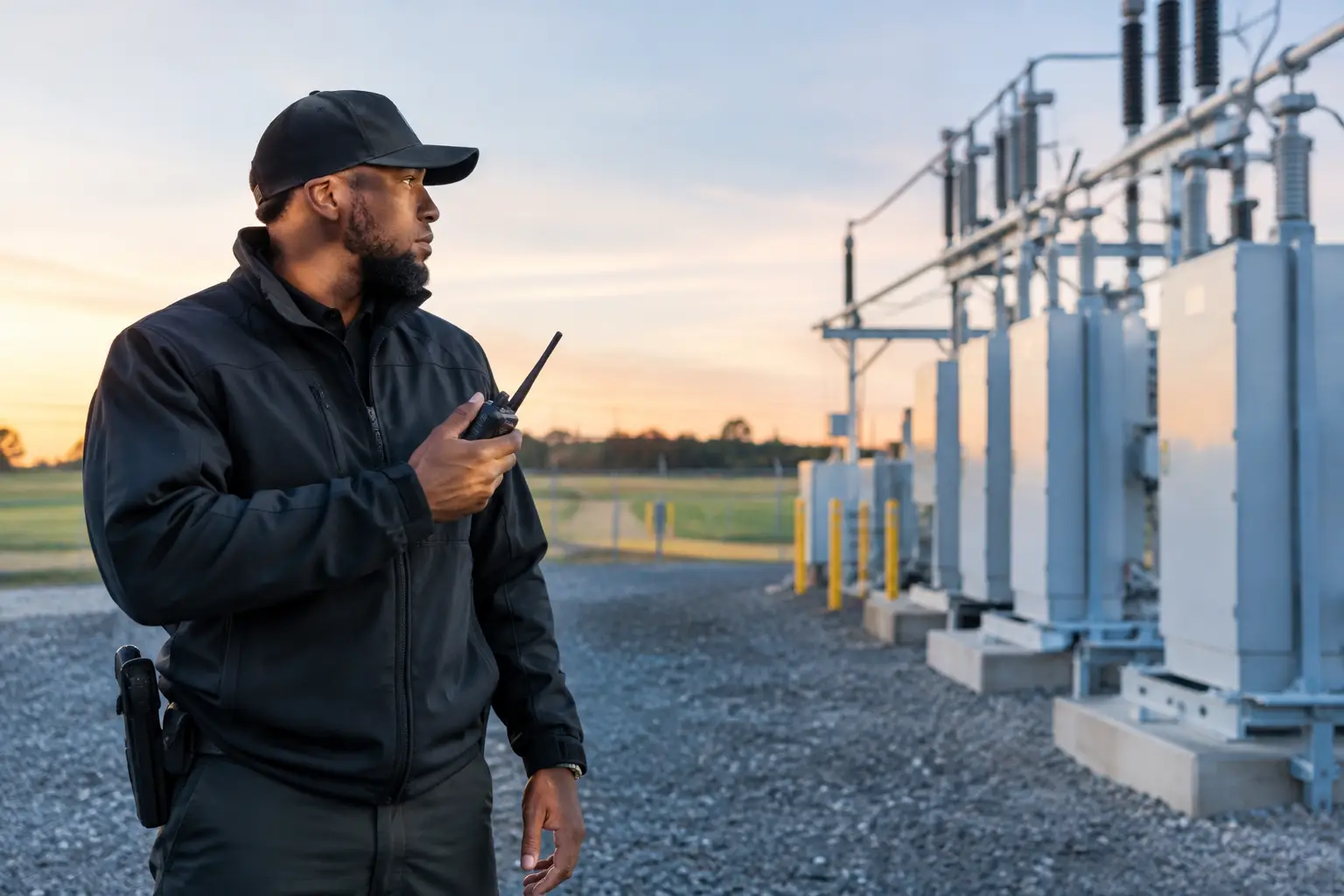
A storm outage can turn a controlled utility site into an exposed work zone within hours. Gates stay open longer, crews rotate through unfamiliar locations, damaged fencing goes unrepaired, and mobile equipment, copper, fuel, and tools become easier targets. To secure equipment during outages, utilities and contractors need an enforcement-capable plan that protects the site while allowing restoration work to move without delay.
The objective is not simply to place someone at a gate. Outage security must establish control over access, deter theft and trespass, support crew safety, preserve incident evidence, and give site leadership a documented record of what occurred. For critical infrastructure, that standard calls for licensed, insured, off-duty sworn law enforcement officers who can take direct action when a security condition becomes a criminal matter.
Why Outages Create Equipment Security Gaps
Normal site security is built around predictable operations. An outage changes that operating environment. Contractors may arrive before daylight, mutual-aid crews may be unfamiliar with the property, staging areas may be added quickly, and equipment may be placed in locations that are not normally occupied or monitored.
That activity creates opportunity for unauthorized access. A person approaching a yard at night may claim to be a contractor, a delivery driver, or part of a restoration crew. Without a defined credentialing and access process, personnel at the gate are left to make judgment calls under pressure. That is not a reliable security control when transformers, cable reels, switchgear, fleet vehicles, generators, and fuel assets are on site.
Copper theft and vandalism also carry consequences beyond replacement cost. Damage to grounding systems, control cable, fencing, or operating equipment can extend restoration timelines, expose crews to hazards, and require additional inspections before equipment can return to service. A delay measured in hours can become a significant operational and public-safety issue.
The right coverage level depends on the site, its location, the type of outage, available perimeter controls, asset value, and public visibility. A small, secured facility with limited crews may need periodic documented patrols. A substation, transmission yard, storm staging area, or active utility construction site may require a sworn officer on site around the clock.
Secure Equipment During Outages With Controlled Access
Access control is the first operational requirement. During restoration, the site must remain open enough for authorized work while still excluding everyone else. That balance is difficult to maintain with cones, temporary signage, or an unarmed presence alone.
A sworn officer provides legal enforcement authority at the entry point. The officer can verify credentials, record contractor and vehicle information, direct traffic, challenge unauthorized persons, and address trespass or criminal activity directly. This creates a clear chain of control for a site that may otherwise have multiple crews, vendors, inspectors, and deliveries moving through the same entrance.
Before coverage begins, the site lead should provide the security team with a current authorized-personnel list, approved vendor information, work areas, equipment locations, restricted zones, emergency contacts, and escalation instructions. This does not need to become a lengthy administrative exercise. It needs to be current, usable, and shared with the officer assigned to the post.
For larger outage operations, separate access lanes can reduce confusion. One lane can serve credentialed utility and contractor crews, another can be reserved for material deliveries, and visitors can be directed to a controlled check-in point. The goal is to keep restoration traffic moving without allowing an unknown vehicle to enter simply because the gate is busy.
Keep a Record of Who Entered and Why
A written access log establishes accountability after a shift change or incident. It should capture the time of entry and exit, driver or crew lead, company, vehicle identification, reason for access, and any exceptions approved by site leadership.
This record is particularly valuable when equipment is discovered missing or damaged. It helps narrow the timeline, supports internal review, and provides law enforcement with usable information if an investigation follows. Documentation also supports compliance-minded operators that must show reasonable physical security controls around critical assets.
Protect the Perimeter and the Equipment Inside It
A locked gate is only one layer of protection. During an outage, security should account for weak points created by temporary staging, damaged barriers, open laydown areas, and limited lighting. A field assessment at the start of coverage helps identify where an intruder is most likely to approach and which equipment presents the greatest theft or sabotage value.
The officer should understand the patrol route, blind spots, camera locations, emergency exits, and locations where crews are working after dark. High-value items should be grouped where practical, placed inside the most controlled portion of the site, and marked for easy verification during patrols. Equipment left outside the primary fence line deserves special attention.
For sites with repeated nighttime exposure, an on-site sworn officer can be paired with remotely monitored solar-camera networks. The combination adds visible command presence, 24/7 surveillance, dispatch support, and documented incident footage. Cameras expand visibility across a broad yard; an officer provides the immediate judgment and legal authority required when an alarm, suspicious vehicle, or trespass event requires intervention.
This model is not a substitute for sound site controls. Cameras require deliberate placement, reliable communication, and clear escalation procedures. But when used with an officer who knows the site and the restoration plan, they create stronger coverage than passive monitoring or patrol checks alone.
Build Security Into the Outage Response Plan
Security is most effective when it is assigned before a storm or planned outage exposes the site. Waiting until equipment disappears, a crew is threatened, or trespass becomes routine puts the operation into a reactive position.
A workable response plan identifies the sites that require priority coverage, anticipated shift schedules, activation contacts, local command structure, access requirements, staging areas, and conditions that trigger expanded protection. It should also define how the security officer communicates with the outage manager, safety lead, and dispatch center.
For planned work, schedule coverage early enough to align officer briefing, site access, and shift turnover with the construction or restoration schedule. For storm conditions, use a provider that can staff 24/7 shifts and operate statewide, not only in a narrow local market. Grid Guard Protective Services deploys licensed, insured, off-duty sworn officers across Georgia for scheduled and rapid-response assignments, with standard 72-hour lead times and emergency coordination for changing field conditions.
Give Officers Clear Escalation Authority
An officer should not have to guess whether to stop a vehicle, remove an unauthorized person, call site management, request additional law enforcement support, or document a safety concern. These decisions should be addressed in the post orders and site briefing.
Clear escalation protocols protect the client as much as the officer. They establish who has authority to approve exceptions, who receives after-hours reports, and when an incident moves from a site-level issue to a law-enforcement response. They also keep supervisors informed when a condition could affect restoration schedules or crew safety.
Use Documentation That Supports Operations and Compliance
During an outage, verbal updates disappear quickly between changing shifts and competing priorities. Written reports create continuity. At a minimum, security documentation should identify officer arrival and relief times, patrol activity, access-control exceptions, suspicious activity, incidents, corrective actions, and communications with site leadership.
For critical infrastructure operators, documentation should align with the organization’s physical security and incident-reporting expectations, including relevant NERC CIP-014 considerations and OSHA-related site safety requirements. The purpose is not paperwork for its own sake. It is evidence that the site had defined controls, trained personnel, active observation, and a documented response when conditions changed.
Documented incident footage can strengthen that record when cameras are deployed. It may help validate timelines, preserve vehicle descriptions, support insurance claims, and provide evidence for criminal cases. The footage is most useful when the security provider has an established process for retaining, reporting, and delivering it to authorized stakeholders.
Avoid the False Economy of Passive Coverage
Outage operations are expensive. That can make low-cost security options attractive, especially when staffing is needed quickly. But passive coverage has limits. A flagger can direct vehicles. An unarmed guard can observe and report. Neither brings the legal enforcement authority of a sworn officer when an unauthorized person refuses instructions, a theft is in progress, or a disturbance threatens crews.
The proper solution still depends on the risk. Not every location needs the same level of security. The decision should reflect asset criticality, criminal activity in the area, crew exposure, site layout, duration of the outage, and consequences of a delay. Where those factors are high, sworn-officer coverage is an operational safeguard, not an optional add-on.
When restoration pressure is highest, security should make the site easier to run: known people entering through controlled points, equipment accounted for, crews protected from interference, and incidents documented before they become delays. That is the standard worth setting before the next outage puts critical assets in the open.