
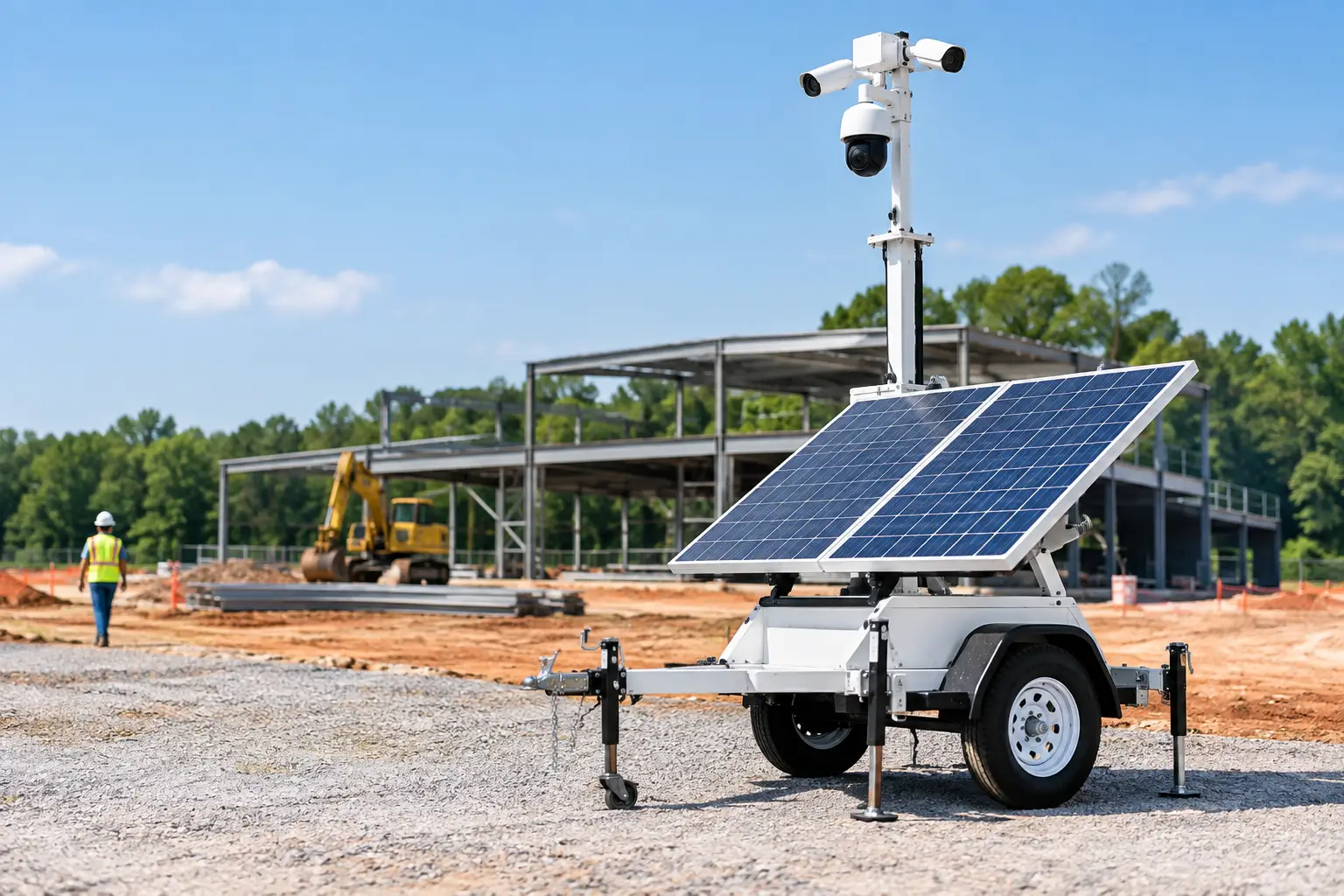
A substation expansion, transmission laydown yard, or utility work zone can become exposed the moment crews leave for the day. Copper theft, fuel loss, vandalism, unauthorized entry, and unsafe after-hours activity do not wait for a guard schedule. Solar camera trailers extend visibility across remote and temporary sites without requiring permanent power or communications infrastructure.
For Georgia utilities, contractors, industrial operators, and municipal teams, the value is not simply a camera on a pole. It is the ability to document conditions, identify an intrusion early, preserve incident footage, and direct the right response before a security problem becomes a delay, claim, outage, or public-safety event.
Where Solar Camera Trailers Fit Best
Solar camera trailers are mobile surveillance units that typically combine solar panels, battery storage, elevated cameras, cellular communications, lighting, and remote monitoring capability. They are particularly useful where a fixed camera system would take too long to install, where utility power is unavailable, or where the risk moves as a project advances.
Their strongest use cases are not limited to vacant sites. They support active utility construction, temporary material yards, pipeline work, storm restoration staging, industrial expansion, municipal projects, and large commercial properties awaiting occupancy. A trailer can be positioned at a gate, along a perimeter break, near high-value materials, or at the entrance to a work zone where after-hours vehicle activity needs to be documented.
Placement matters. A camera trailer aimed only at a gate may record entry but miss the equipment row, fuel tanks, or copper storage area that creates the highest loss exposure. Before deployment, site leadership should identify the assets that would disrupt operations if damaged or removed, the likely approach routes, blind areas, and the response path if an alarm is verified.
What a Camera Trailer Can and Cannot Do
A properly specified trailer creates persistent observation. It can provide live views, motion alerts, recorded video, audible warnings, lighting, and documented incident footage. With active remote monitoring, trained personnel can assess an alert, issue a warning where appropriate, notify designated contacts, and request law-enforcement response when conditions require it.
That is a meaningful improvement over unmonitored cameras that merely capture evidence after a loss. But a trailer is not a physical barrier, and it does not carry legal enforcement authority. It cannot conduct a traffic stop, remove a trespasser, secure a breach, direct arriving crews through a hazardous scene, or make an arrest. The best deployment plan recognizes that distinction.
For lower-risk, well-contained sites, remote surveillance may provide the coverage needed between operating hours. For high-consequence sites, repeated intrusion activity, exposed critical infrastructure, or projects with valuable materials and crews working around the clock, the stronger model is layered protection. Remote monitoring identifies the issue; an on-site sworn officer provides visible deterrence, legal authority, and direct field response.
Solar Camera Trailers and Critical Infrastructure
Critical infrastructure security requires more than general property monitoring. A transmission yard, substation perimeter, or utility construction site may carry operational, safety, regulatory, and public confidence consequences that exceed the value of the physical property involved.
Camera coverage can support a documented security posture by creating time-stamped records of perimeter activity, visitor movement, gate conditions, and incident response. Those records can help site managers investigate theft or vandalism, support insurance reporting, establish a timeline after an event, and maintain documentation aligned with internal security procedures and NERC CIP-014-related planning expectations.
The footage is only as useful as the operating process behind it. Decision-makers should establish who receives alerts, who has authority to approve a response, where incident reports are sent, and how video is retained. A camera system without clear escalation can turn a verified event into an unanswered email or a delayed phone call.
This is especially important during storm and outage response. Restoration yards can appear quickly, shift locations, and hold transformers, cable, fuel, tools, and specialized equipment in open or partially secured areas. Solar-powered units can be deployed without waiting for permanent site services, while sworn officer coverage can be scaled for overnight protection, access control, and rapid field response.
How to Plan a Productive Deployment
Start with the operational problem, not the number of trailers. A project may need one unit at a constrained entry point, while a long linear construction site may require several positions or a combination of cameras and officer patrols. The goal is to cover the exposure that creates real schedule, safety, or loss consequences.
A site assessment should account for terrain, vegetation, trailer sightlines, lighting conditions, cellular signal, traffic patterns, and the locations of critical assets. It should also consider routine changes. A trailer placed correctly during initial grading may lose its view once material stacks, equipment, fencing, or structures move into the frame.
Define the response protocol before the unit arrives. Name the contacts for routine alerts and emergency escalation. Set expectations for alarm verification, warning procedures, notification timing, law-enforcement dispatch, and incident reporting. If an on-site officer is part of the plan, establish radio or phone coordination between remote monitoring, project supervision, and the officer so the response is controlled rather than improvised.
Finally, review performance. If alerts are frequent but not actionable, the camera position or detection settings may need adjustment. If a recurring trespass route is identified, the answer may be a barrier repair, different trailer location, scheduled officer coverage, or a combination of all three. Security should adapt to what the site is showing you.
Selecting Solar Camera Trailers for the Field
Procurement should focus on capability and operating accountability rather than a generic equipment specification. Confirm the expected camera coverage, night performance, recording duration, cellular reliability, solar and battery capacity, remote-monitoring process, maintenance responsibility, and response documentation. Ask what happens when weather, heavy cloud cover, site dust, vandalism, or a communications interruption affects the unit.
For infrastructure and construction work, it is also useful to confirm deployment timing, relocation procedures, service coverage across the project footprint, and who is responsible for reviewing footage after an incident. A vendor that can deliver equipment but cannot provide clear escalation procedures may leave the site team carrying the response burden.
The right answer also depends on the threat. A remote rural laydown yard may prioritize long-duration power and wide-area coverage. A dense urban work zone may need cameras that document vehicle entry, public interaction, and equipment movement without creating unnecessary blind spots. A high-risk copper-theft location may require visible trailers, active monitoring, hardened access controls, and sworn officer presence during the hours of greatest exposure.
When to Add a Sworn Officer
Camera trailers are a force multiplier, not a replacement for enforcement-capable security. Add a sworn officer when the site has a credible history of theft or trespass, valuable assets that cannot be exposed, active crews working overnight, confrontational access-control conditions, or a need for immediate on-site decision-making.
An off-duty sworn officer can address criminal activity directly within legal authority, provide visible command presence, manage access, coordinate with responding agencies, and produce clear incident documentation. That distinction matters when a verified intrusion is occurring now, not when video is reviewed the next morning.
Grid Guard Protective Services combines licensed, insured, off-duty sworn law enforcement officers with remotely monitored solar camera networks for Georgia sites that need both visibility and direct response. Coverage can be planned for scheduled construction activity or rapidly organized around outages, storm restoration, and changing site conditions.
The most effective security plan is the one that matches the actual exposure: cameras where visibility is the gap, sworn officers where enforcement and field control are required, and documented procedures connecting both. When the site changes, the protection plan should change with it.