
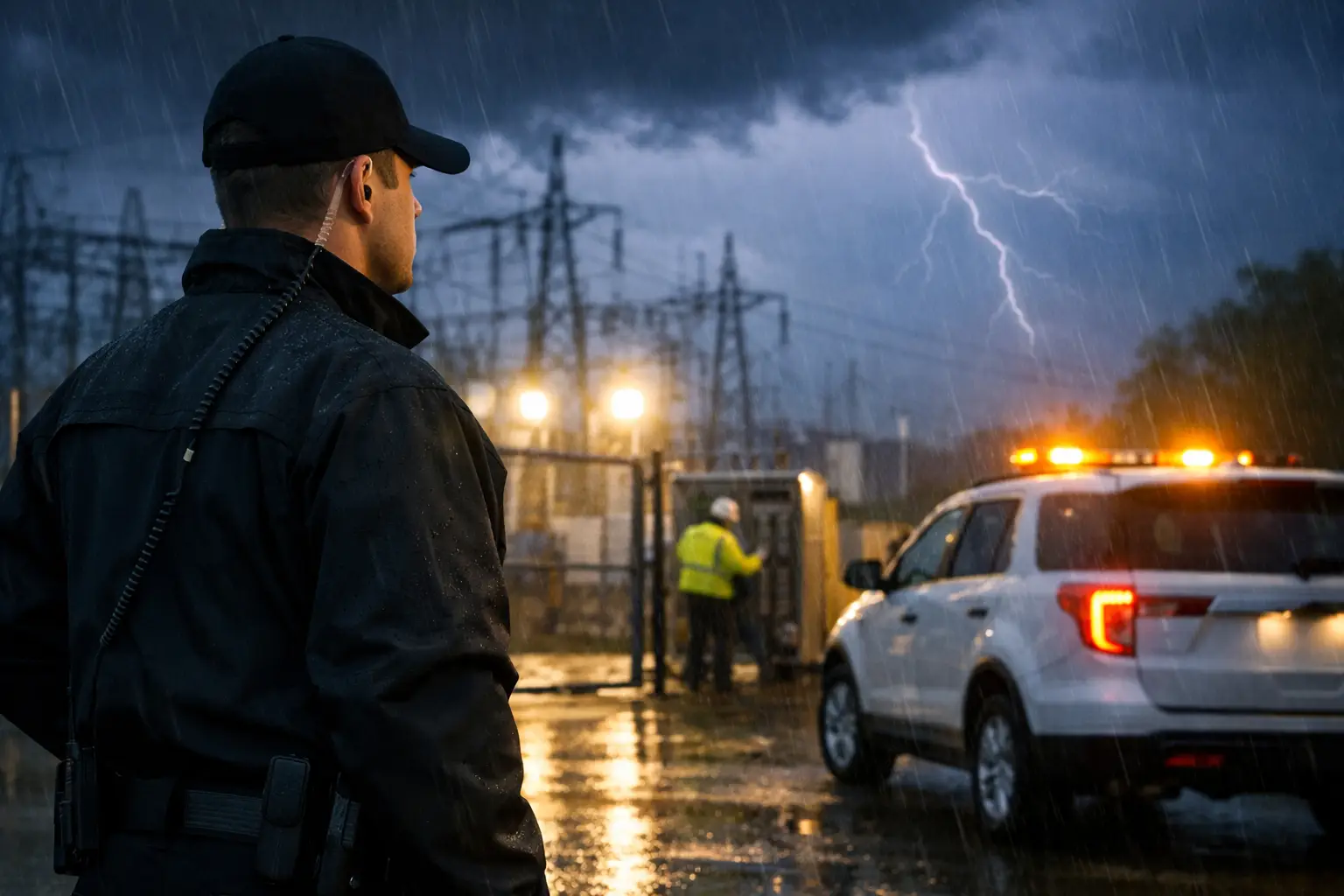
A storm outage security response begins before the first repair truck reaches the site. Once power is down, normal access controls change fast: gates are left open for crews, contractors arrive from multiple jurisdictions, equipment is staged in exposed areas, and public attention increases. Those conditions create an immediate security and safety problem alongside the restoration problem.
For utilities, transmission operators, contractors, and public-works teams, the objective is not simply to place a body at a gate. The objective is to maintain controlled access, protect critical assets and crews, manage traffic risks, and document what occurred while the operational picture changes by the hour. That calls for sworn, licensed, insured officers with legal enforcement authority, not passive observation.
Why Outage Conditions Change the Security Mission
Storm damage creates opportunities for trespass, theft, vandalism, and unsafe public behavior. A substation that is normally quiet may receive line crews, tree contractors, fuel deliveries, equipment operators, utility representatives, inspectors, and mutual-aid personnel in a single shift. At the same time, damaged fencing, impaired lighting, standing water, and limited communications can weaken the site controls relied on during normal operations.
Copper theft and equipment theft are especially serious during extended outages. Material may be staged near a work zone, vehicles may be parked overnight, and crews may move between locations with little notice. An unsecured transformer yard, pole yard, mobile command post, or laydown area can become a target before an operations team has time to establish a normal perimeter.
The public-facing risk is just as real. Drivers may enter closed work zones looking for a route around debris. Residents may approach restoration crews seeking information. Unauthorized people may enter a restricted area to inspect damage, take photographs, or retrieve property. A sworn officer can give lawful direction, address trespass and criminal conduct directly, and request additional law-enforcement support when conditions warrant. A cone or flagger cannot provide that authority.
Build the Storm Outage Security Response Around Operations
Security coverage must follow restoration priorities, not a fixed guard-post model. The most useful plan identifies the sites, functions, and decision points that require officer presence as conditions develop. It should be created with outage operations, safety, field supervision, and security leadership at the table.
Protect the locations that affect restoration
Priority locations usually include substations, transmission yards, switching locations, damaged distribution facilities, equipment staging areas, fuel points, contractor check-in locations, and overnight crew accommodations. The correct order depends on the outage. A widespread transmission event may require immediate substation coverage, while a local distribution event may place greater emphasis on traffic control and protection of mobile crews.
Do not assume every site needs the same post order. Some locations need continuous access control. Others need mobile patrols, scheduled checks, or coverage during deliveries and shift changes. Matching officer assignments to the actual risk controls cost without leaving high-consequence assets exposed.
Establish a single access-control standard
During mutual-aid operations, different companies may use different badges, vehicle markings, work orders, and dispatch channels. Without a defined site-entry process, crews lose time and unauthorized individuals can blend into legitimate activity.
Field leadership should establish who can authorize access, what identification is accepted, how visitors are logged, and what occurs when credentials cannot be verified. Officers need current contact names and a clear escalation path. When a gate is opened to support restoration, someone must still own the decision to allow entry.
A practical standard also distinguishes between employees, approved contractors, delivery drivers, government personnel, media, and members of the public. The purpose is not to slow restoration. It is to make fast entry decisions defensible and consistent.
Keep traffic enforcement separate from gate coverage
A site officer cannot effectively control access while also standing a half-mile away at a blocked intersection. Storm deployments often fail when one assignment is expected to cover too many functions.
Work-zone traffic enforcement should be staffed based on the roadway hazard, traffic volume, visibility, and crew exposure. Sworn officers bring real authority to lane closures, detours, moving equipment, and impatient drivers. Gate and perimeter posts should remain focused on access control, asset protection, and incident response.
What Sworn Officers Bring to an Outage Site
Conventional contract security may be appropriate for low-risk observation duties, but storm conditions often demand more. A sworn officer has legal enforcement authority and command presence that changes how trespassers, aggressive drivers, and unauthorized visitors respond.
That authority matters when the site is unstable. Officers can intervene when someone refuses lawful direction, preserve the scene after theft or vandalism, coordinate with responding agencies, and prepare incident documentation that supports follow-up action. Their role also gives site managers a designated security professional who can communicate clearly with field supervisors and public-safety partners.
This does not mean every outage requires an officer at every location around the clock. It means the staffing decision should reflect the consequence of unauthorized access, the value and criticality of assets, the presence of crews, and the likelihood of public interaction. A remote rural laydown yard may need overnight patrols and monitored cameras. An urban substation with active restoration work may require continuous sworn-officer coverage.
Use Documentation as an Operational Control
During an outage, memory is not a record. Shift changes happen quickly, site conditions evolve, and decisions made at 2:00 a.m. may be reviewed days or weeks later. Security documentation should show who was present, what was observed, what action was taken, and when site leadership was notified.
Useful documentation includes access denials, trespass warnings, traffic incidents, suspicious vehicles, damaged barriers, equipment deliveries, law-enforcement contacts, and any disruption to crews or restoration activity. It should be factual, time-stamped, and aligned with the utility's reporting process.
For critical infrastructure, documented incident footage can strengthen this record. Augmented protection that combines an on-site sworn officer with remotely monitored solar-camera networks gives the operation both a physical response capability and a reviewable visual record. Cameras extend observation across wide or difficult terrain; they do not replace an officer when a person must be directed off-site, a perimeter breach requires investigation, or crews need immediate support.
Documentation can also support security planning tied to NERC CIP-014 and OSHA-related infrastructure expectations. Security vendors should not make blanket compliance claims for an owner’s program. They should provide the records, assignment accountability, incident reports, and field discipline that help the owner demonstrate that protective measures were planned and carried out.
Plan Mobilization Before the Forecast Becomes an Emergency
The best time to source storm coverage is before severe weather is imminent. Once a major event is underway, decision-makers are competing for officers, lodging, vehicles, fuel, and communications support. Pre-event planning gives both the customer and provider time to confirm locations, post instructions, shift lengths, staging arrangements, and points of contact.
A procurement-ready provider should be able to state its officer credentials, insurance status, coverage geography, scheduling expectations, and documentation process clearly. Standard coverage may be arranged with a 72-hour lead time, while emergency conditions require a direct discussion about available personnel, priority sites, and response windows. Promising a response without confirming the operational requirement creates false confidence.
Grid Guard Protective Services deploys licensed, insured, off-duty sworn law enforcement officers across Georgia for planned and emergency infrastructure coverage, including 24/7 shifts. For outage leaders, the practical question is not whether security is needed. It is where an enforcement-capable officer will protect the restoration effort most effectively in the next operational period.
Give the Security Team a Clear Field Brief
Every deployed officer should receive a site-specific brief before taking post. The brief should identify restricted areas, known hazards, authorized contacts, vehicle and badge expectations, emergency routes, radio or phone procedures, traffic-control limits, and the conditions that require escalation.
It should also define the officer’s authority within the operation. Officers protect the site and support safe restoration, but they should not be asked to make engineering decisions or direct specialized utility work. Clear boundaries prevent confusion while keeping security integrated with operations.
A storm can damage lines, roads, fences, schedules, and communications in a matter of hours. It does not need to damage accountability. When access is controlled, crews are protected, incidents are documented, and sworn officers are positioned where risk is highest, restoration teams can keep their attention on returning service safely.