
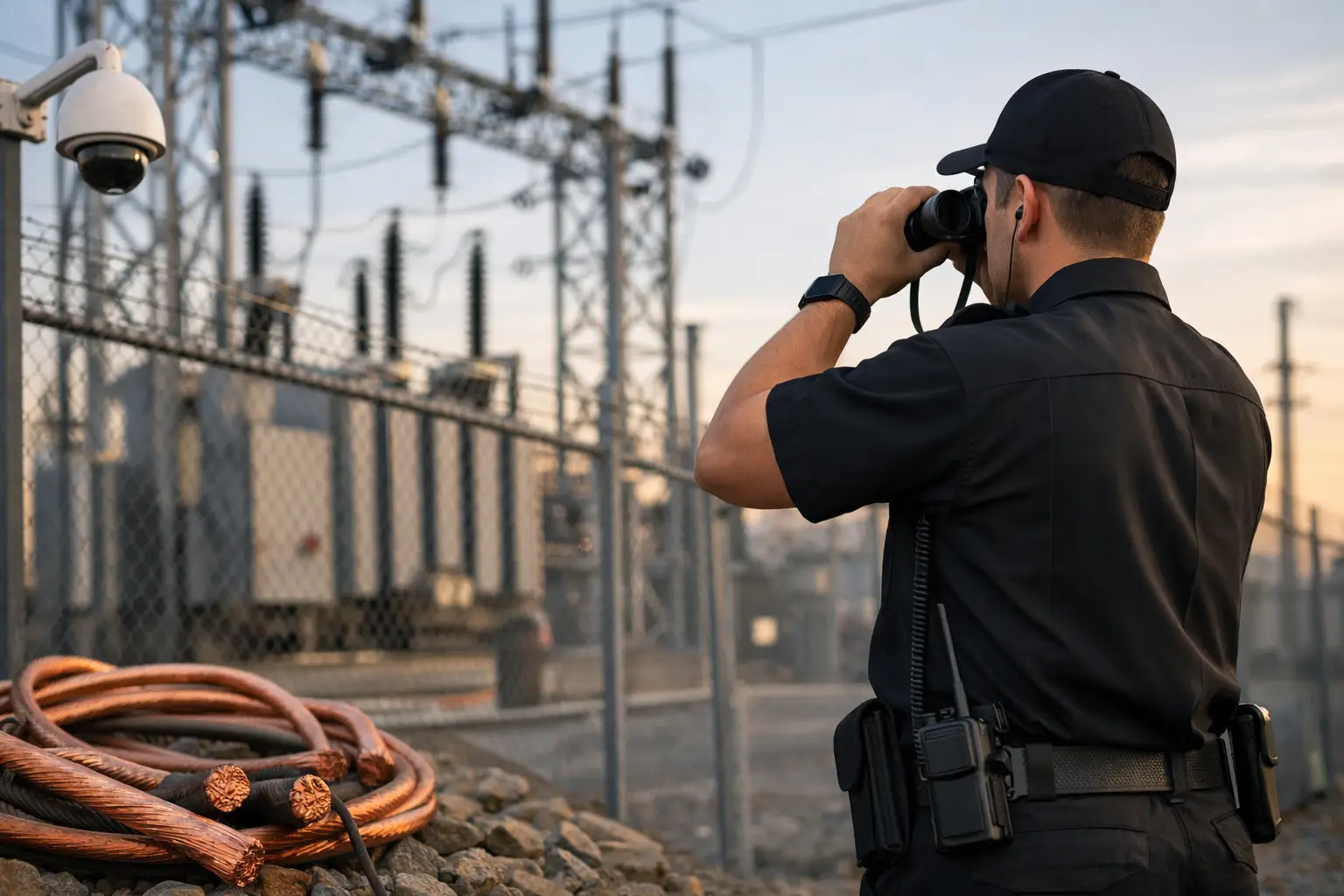
A cut perimeter fence, a disabled camera, and a missing grounding conductor are not ordinary property-loss issues. At a substation, copper theft can expose crews and the public to lethal electrical hazards, delay restoration work, compromise equipment, and create an outage risk that far exceeds the scrap value of the metal. Effective substation copper theft prevention is therefore an operational security function, not a patrol checkbox.
For utilities, transmission operators, and contractors, the objective is clear: make unauthorized entry difficult, make criminal activity visible quickly, and ensure a sworn officer or responding agency can take lawful action before thieves reach energized or safety-critical components. The right approach depends on site location, asset configuration, construction phase, historical incidents, and response time from local law enforcement. It should also produce documentation security, operations, safety, and compliance teams can use.
Why Copper Theft Requires a Different Security Plan
Copper theft at electrical infrastructure is rarely a random act of vandalism. Offenders may scout access points, observe shift changes, look for blind camera zones, and return when a site appears unstaffed. Remote substations, transmission yards, laydown areas, and active utility construction sites can be especially exposed after dark, during weekends, and during storm recovery when crews and equipment are spread across multiple locations.
The direct replacement cost is only part of the loss. Stolen grounding material, control wiring, bus components, or transformer-related copper can force inspections, rework, testing, and outage coordination. A damaged fence or gate can leave the site open for the next intrusion. If a thief enters an energized area, the incident can become a fatality, an emergency response event, or a public-safety exposure.
Generic guard coverage may create a visible presence, but presence alone does not always resolve a trespass or criminal act. A licensed, insured, off-duty sworn law enforcement officer brings legal enforcement authority, command presence, and the ability to address unlawful entry directly within applicable law and agency policy. That distinction matters when an incident is active and every minute affects asset protection and crew safety.
Build Substation Copper Theft Prevention Around Layers
No single camera, lock, or patrol route will secure every substation. The strongest plans combine physical hardening, detection, a defined response path, and disciplined records. Each layer should cover the failure points of the others.
Start with the site and the theft path
Assess the site as an offender would. Identify where someone can park without being seen, cut fencing, enter through a service gate, approach copper-bearing equipment, and leave with material. Review adjacent roads, wooded approaches, drainage corridors, abandoned structures, and properties that create concealment.
Then examine the basics that are often overlooked after maintenance activity or storm work: gate latches, fence ties, vehicle gates, signage, exterior lighting, lock control, and camera sightlines. A good assessment also accounts for legitimate site traffic. Crews, vendors, inspectors, and emergency personnel need a controlled way to enter without turning access control into a delay during critical work.
Asset prioritization should be specific. Not all copper presents the same operational consequence. Identify components whose removal could create a grounding hazard, disable controls, interrupt commissioning, delay energization, or require a specialized replacement. Security staffing and camera coverage should concentrate on those areas first rather than treating the entire perimeter as equal risk.
Make detection actionable
Remote cameras and intrusion alerts are valuable only when someone monitors them, verifies the event, and has a defined escalation process. An unreviewed alert at 2:00 a.m. is evidence after a loss, not prevention.
Augmented protection pairs an on-site sworn officer with remotely monitored solar-camera networks, 24/7 surveillance, dispatch, and documented incident footage. The camera network extends observation across fence lines, equipment pads, gates, and vehicle approaches. The officer provides immediate on-site judgment and a lawful enforcement-capable response when suspicious activity, trespass, or attempted theft is confirmed.
This model is particularly useful where permanent power or communications are limited, or where a temporary construction site needs protection before its final security systems are installed. It also allows coverage to scale. A high-risk period may call for continuous officer presence; a lower-risk location may benefit from scheduled patrols supported by monitored cameras. The decision should follow the threat and operational consequences, not a one-size staffing formula.
Control access without slowing the work
Copper theft prevention can fail when sites are busy. Construction personnel may prop gates open, subcontractors may arrive outside planned hours, and material deliveries may occur during low-visibility periods. Access procedures must be practical enough that crews will follow them.
Use a clear authorization process for workers, vehicles, and deliveries. Require vendors to identify a site contact before entry. Maintain visitor and vehicle records during active projects, and immediately report missing badges, keys, locks, or gate codes. When the site is under officer coverage, the officer can verify access, keep an arrival and departure record, and challenge unauthorized persons before they reach sensitive areas.
For large construction or storm-restoration operations, assign protected staging areas for reels, grounding materials, tools, and spare components. The most attractive material is often not behind the substation fence. It may be in a laydown yard, on a trailer, or staged near an open work zone. Security planning should follow the material through delivery, storage, installation, and removal of scrap.
Plan the Response Before an Alarm Occurs
A credible response plan answers simple field questions in advance: Who receives an alarm? Who verifies it? Who can dispatch? Who contacts utility operations? Where do responders stage? What must be preserved for investigation? Without those answers, personnel lose time making calls while an intrusion develops.
The plan should distinguish between suspicious activity, confirmed trespass, attempted theft, equipment damage, and an emergency involving an energized area. Response personnel must understand site-specific hazards and never pursue a suspect into an electrical hazard zone. Security exists to protect people as well as property.
Sworn officer coverage provides a defined point of accountability at the site. Officers can conduct visible patrols, inspect gates and fencing, challenge unauthorized access, coordinate with local agencies as appropriate, and document observations and incidents. For a recurring problem location, patrol timing should vary. Predictable rounds can be observed and avoided by repeat offenders.
Rapid coverage also matters after a theft attempt. A damaged perimeter can invite another entry before repairs are complete. Temporary officer deployment and mobile camera support can protect the location while utility teams inspect, repair, and restore normal controls. Grid Guard Protective Services provides statewide Georgia coverage, 24/7 shift availability, and scheduled or rapid-response sworn officer staffing, with standard planned deployments typically arranged on a 72-hour lead time.
Documentation Supports Operations, Claims, and Compliance
After an intrusion, the quality of documentation affects more than a police report. Operations needs to know what was observed and when. Safety teams may need records of hazards, damaged barriers, and site access. Risk and legal teams may need incident footage, officer logs, photographs, and a clear account of notifications and response actions.
Documented incident footage and officer reporting establish a usable timeline: detection, dispatch, arrival, contact, site condition, evidence preservation, utility notification, and turnover. This can support internal investigations, insurance claims, contractor accountability, and corrective action planning.
For facilities with NERC CIP-014-related physical security considerations, security documentation should align with the organization’s own risk assessment and procedural requirements. An officer staffing provider does not replace a utility’s compliance program, but complete field records can strengthen the evidence that physical-security controls were actively deployed, monitored, and reviewed. The same discipline supports OSHA-related site safety expectations by recording access issues and unsafe conditions observed during coverage.
Match Coverage to the Real Risk Window
Full-time coverage is not automatically the right answer, and neither is a camera-only approach. A staffed urban substation with strong police proximity may need targeted overnight coverage after a local theft pattern. An isolated transmission yard with repeated perimeter breaches may justify a more sustained combination of sworn officers and monitored surveillance. A construction site may need heightened protection only during material delivery, overnight storage, and energization milestones.
Review incident history, local scrap-theft activity, asset value, repair lead times, response distance, and the cost of an interruption. Then set coverage around the periods when access is easiest and the consequence of delay is highest. Reassess after storms, schedule changes, contractor transitions, or any perimeter compromise.
The most effective security posture is the one that makes a thief’s window of opportunity too visible, too short, and too risky to exploit while keeping authorized crews moving safely. That is the standard a substation protection plan should meet every shift.