
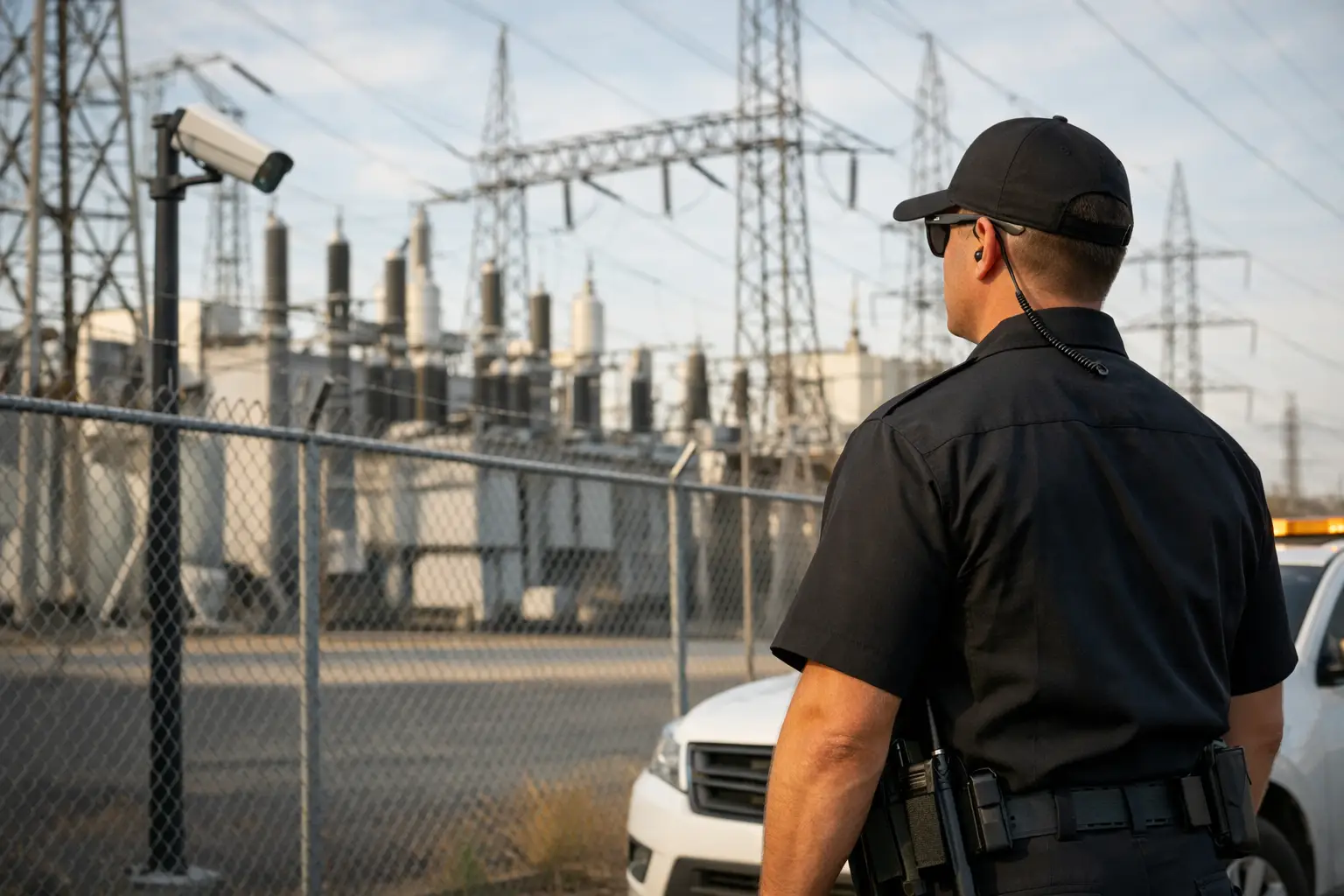
A cut perimeter fence, an open gate, or a truck parked where it does not belong can become an outage, an injured employee, or a delayed restoration effort. Substation security is not simply a guard at a gate. It is an operational control that protects high-value equipment, keeps unauthorized people away from energized assets, and gives site leadership a documented response when conditions change.
For utilities, transmission operators, and contractors, the right coverage depends on the site, the threat, the work underway, and the consequence of interruption. A remote rural substation facing repeated copper theft needs a different plan than a transmission yard receiving daily contractor traffic or a storm-damaged site awaiting repairs. The common requirement is clear: security personnel must be able to recognize risk, act within their authority, and document what occurred.
Why Substation Security Requires Enforcement Capability
Substations are attractive targets because they concentrate valuable materials and essential equipment behind a perimeter that may be lightly staffed or unattended for long periods. Copper theft, vandalism, dumping, trespass, and unauthorized vehicle access can create more than a property-loss claim. They can damage transformers and control equipment, introduce electrical hazards, interrupt planned work, and place restoration schedules at risk.
A conventional unarmed guard may observe, report, and request assistance. That model can be appropriate for low-risk access monitoring, but it has limits at a critical-infrastructure site. When an intruder refuses to leave, attempts to enter a restricted area, threatens personnel, or damages property, delayed law-enforcement involvement can allow the incident to escalate.
Sworn, licensed, insured off-duty law enforcement officers bring legal enforcement authority and command presence to the assignment. They can address trespass and criminal activity directly, coordinate with responding agencies, preserve the initial facts of an incident, and apply local knowledge to a situation that is moving quickly. Their presence also changes the calculation for opportunistic theft and unauthorized access. A marked, staffed perimeter is a stronger deterrent than passive signage or an unattended camera pole.
This is not an argument that every substation requires a full-time officer. Security should follow risk. The question is whether the site can accept the operational and safety consequences of a delayed response if someone defeats the perimeter or interferes with work.
Build Coverage Around the Site's Actual Exposure
An effective substation security plan begins with conditions on the ground, not a generic post order. Site leaders should identify where people enter, which assets are most exposed, when crews are present, and what activity is normal during each shift. That information determines officer position, patrol route, camera placement, access-control procedures, and escalation protocol.
Perimeter and access points
Fences, gates, vehicle entrances, pedestrian access points, and adjacent roads deserve close attention. A locked gate is only effective if someone verifies who is entering and leaving. During construction, maintenance outages, and equipment deliveries, access patterns can change by the hour. An officer stationed at the right entrance can verify credentials, manage vehicle flow, prevent tailgating, and keep unauthorized visitors from reaching the work area.
The plan should also address secondary entry points. Theft crews often avoid the main gate and approach through damaged fencing, easements, wooded boundaries, or neighboring parcels. Patrols should vary in timing and route rather than becoming predictable.
High-risk periods
Many incidents occur when staffing is reduced: overnight, weekends, holidays, shift changes, and during severe weather. Storm response creates a separate exposure. Crews may be working under pressure, equipment may be staged in temporary locations, and public curiosity can bring vehicles and pedestrians near hazardous areas.
Security coverage during these periods protects more than materials. It helps keep the public outside controlled zones, supports orderly crew access, and gives operations a reliable point of contact if conditions deteriorate. Twenty-four-hour shifts may be warranted during active restoration, prolonged construction, repeat theft activity, or an identified threat. For a lower-risk location, scheduled patrols and remote monitoring may provide a more proportionate answer.
Contractor and visitor control
Substation work often involves multiple employers, delivery drivers, inspectors, utility personnel, and specialty contractors. Without a defined access process, a site can become vulnerable to unauthorized entry disguised as normal work activity.
Officer coverage should align with the site's approved-access process. That can include checking identification against a roster, confirming the purpose of entry, recording vehicle details, directing visitors to a designated staging area, and notifying the site contact when an exception arises. The officer should not replace the utility's access authorization process. The officer enforces it consistently at the field level.
Cameras Extend Visibility, but They Do Not Replace a Response
Solar-camera networks, remote monitoring, 24/7 surveillance, and dispatch can extend coverage across a large or remote property. They are especially useful where fixed power or communications are limited, where multiple perimeter areas require observation, or where a site needs documented incident footage for investigation and insurance purposes.
Camera coverage works best when it is part of a response plan. A camera can detect movement and preserve footage. It cannot physically stop a vehicle at a gate, separate a trespasser from energized equipment, or manage a confrontation. The value comes from verified alerts, clear escalation instructions, and a capable responder who can reach the site.
Augmented protection combines an on-site sworn officer with remotely monitored solar cameras. This model gives the officer greater situational awareness across the property while preserving a real enforcement presence at the point of access. It can be particularly useful for larger transmission yards, construction staging areas, and substations with recurring after-hours activity.
There are trade-offs. Camera placement must account for blind spots, vegetation, lighting, weather, communications reliability, and the distance between the alert and the officer's position. A useful security assessment tests these practical limits before an incident exposes them.
Documentation Supports Operations and Compliance
A security event is only partly resolved when the immediate threat ends. Utility and site leadership may need a clear record for internal review, law-enforcement follow-up, insurance, contractor management, and compliance obligations. Vague shift notes do not provide the same value as time-stamped, fact-based reporting supported by documented incident footage when available.
Officer reports should record the relevant facts: arrival and departure times, patrol activity, access issues, suspicious persons or vehicles, actions taken, notifications made, and any enforcement activity. Reporting should be objective and usable by people who were not at the site when the incident occurred.
For covered facilities, physical-security planning may intersect with NERC CIP-014 expectations. The exact obligation depends on the facility and the responsible entity, and officer staffing does not replace a utility's required assessments, plans, or compliance program. It can, however, support the execution of site controls by documenting access activity, observed vulnerabilities, incidents, and corrective actions. The same discipline supports OSHA-related jobsite expectations when officers are managing access around active construction or hazardous work areas.
Set Clear Deployment Expectations Before Coverage Begins
Security fails when responsibilities are assumed instead of assigned. Before the first shift, the utility, contractor, or site manager should provide the officer team with a current site map, authorized-contact list, access rules, emergency procedures, boundaries of responsibility, and instructions for incident escalation. The officer should know who can approve entry, who receives after-hours notifications, and when an issue requires immediate law-enforcement action versus site-management follow-up.
A usable deployment plan should establish four items:
- The post location, patrol area, shift schedule, and relief process.
- Authorized vehicles, personnel, contractors, and delivery procedures.
- Emergency contacts, radio or phone protocols, and incident-escalation thresholds.
- Reporting requirements, including daily activity logs and documented incident footage when cameras are deployed.
Planned coverage should be scheduled early enough to confirm staffing, site instructions, and insurance requirements. Emergency conditions are different. A provider with statewide Georgia coverage, 24/7 shift availability, and a defined rapid-response process can support outage restoration and urgent site protection when normal planning windows disappear. For routine assignments, Grid Guard Protective Services can generally arrange sworn-officer coverage with 72-hour lead times and provide quotes within 48 hours, subject to location and assignment needs.
Measure Security by What It Prevents and Proves
The best security program is not judged only by arrests or incident counts. A quiet site may indicate that deterrence, controlled access, and visible enforcement are working. Performance should also be measured through practical indicators: access violations stopped before entry, response times to alerts, completion of patrols, recurring perimeter issues identified, quality of reports, and continuity of coverage during critical work.
Review those records with operations and safety leadership. If an officer repeatedly encounters an unsecured gate, an unlit boundary, unclear contractor rosters, or vehicles bypassing the designated entrance, the finding should produce a correction. Security is most effective when it identifies weaknesses early enough to prevent a larger event.
A substation can be unmanned without being unprotected. Match sworn enforcement, surveillance, access control, and documentation to the site's real exposure, then give the security team the authority, instructions, and communication path needed to act before a threat becomes an outage.