
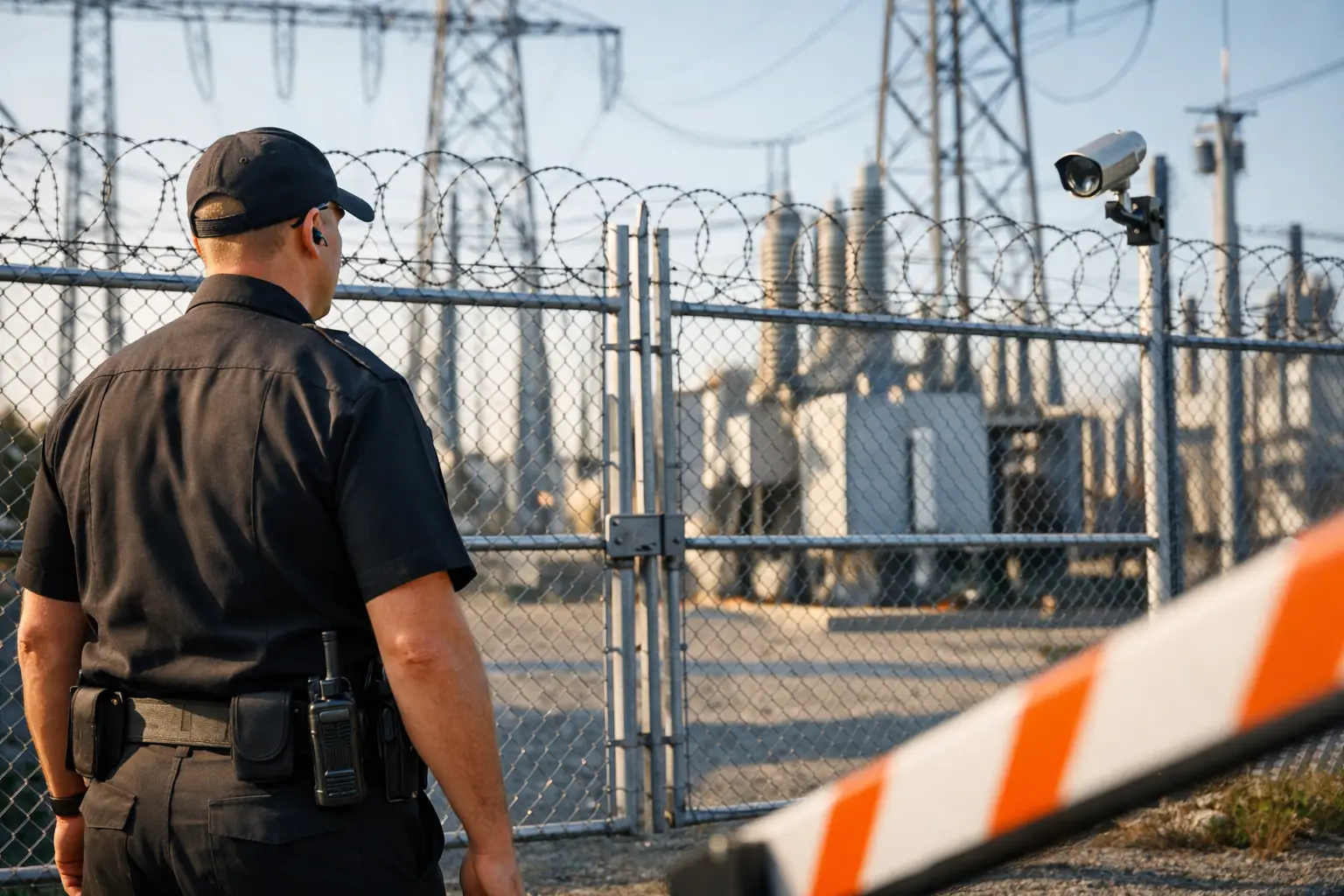
A breached fence at a transmission yard is not a routine security issue. It can become a copper-theft investigation, an energized-equipment hazard, a delayed restoration event, or a regulatory documentation problem before the next shift arrives. Effective transmission yard trespass prevention is built around early detection, a lawful response, and records that show exactly what occurred and how the site responded.
For utility and transmission operators, the objective is not simply to make intrusion more difficult. The objective is to prevent unauthorized access from affecting personnel safety, asset availability, construction schedules, outage work, or compliance obligations. That requires more than passive patrols, signage, or a camera system that only captures evidence after the loss.
Why Transmission Yards Attract Trespass Risk
Transmission yards create a distinct security environment. Their footprint may be remote, lightly staffed, accessible from public roads, and surrounded by fencing that receives limited day-to-day inspection. They also contain high-value materials, specialized tools, vehicles, control equipment, and infrastructure that can be dangerous to anyone who enters without authorization.
Not every trespass event is an organized theft attempt. Some involve curiosity, shortcutting through a site, vandalism, dumping, or people seeking shelter. Others are deliberate attempts to remove copper, cut grounding conductors, steal tools, or gain access to equipment. The response plan must account for each possibility without treating all activity as the same type of threat.
A conventional unarmed guard can observe and report. A sworn, licensed, insured law enforcement officer can address unlawful entry with legal enforcement authority, establish control at the scene, and coordinate directly with local agencies when escalation is necessary. That distinction matters when the person at the gate is testing limits, refusing to leave, or has already committed a criminal act.
Transmission Yard Trespass Prevention Starts at the Perimeter
The perimeter is where prevention becomes measurable. A transmission yard should have a clear answer to four questions: Where can someone enter? How will the site detect it? Who responds? What documentation is created?
Fencing, locked gates, warning signs, lighting, and access-control hardware remain necessary. They slow intrusion and establish the boundaries of lawful access. But they are only one layer. A cut fence discovered the following morning may prove that a barrier was present. It does not prove that the site was protected during the critical window.
Site managers should inspect recurring weak points: fence lines near wooded areas, drainage crossings, gate hinges and chains, material laydown areas, contractor entry points, and locations obscured from nearby roads or occupied buildings. During construction, the perimeter often changes faster than the security plan. Temporary gates, open trenches, staged materials, and multiple subcontractors can create access gaps that did not exist at the start of the project.
A practical prevention plan identifies authorized entry routes, defines after-hours access procedures, and gives officers a current contact hierarchy. Crews, delivery drivers, contractors, utility representatives, and emergency personnel should not be left to informal gate decisions. Clear authorization protocols reduce both unlawful entry and the operational confusion that can accompany legitimate late-night work.
Detection Must Lead to a Response
Cameras are valuable when they are positioned for the actual threat path and monitored in a way that produces action. A solar-camera network can extend visibility across remote perimeters, entry roads, equipment areas, and material storage zones without waiting for permanent power or communications infrastructure. Remotely monitored systems can identify suspicious activity, dispatch a response, and preserve documented incident footage.
The trade-off is straightforward. Cameras provide broad, continuous observation, but they do not create physical command presence at the gate. An officer provides immediate authority and site control, but cannot watch every acre at once. For many transmission yards, the stronger model is augmented protection: an on-site sworn officer supported by remote surveillance, 24/7 monitoring, dispatch capability, and recorded footage.
This approach is especially useful during elevated-risk periods. Those periods may include overnight construction, a major material delivery, storm restoration, known theft activity in the area, an outage window, or a period when a damaged perimeter cannot be immediately repaired. Rather than staffing every location at the same level all year, operators can align coverage with the risk and consequences of the work underway.
False alarms also need disciplined handling. Repeated non-actionable alerts train responders to discount the system, while delayed review can allow a real intrusion to develop. Camera placement, detection zones, vegetation control, and a defined verification process should be reviewed after each meaningful event. Prevention improves when the system is adjusted based on field evidence rather than assumed to be adequate.
Use Sworn Officers Where Authority Changes the Outcome
Visible officer presence changes the decision-making of opportunistic trespassers. Marked patrol activity, controlled access points, and a uniformed sworn officer communicating with contractors and visitors establish that the yard is actively protected, not merely equipped with signs and cameras.
The value is not appearance alone. Sworn officers bring legal enforcement authority that generic contract security and unarmed guards do not possess. They can investigate suspicious conditions, contact individuals entering restricted areas, address trespass directly, preserve the scene when criminal activity is suspected, and generate reports that support utility security, safety, legal, and insurance requirements.
Officer assignments should be site-specific. A transmission yard patrol needs current knowledge of gate locations, designated access routes, restricted equipment areas, emergency contacts, contractor activity, and any safety limitations. An officer should also understand when a condition requires immediate escalation to site operations, law enforcement, fire response, or utility emergency management.
For planned work, coverage can be scheduled around crew arrival, shift changes, deliveries, and overnight laydown exposure. For emergency conditions, the ability to deploy statewide across Georgia on 24/7 shifts is equally important. Grid Guard Protective Services can generally schedule planned officer coverage with a 72-hour lead time and provide quotes within 48 hours, while maintaining rapid-response capability for storm and outage conditions.
Document Incidents for Operations and Compliance
A trespass event is not complete when the individual leaves or is removed from the site. It should produce a usable record. The report should state the time, location, officer observations, access method, parties involved, actions taken, property condition, notifications made, and whether camera footage or photographs were preserved.
That level of documentation serves several operational purposes. It helps security managers identify patterns, such as repeated activity at one fence segment or during a certain shift. It gives operations teams a factual record when equipment is found disturbed. It also supports post-incident decisions about repairs, staffing changes, lighting, camera repositioning, and coordination with law enforcement.
For regulated or high-consequence facilities, documentation should align with the organization's physical-security and safety processes, including NERC CIP-014 considerations where applicable and OSHA-related site requirements. The exact documentation standard depends on the asset classification, ownership structure, work scope, and internal policy. What should not vary is the expectation that incidents are recorded promptly, consistently, and with enough detail to withstand review.
Documented incident footage adds another layer of accountability. It can help establish sequence of events, verify officer response times, support criminal investigations, and distinguish a confirmed intrusion from a non-threatening alarm. Footage is most useful when retention, access, and handoff procedures are decided before an event occurs.
Build a Coverage Plan Around Risk Windows
The right staffing model depends on the yard, the current project phase, local crime conditions, and the consequences of an interruption. A fully operating transmission facility may need scheduled patrols and remote monitoring. A construction yard holding copper, tools, and fleet equipment may require fixed-post coverage overnight. A storm staging location may need an officer who can control access, protect crews, and keep unauthorized vehicles out of an active work zone.
Risk windows deserve special attention. Night shifts, weekends, holidays, severe weather, delayed fence repairs, equipment deliveries, and periods between construction phases can all increase exposure. A plan that adds enforcement-capable coverage during these windows can be more effective than a static approach that spreads resources too thinly across lower-risk hours.
Before coverage begins, give the assigned officer a concise post order and a current site map. Include authorized contacts, access rules, patrol expectations, camera locations, emergency procedures, reporting requirements, and known hazards. This is not administrative padding. It is what allows the officer to make sound decisions under field conditions without interrupting operations for every routine question.
A transmission yard does not need more activity around its perimeter. It needs fewer opportunities for unauthorized people to reach critical assets. When barriers, monitored detection, sworn enforcement, and documented reporting are coordinated around real risk windows, site security becomes an operational control that protects crews, schedules, and system reliability.