
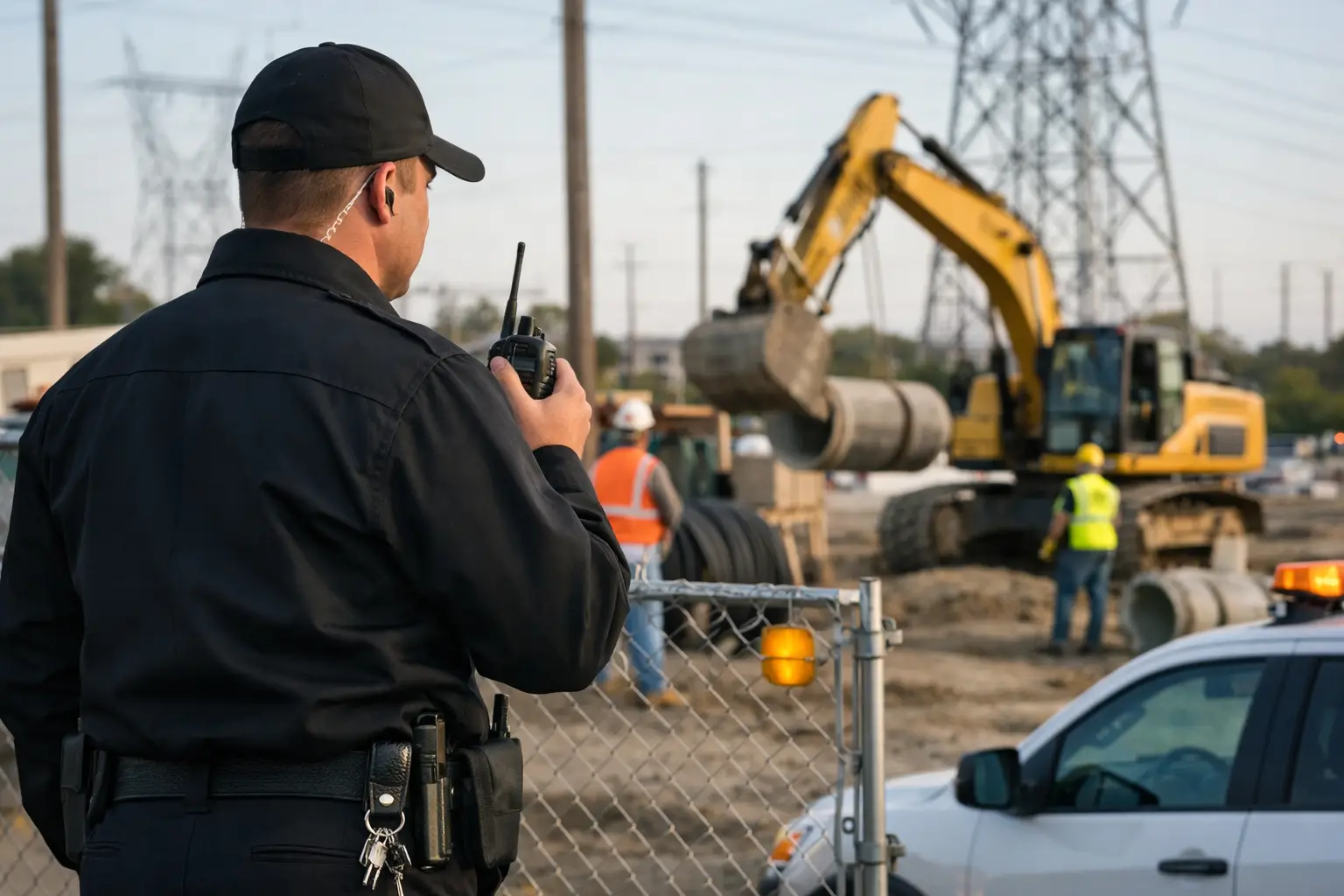
A stolen reel of copper, an open gate after hours, or a driver who ignores a lane closure can turn a planned utility project into a schedule, safety, and liability problem. Utility construction site security is not a passive presence at the entrance. It is an enforcement-capable operation that protects crews, equipment, materials, work zones, and the public while keeping the project moving.
For utility contractors and infrastructure operators, the exposure changes as the job progresses. A greenfield transmission project, an urban underground utility installation, and an emergency restoration site do not carry the same risks. The security plan has to match the work, the location, the asset value, public traffic conditions, and the consequences of unauthorized access.
Security Must Protect the Work, Not Just the Fence
Construction sites are temporary by design. Access points move, laydown yards expand, subcontractors rotate, and equipment may be left in isolated areas overnight. That creates gaps that conventional unarmed guard coverage or periodic drive-throughs may not address.
The objective is operational control. A qualified officer needs to know who is authorized to enter, where vehicles should stage, what materials require focused attention, and which conditions require immediate escalation. At a utility construction site, security decisions can affect crew safety, outage restoration, traffic flow, environmental controls, and the sequence of work.
Sworn, licensed, insured off-duty law enforcement officers bring legal enforcement authority to that environment. They can address trespass, criminal activity, disorderly conduct, and unsafe public interference directly. That distinction matters when a verbal request to leave is not enough, when a work-zone driver refuses direction, or when theft activity requires a report that can support an investigation and insurance claim.
Where Utility Construction Site Security Breaks Down
Most failures are predictable. They happen when site coverage is treated as a generic guard-post assignment instead of a field operation with changing risks.
Uncontrolled access after hours
Construction gates are often secured, but perimeter conditions are not always consistent. Temporary fencing can be moved, damaged, or bypassed. Materials may arrive before permanent storage controls are in place. Copper, wire, fuel, generators, tools, and specialized equipment all create theft opportunities that can delay a critical path activity.
An officer assigned to after-hours coverage should conduct visible perimeter checks, monitor access points, document suspicious activity, and preserve a clear record of incidents. Visibility is useful, but accountability is what makes the coverage defensible after an event.
Public intrusion into active work areas
Utility work frequently occurs near neighborhoods, commercial corridors, public roads, and active facilities. Residents, delivery drivers, pedestrians, and motorists may not recognize an energized-work area, excavation hazard, or restricted equipment zone. A cone line cannot provide enforcement. A flagger can direct traffic, but does not carry the real authority a sworn officer can provide when conditions become unsafe.
For road-adjacent work, officers can support traffic enforcement, deter aggressive driving, protect crews entering and exiting the work zone, and coordinate response when a crash or confrontation affects the operation. This is particularly valuable on projects with repeated lane shifts, overnight work, or congested public access.
Security coverage without useful documentation
When property is damaged or an unauthorized person enters a site, the report must do more than state that an officer was present. Project leadership may need times, observations, actions taken, involved parties, law enforcement case details, photographs or video availability, and a record of site conditions.
Documented incident footage and field reports support claims, internal reviews, contractor accountability, and compliance readiness. For facilities and projects operating near critical infrastructure, documentation also helps align physical security practices with NERC CIP-014 expectations and OSHA-related safety requirements. The exact documentation standard depends on the asset, contract, and owner requirements, but the principle is consistent: if it was not documented clearly, it is harder to defend later.
Build Coverage Around the Project Phase
Security requirements should be reviewed before mobilization and adjusted as the site changes. The right coverage model depends on threat level, project value, geography, shift schedule, nearby traffic, and whether the work supports normal construction or emergency restoration.
During early mobilization, access control and material protection are usually the priority. Officers can establish vehicle entry procedures, verify deliveries, maintain a visitor record when required, and identify perimeter weaknesses before valuable equipment accumulates onsite.
As the project reaches active construction, crew protection and work-zone control often become more important. This is where sworn officers can manage unauthorized entry, support traffic enforcement, and maintain command presence around excavations, heavy equipment, road closures, and sensitive utility assets.
During commissioning, outage work, or storm response, the operating environment becomes less predictable. Crews may work extended shifts, replacement equipment may arrive quickly, and public frustration can rise when service is disrupted. Security staffing must be available around the clock and able to scale without creating another logistical burden for the project manager.
Use Officers and Remote Surveillance for Different Jobs
An on-site sworn officer and a camera network solve different problems. Treating one as a full replacement for the other can leave gaps.
A sworn officer provides immediate physical presence, legal enforcement authority, access control, traffic management, and direct intervention when conditions develop. That is especially important during active work, at contested access points, or where the public is close to crews and equipment.
Remotely monitored solar-camera networks extend observation across large or remote sites. They are useful for laydown yards, long perimeters, substations under construction, storage areas, and locations where overnight coverage needs added visibility. With 24/7 surveillance, dispatch support, and documented incident footage, cameras can identify activity quickly and strengthen the evidentiary record.
For higher-risk sites, augmented protection combines both. The officer handles the field environment while remote monitoring increases coverage beyond a single post. The trade-off is cost and deployment planning, but the combined model is often justified when theft exposure, project delays, or public access risks are substantial.
What to Require From a Security Provider
Utility and construction leaders should evaluate more than hourly rates. Low-cost coverage that cannot respond appropriately to trespass, cannot document incidents, or cannot staff a storm event may become expensive when work stops.
Confirm that assigned personnel are sworn officers, licensed where required, insured, and capable of working in utility and construction environments. Ask how the provider handles reports, incident footage, shift relief, escalation, and coordination with site leadership. Coverage should also be available for nights, weekends, holidays, and extended shifts, not only standard business hours.
Georgia-wide reach matters when a contractor has multiple active projects or a utility needs support away from a major metro area. Grid Guard Protective Services deploys sworn officers across all Georgia counties, with 24/7 shift availability, standard 72-hour lead times for planned coverage, and rapid-response staffing for storm and outage conditions. Quotes should be clear enough for procurement and operations teams to compare staffing, hours, documentation, insurance, and any surveillance components without guessing at the scope.
Establish Site Rules Before the First Shift
The strongest officer assignment still depends on a clear post order. Before deployment, the project team should define site boundaries, authorized access points, delivery procedures, restricted areas, emergency contacts, towing authority, work-zone limits, and escalation expectations. Officers should know who can approve entry after hours and who receives an incident call at 2:00 a.m.
It also helps to identify site-specific risks that may not be obvious from a map. These can include recurring theft attempts, adjacent encampments, local traffic behavior, sensitive customer complaints, energized equipment boundaries, or a nearby school or hospital that changes traffic conditions. A short pre-deployment briefing prevents the officer from learning critical details only after an incident occurs.
Security should not slow a competent crew down. It should remove avoidable interruptions, keep unauthorized people out of hazardous areas, and give supervisors a documented chain of action when something goes wrong. The most useful coverage is measured by fewer disruptions, better control at the perimeter, safer work zones, and a project team that knows exactly what happened on every shift.
Before the next mobilization, treat security as a line item tied to schedule protection and field safety, not an afterthought added after the first theft or traffic incident. That is when coverage can be planned around the work instead of reacting to the damage.