
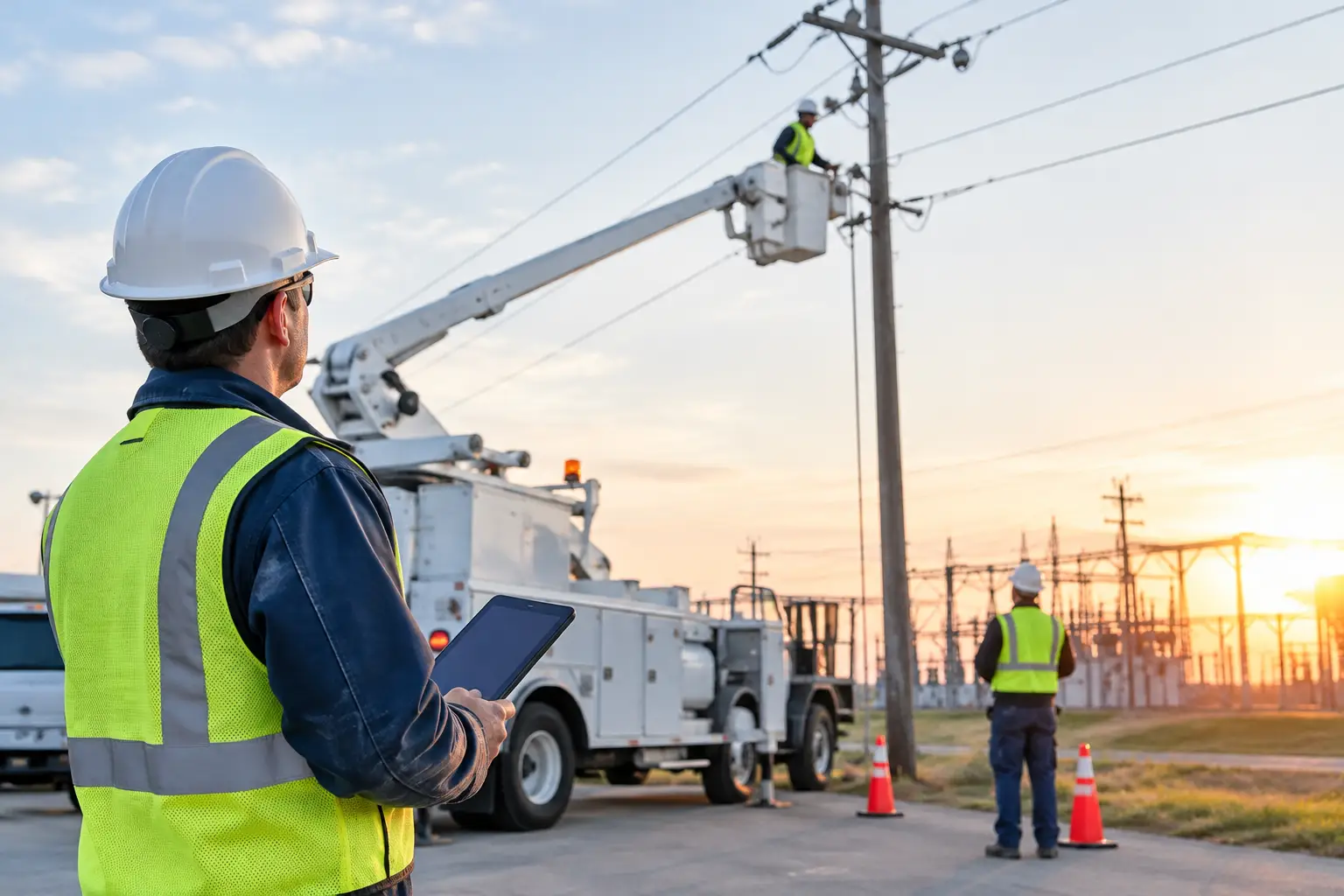
A major storm has cleared, but the risk has not. A damaged transmission corridor, an open substation gate, or a staging lot full of generators and copper-bearing equipment can draw trespassers within hours. This utility restoration example shows what enforcement-capable site protection can look like during the first 72 hours of a large outage response in Georgia.
The scenario is representative, not a substitute for a utility's emergency operations plan. Every restoration event depends on site conditions, local jurisdiction, asset criticality, weather, crew size, and the utility's own security procedures. The operating principle remains consistent: restoration security must protect people, equipment, access, and documentation without slowing the work that returns power.
The Incident: Storm Damage Across Multiple Sites
A severe thunderstorm damages a utility's distribution network across three counties. Two substations report perimeter damage. Several feeder lines are down, and a transmission-yard access road is partially blocked by debris. The utility establishes a primary staging area at a county fairground, where outside line crews, contractors, fuel vendors, and material deliveries will cycle through around the clock.
The immediate security concern is not limited to theft. Crews are working near energized hazards, public roads remain congested, and residents may approach damaged infrastructure seeking information or attempting to check conditions near their homes. At the same time, displaced equipment, open gates, and reduced lighting create opportunities for unauthorized access.
The utility's restoration lead needs more than a passive post. The assignment calls for licensed, insured, off-duty sworn law enforcement officers who can establish visible command presence, coordinate with local agencies, address trespass within their lawful authority and agency policy, and create an incident record that supports operational review.
Utility Restoration Example: The First 12 Hours
In the first operational period, the priority is site control. A sworn officer is assigned to each compromised substation and another is placed at the main staging area. Additional coverage is positioned where crews must work adjacent to active traffic or where heavy equipment enters and exits a public roadway.
At the substations, officers verify who is authorized to enter, maintain an access log when required by the site plan, and report perimeter conditions to the utility's designated contact. If fencing is damaged or a gate cannot be secured, the officer documents the condition, preserves the scene if criminal activity is suspected, and keeps unauthorized persons away from the facility until repairs or additional controls are in place.
At the staging area, the work is different but equally consequential. Officers manage vehicle flow, separate public traffic from utility traffic, and direct vendor arrivals to the correct check-in point. That control reduces the chance that an unvetted vehicle reaches fuel, transformers, cable, or crew work areas.
A cone line can mark a boundary. A flagger can support movement. Neither provides the legal enforcement authority or command presence of a sworn officer when a driver ignores instructions, an individual refuses to leave, or a traffic conflict threatens crew safety. During restoration, those differences can affect whether a work zone stays productive or becomes a preventable incident.
Hours 12 Through 36: Protecting the Restoration Schedule
Once the initial damage assessment is complete, operations expand. Mutual-aid crews arrive from outside the area. Material deliveries increase. Some sites are restored and released, while others remain exposed because repairs require multiple shifts or replacement equipment.
The utility's security lead adjusts staffing based on the evolving restoration map. A fixed post may remain necessary at a high-value substation with damaged perimeter controls, while a mobile officer can conduct scheduled checks of smaller sites where crews are not continuously present. This is where a written deployment plan matters. Security coverage should be tied to actual risk, not simply divided evenly across locations.
For example, a site containing transformers, control-house access, or large quantities of conductor may justify continuous officer coverage. A closed work location with intact fencing and remote camera visibility may require periodic patrols instead. The correct level of protection depends on asset value, exposure, public access, prior incidents, lighting, and how quickly local law enforcement can respond if a problem occurs.
During this period, officers also reduce friction between restoration crews and the public. They can keep unauthorized visitors outside a work perimeter, assist with traffic control at constrained access points, and communicate observed hazards through the utility's chain of command. Their role is not to direct electrical work or replace a utility safety officer. It is to secure the operating environment so qualified crews can focus on restoration.
Documentation should be continuous. A useful report records shift times, officer assignment, site condition, access-control issues, patrol observations, law-enforcement contacts, vehicle or individual descriptions when relevant, and any incident action taken. Where solar-camera networks and remote monitoring are deployed, documented incident footage can supplement the officer's field report and provide a clearer timeline of activity.
Hours 36 Through 72: Transitioning From Emergency Coverage
By the third day, the utility may have restored most customers while retaining a smaller number of complex repairs. This is the point where some organizations reduce security too early. The visible emergency has passed, but exposed equipment, contractor demobilization, and fatigued crews still create vulnerabilities.
A disciplined transition begins with a site-by-site review. Which locations remain open? Which temporary controls are still in place? Has damaged fencing been repaired? Are keys, access cards, material inventories, and portable generators accounted for? Have temporary work-zone traffic measures been removed or extended? These questions help prevent a restoration event from ending with an avoidable loss, injury, or compliance problem.
Security coverage can then shift from emergency posture to targeted protection. A continuous substation post may be replaced by scheduled patrols after perimeter repairs are confirmed. Staging-area coverage may remain in place until high-value materials and contractor equipment have cleared. If camera monitoring is available, the utility can use it as an added layer for sites that no longer require an officer on location every hour.
The trade-off is straightforward. Reducing coverage controls cost, but doing so before physical conditions are secured can expose the utility to theft, vandalism, trespass, and delayed repairs. The decision should be based on documented conditions, not on the calendar alone.
What Makes This Model Operationally Useful
A restoration security plan works when it fits the pace of field operations. Officers need a defined post order, primary and backup utility contacts, access instructions, a communication channel, escalation criteria, and clarity on what must be documented. Utility personnel need a staffing partner that can provide sworn, insured officers on 24/7 shifts and adjust coverage as restoration priorities move.
For Georgia utilities and contractors, statewide availability also matters. A storm rarely respects county lines. Coverage may be needed at a rural substation, a municipal staging yard, a roadside work zone, and an industrial service entrance during the same event. Grid Guard Protective Services supports planned and emergency assignments with specialized sworn-officer staffing, standard 72-hour lead times for scheduled coverage, and rapid-response coordination when conditions require faster action.
The strongest restoration posture is not the largest one. It is the one that places real authority where crews, assets, and public exposure create the greatest risk. When security is planned as part of restoration operations, officers protect more than a perimeter. They help protect the schedule, the workforce, the evidence trail, and the public trust that follows every major outage.