
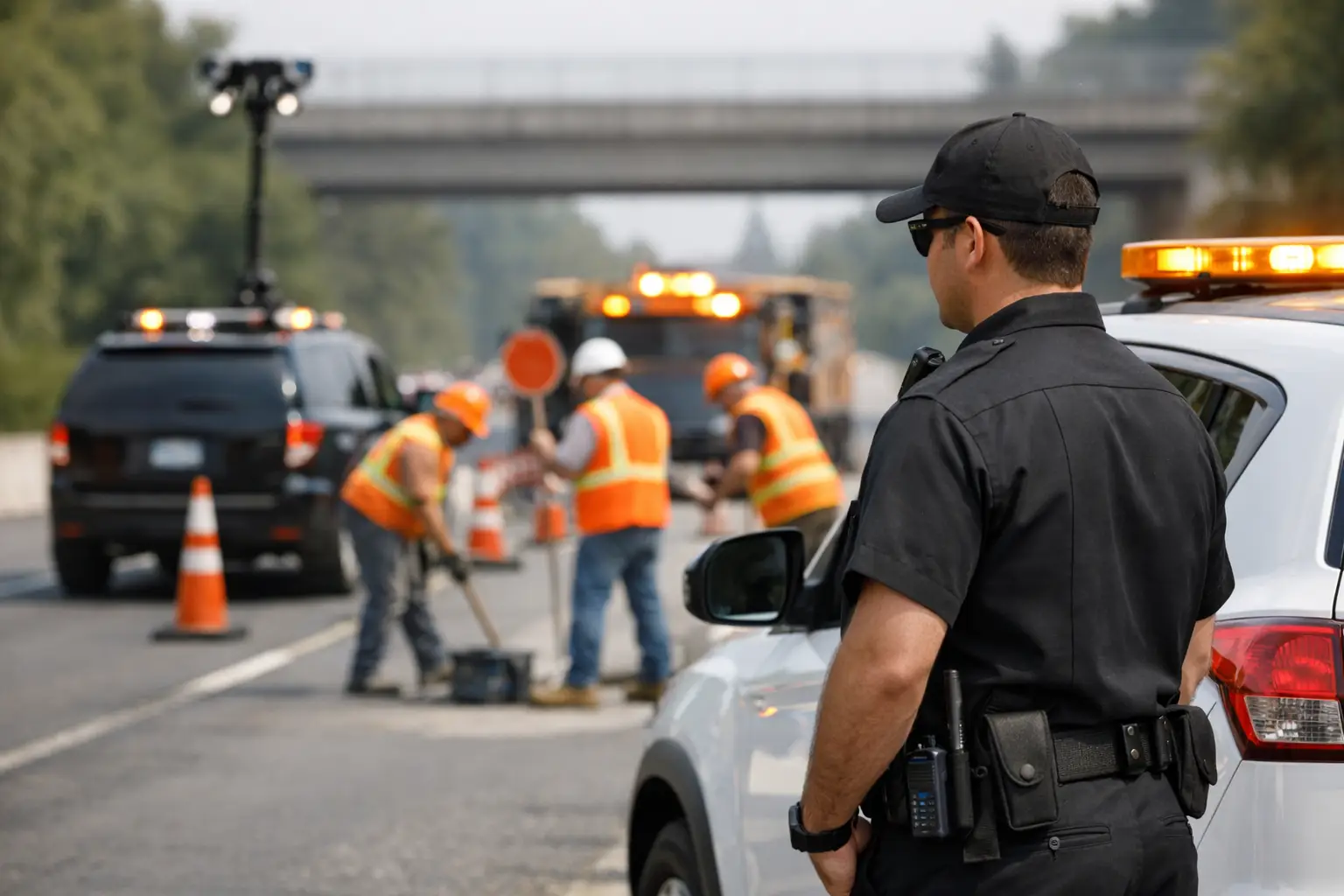
A lane closure can be properly signed, tapered, and staffed, yet still become dangerous the moment a driver ignores a flagger, cuts through cones, or confronts a crew member. Work zone enforcement puts a sworn law enforcement officer at the point where traffic control needs legal authority. That authority protects workers, supports lawful traffic movement, and gives project leaders a documented response when conditions escalate.
For utility construction, roadwork, emergency repairs, municipal projects, and large commercial work near active traffic, the issue is not simply whether someone can direct vehicles. The issue is whether the person on site can command compliance, address reckless behavior, and act when an unsafe situation becomes a criminal or public-safety matter.
Why Work Zone Enforcement Requires More Than Traffic Control
Cones, signs, arrow boards, and flaggers remain essential parts of a traffic control plan. They establish the work area and communicate the intended path of travel. They do not, however, stop a speeding motorist, resolve an aggressive confrontation, or provide an enforcement response to a driver who enters a closed lane.
A sworn officer brings licensed, insured law-enforcement capability to the work zone. Drivers recognize the command presence of a marked law-enforcement position and understand that violations may carry immediate consequences. This changes behavior before an incident occurs, particularly on high-speed corridors, congested urban routes, school-adjacent projects, and sites where traffic patterns are changing by the hour.
The value is equally clear when a problem does occur. An officer can address violations directly, request additional law-enforcement resources when needed, preserve the scene after a crash, and prepare incident documentation that helps the contractor, utility, municipality, or property operator account for what happened.
This is real authority a cone or flagger cannot provide.
Where Sworn Officers Deliver the Most Value
Work zone enforcement is not necessary for every small, low-speed project. A short-duration activity on private property with minimal vehicle exposure may need only a qualified traffic-control crew. The risk profile changes when work affects public travel lanes, involves valuable equipment, requires repeated lane shifts, or places crews beside high-speed traffic.
Utility projects often create the most demanding conditions. A damaged pole, underground fault, transmission-related activity, or emergency outage repair can bring personnel and equipment into a roadway with little notice. Crews may be working at night, in poor weather, or during peak traffic, while the public is frustrated by delays and uncertain about the detour. An officer provides a controlled perimeter while the field team focuses on restoration.
Planned construction has different pressures. Road widening, fiber installation, water and sewer work, pipeline activity, and long-term utility upgrades need reliable coverage across multiple shifts and changing phases. The right deployment may involve officers at key closure points, intersections, equipment crossings, or entrances where construction traffic meets public traffic.
Municipal public works departments also use enforcement-capable coverage for paving, tree work, sidewalk repairs, special events, and temporary closures. In each case, the objective is the same: maintain an orderly work area, protect the public, and reduce the chance that a traffic conflict becomes a crew injury, schedule disruption, or liability event.
Build Enforcement Into the Traffic Control Plan
Effective coverage starts before the officer arrives. The project manager, safety lead, or traffic-control supervisor should define the work zone's operating conditions: location, shift hours, planned closures, detours, equipment movements, anticipated traffic volume, and known hazards. This allows the officer to be positioned where authority will have the greatest preventive effect.
Match Coverage to the Actual Exposure
A stationary closure on a controlled-access road requires a different posture than a moving utility crew in a dense downtown corridor. Night work may require stronger visual presence and closer coordination with the traffic-control lead. A school-zone project may demand attention during arrival and dismissal periods rather than full-shift coverage.
The practical question is not, "How many officers can we place on the project?" It is, "Where can an officer prevent the most serious operational failure?" In some cases, one officer at a critical merge point is the right solution. In others, a multi-point closure, heavy equipment crossing, or prolonged detour requires a larger coordinated detail.
Establish Clear Field Authority
The officer should know who controls the work sequence, who can pause operations, and how changing conditions will be communicated. The traffic-control supervisor manages the temporary traffic control setup. The sworn officer manages enforcement decisions and law-enforcement response. Those roles should support each other without confusion.
A pre-shift briefing should cover lane closure times, radio or phone contacts, emergency access routes, staging areas, anticipated deliveries, and procedures for crashes or hostile encounters. For emergency repairs, the briefing may be brief, but it should still establish command contacts and immediate priorities.
Plan for Documentation, Not Just Presence
A visible officer is preventive. Documentation is what makes the response accountable after the fact. Project teams should expect clear records of material incidents, enforcement actions, collisions, unauthorized entry, confrontations, and conditions that forced a work stoppage.
That record can support internal safety reviews, contractor coordination, insurance matters, public-agency reporting, and dispute resolution. For infrastructure operators managing OSHA-related requirements or broader security obligations, organized documentation also demonstrates that the site responded to known risks with qualified personnel and defined procedures.
What Can Go Wrong Without Enforcement-Capable Coverage
The most obvious risk is a vehicle entering the work area. The consequences may range from damaged cones and delayed work to severe injury or a fatality. Yet many work-zone failures begin earlier: a driver refuses to merge, blocks construction equipment, follows an unauthorized route, or verbally threatens a flagger who has no authority to enforce compliance.
Crews working around critical infrastructure face additional exposure. Utility trucks, generators, cable reels, transformers, and stored materials can attract theft, tampering, or opportunistic trespass, especially on overnight or storm-response projects. A sworn officer can address behavior that falls beyond routine traffic direction and secure the work area while crews restore service.
There is also a schedule cost. A single crash, traffic confrontation, or uncontrolled equipment crossing can halt operations for hours. When a project is tied to an outage window, a municipal permit, a road closure approval, or a customer restoration commitment, lost time spreads quickly through the operation.
Using generic security or relying solely on flaggers can be appropriate in lower-risk settings, but it has a limit. Private security personnel and traffic-control workers do not carry the same legal enforcement authority as a sworn officer. Decision-makers should assess that gap honestly before an incident exposes it.
Staffing Work Zone Enforcement in Georgia
Coverage needs can be planned weeks ahead or requested during an active emergency. A qualified provider should be able to clarify the officer's status, insurance coverage, availability, shift capability, service geography, reporting process, and coordination requirements before the assignment begins.
Grid Guard Protective Services deploys licensed, insured, off-duty sworn law enforcement officers across Georgia counties for planned and rapid-response assignments. Standard scheduling generally requires 72 hours of lead time, while 24/7 shift availability supports projects that cannot wait for normal business hours. Quotes are provided within 48 hours so operations teams can make staffing decisions without slowing the project schedule.
For storm and outage response, conditions may change faster than a standard procurement cycle. The coverage plan should be scalable, with officers available for temporary closures, utility staging areas, damaged-infrastructure sites, fuel or equipment deliveries, and overnight repair operations. If a site also faces theft or trespass risk, an on-site officer can be paired with remotely monitored solar-camera coverage, 24/7 surveillance, dispatch, and documented incident footage.
Questions to Settle Before the First Shift
Procurement teams should confirm more than an hourly rate. They need to know whether the assigned personnel are sworn officers, whether they are licensed and insured, and whether they can operate within the project's required schedule and geography. They should also confirm the process for reporting incidents, extending shifts, replacing an officer, and requesting additional coverage.
The project lead should provide accurate site information. That includes the traffic-control plan, work order or permit details, staging map, expected equipment movements, and a reliable on-site contact. Last-minute changes happen, especially on utility work, but a clear starting picture prevents avoidable confusion at the closure.
Finally, define the threshold for escalation. If traffic backs up beyond a certain point, if a crash occurs, if a motorist enters the closure, or if crews encounter threats or unauthorized access, everyone should know who makes the call and how the operation is stabilized.
A work zone is safest when enforcement is treated as part of the operating plan, not as a last-minute reaction after a close call. Put sworn authority where the risk is highest, give the officer a clear mission, and preserve the documentation that proves your crews and the traveling public were protected.